



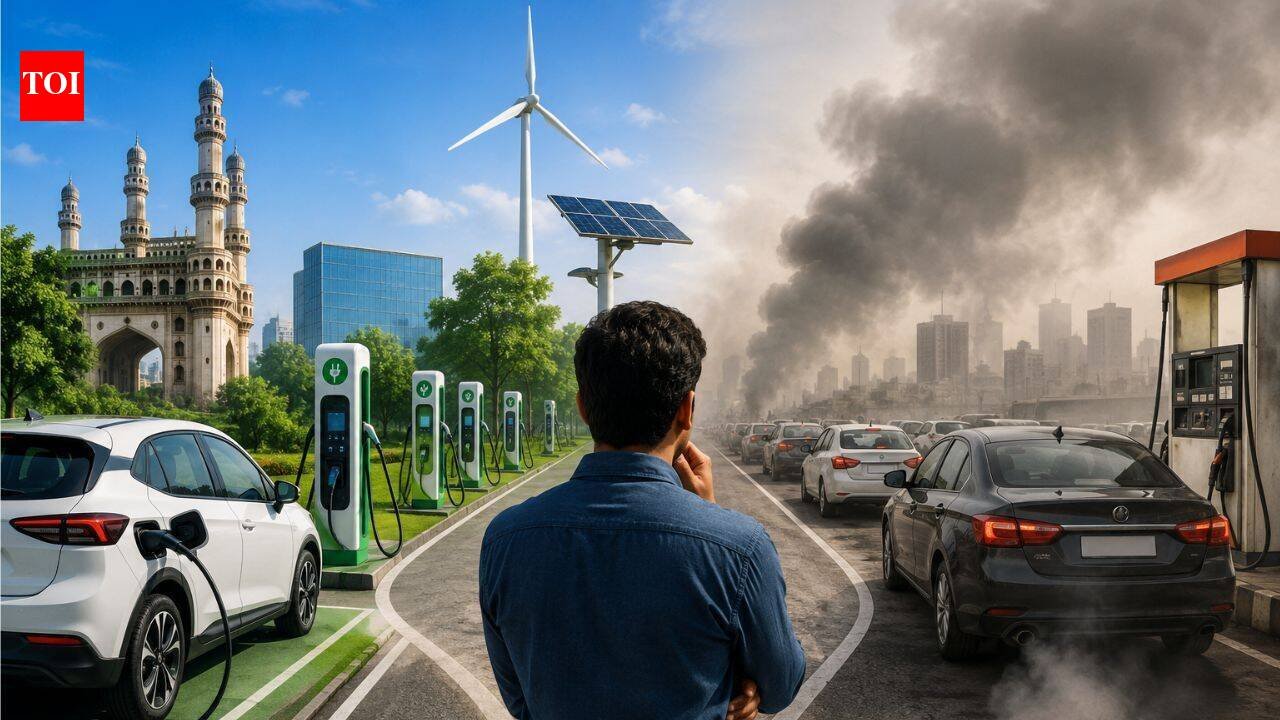
HYDERABAD: Despite having one of the country’s strongest public charging networks, Telangana is struggling to convert infrastructure into electric vehicle adoption, highlighting a growing gap between EV readiness and consumer demand.A new SBI Research report released on Wednesday shows that while the state has built an extensive charging ecosystem, electric vehicles still account for just 4.9% of new vehicle registrations — significantly below the national average of over 8%.
The findings suggest that Telangana has largely addressed one of the biggest barriers to EV adoption — charging infrastructure. The challenge now appears to be convincing more consumers to make the switch from conventional fuel-powered vehicles.While Telangana is yet to gain momentum, several states are already racing ahead. Odisha leads the country, with EVs accounting for 12.7% of new vehicle registrations, followed by Kerala (12.3%) and Karnataka (10.9%). Delhi has also crossed the 10% mark.In comparison, Telangana has registered 25,708 pure EVs this year, with fewer than one in every 20 new vehicles sold running on electricity.Ironically, the state’s biggest advantage lies in an area where many others continue to lag. According to the report, Telangana has 1,062 public charging stations, including 548 fast chargers, making it one of the most robust charging networks in the country. Fast chargers account for 52% of all public charging points in the state, well above the national average of 30%.Only Goa (60%) and Andhra Pradesh (54%) have a higher share of fast chargers, while Tamil Nadu is on a par with Telangana. The report notes that the rapid expansion of fast-charging infrastructure will be critical if India is to accelerate EV adoption in the coming years.Telangana’s charging network is also among the least burdened in the country, indicating substantial capacity for future growth.
The state has just 20 EVs for every public charging station — the lowest ratio among major states. By contrast, Odisha has 243 EVs per charger, Bihar 226 and Chhattisgarh 221, reflecting far greater pressure on charging infrastructure. Karnataka and Haryana each have 52 EVs per charging station, while Delhi has 63.The report argues that Telangana’s low charger-to-EV ratio demonstrates that infrastructure availability is no longer the principal constraint. Instead, consumer uptake is emerging as the key challenge.More broadly, the report highlights a structural shift in India’s energy consumption patterns, arguing that the country’s dependence on oil is steadily declining despite global geopolitical uncertainties.Oil consumption as a share of GDP has fallen from 1.4% in FY14 to 0.7% in FY26, while crude oil imports as a share of GDP have dropped from 8.6% in Q2 FY14 to 3.1% in Q2 FY26.According to SBI Research, the transition has been driven by the rapid expansion of renewable energy, growing metro rail networks, replacement of diesel-powered irrigation pumps with solar alternatives, and the gradual adoption of electric mobility across the country.For Telangana, the report suggests the foundation for an EV transition is already in place. The next phase, however, may depend less on adding chargers and more on creating the conditions that persuade motorists to embrace electric vehicles.


