






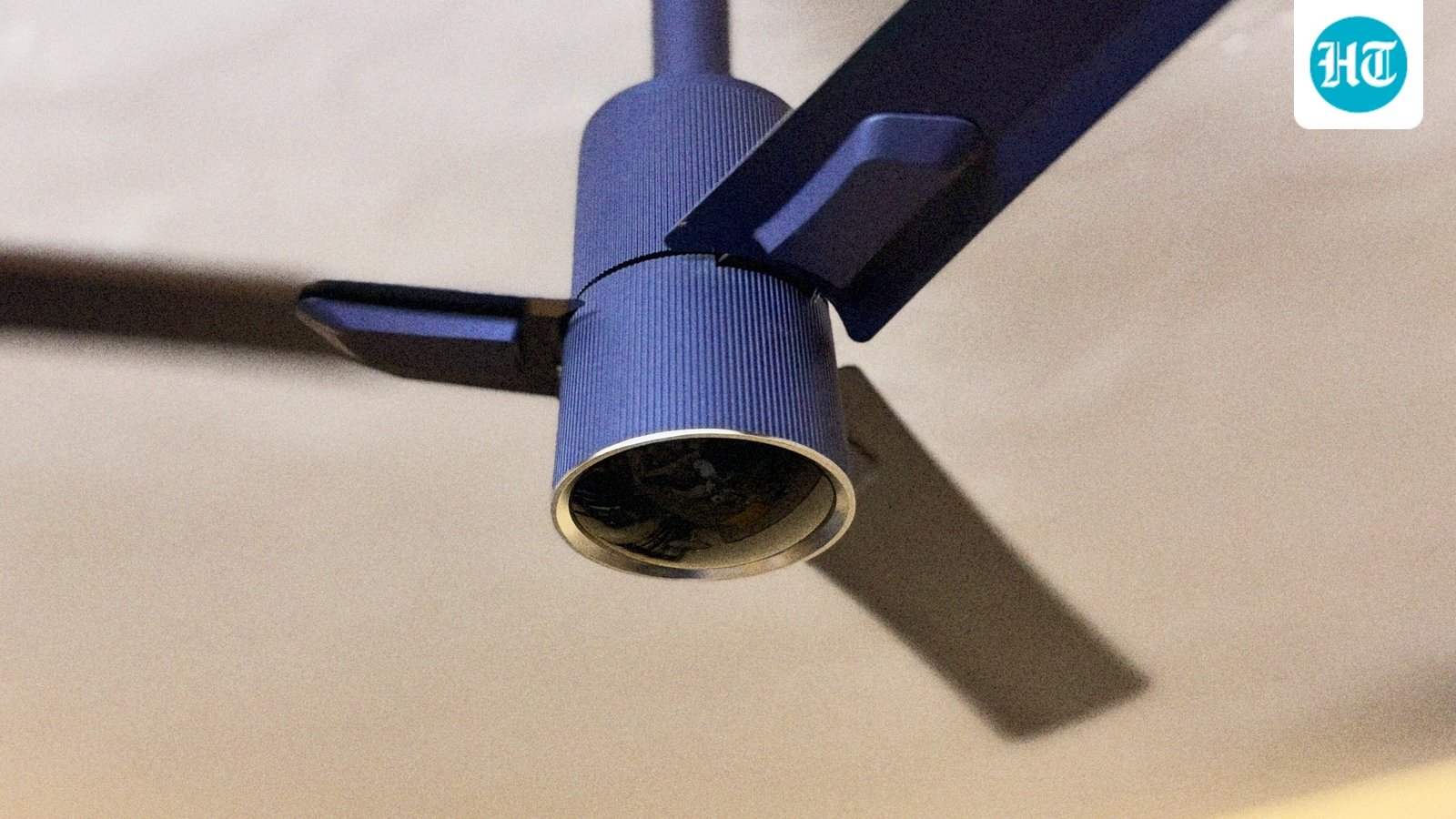
I’ve been using BLDC fans exclusively for over two years now. First, it was the Orient Electric Aeon BLDC, and now, the second BLDC fan I’m reviewing is the Goldmedal Spacio BLDC, a five-star-rated ceiling fan. I have the Space Blue variant.
Now, unlike a typical review, I’m going to take you through the ins and outs of owning a BLDC fan, what the Goldmedal Spacio gets right and wrong, and whether you should be spending over ₹5,000 on a BLDC fan instead of a traditional ceiling fan.
More importantly, I’ll be taking you through real-world use cases, the major advantages and disadvantages, and whether the additional investment makes sense in the long run. So, by the end of this review, you should have a fair idea of whether a BLDC fan deserves a place in your home.
Let’s get into the details.
Can a ceiling fan actually make your room look better?
Now, coming in above ₹5,000, I would certainly expect a fan to look good, and this Space Blue variant definitely stands out. It immediately gives the room a more premium look.
Like I told you, I was previously using the Orient Electric Aeon BLDC, which came in white and had a rather minimalistic design. The Space Blue colour of the Goldmedal Spacio, on the other hand, definitely stands out in my rented apartment.
You also have other colour options, including Snow White, Magna Matte, Ash Grey and Tuscany Gold, in case those are more to your liking. Personally, though, I prefer Space Blue. It elevates the aesthetics of my room, which is rather quirky in its own right.
The fan is also easy to clean. I’ve cleaned it twice after using it for over two months, having got my hands on it in late July. Any regular cleaning cloth glides over the blades, making the process fairly straightforward. No unnecessary fuss.
The fit and finish are nice, too, and you also get LED indicators that light up.
Having said that, the LEDs are blue, which might not be the most ideal choice out there. I would have appreciated a warm white light instead. I’m not sure if there’s a particular reason behind choosing blue, but the brightness is neither too high nor too low.
The LEDs do serve a functional purpose, though.
Let’s say you’re running the fan at speed one. One LED lights up. Increase the speed to two, and two LEDs illuminate. At speed three, you get three LEDs, and so on. When you switch to the highest speed, five LEDs briefly light up before the display returns to showing all six LEDs.
You can also turn off the LEDs altogether using the remote control.
It’s a nice functional touch, and a useful indicator, I would say.
Does the Goldmedal Spacio BLDC actually keep you cool?
Let’s talk about airflow, because that’s arguably the most important part of any ceiling fan.
I’ve been using the Goldmedal Spacio alongside an air conditioner, and let me tell you, the airflow is excellent.
Goldmedal claims a maximum speed of 350 RPM and an air delivery of 225 CMM. Technicalities aside, I think the air spread is decent in my 1RK apartment.
I’ve mostly been using the fan at speeds one or two, and even then, the airflow is good enough for my needs. And the best part? It barely makes any noise at those speeds.
Even at the highest speed, level five, the fan isn’t particularly loud.
Low noise generation is definitely one of the biggest positives here. The fan also runs quite steadily, without any noticeable wobbling.
You’re unlikely to be disturbed by the sound of the fan on those quiet days when you just want to relax. In fact, if anything, I notice the sound of my air conditioner more than the fan itself.
The remote control is the real luxury here, but are all those modes useful?
The remote control is arguably the most important part of a BLDC fan for me, apart from the power savings, of course.
Why? Because that’s how you interact with the fan every single day. It’s also one of the biggest conveniences compared to a traditional ceiling fan controlled by a wall regulator.
In this case, you get a minimalistic, lightweight white remote with a simple layout.
There are plus and minus buttons to adjust the speed, a red power button to turn the fan on or off, and a dedicated button to control the LEDs. You also get a timer, sleep mode, boost mode and a few other functions.
All in all, the operations are straightforward, and the remote itself feels decent in terms of quality.
It has held up well over the last two months, without too many visible scratches. The matte finish helps, and there’s also a tiny display that indicates the selected functions.
The timer is particularly useful. You can choose between three durations: two hours, four hours and eight hours, depending on whether you press the button once, twice or thrice.
Then there’s the boost mode, which immediately switches the fan to its highest speed for maximum airflow.
You also get a mop mode, which runs the fan at speed five for five minutes before returning to your previously selected speed. A useful little addition, especially when you want maximum airflow for a short period.
And finally, there’s the breeze mode.
Goldmedal says this simulates a natural breeze by varying the fan speed at regular intervals.
Now, this is definitely a gimmick in my book.
I don’t see much of a use case for it. I’d rather choose the speed myself. I mean, who really wants a simulation of natural breeze inside their bedroom? If I wanted that, I’d probably just open a window.
Nevertheless, the option is there if that’s your thing.
Is installing a BLDC fan in a rented apartment a headache?
My installation experience was quite smooth.
After the fan was delivered, the technician promptly arrived and uninstalled my existing traditional ceiling fan.
For context, I recently moved to Delhi and currently live in a rented apartment. My Orient Electric Aeon BLDC remained back home, which is why I was missing the convenience of having a BLDC fan in the first place.
The technician installed the Goldmedal Spacio in about 20 to 25 minutes, cleaned up afterwards and left.
No drama, no unnecessary delays.
So, at least in my experience, the installation process was straightforward.
How much electricity can a 32W BLDC fan actually save?
Now, here’s another important reason why you might want to consider a BLDC fan: electricity consumption.
The Goldmedal Spacio has a rated power input of 32W, which is considerably lower than that of many traditional ceiling fans.
And while that might not sound like a massive difference on paper, the savings can add up over time, especially if you’re someone who runs a ceiling fan for several hours every day.
Let’s say you compare it with a traditional 70W ceiling fan, and both run for eight hours daily.
|
Power consumption |
Traditional fan (70W) |
Goldmedal Spacio (32W) |
| Daily consumption | 0.56 kWh | 0.256 kWh |
| Monthly consumption (30 days) | 16.8 units | 7.68 units |
| Annual consumption (365 days) | 204.4 units | 93.44 units |
| Annual electricity cost at ₹8/unit | ₹1,635 | ₹748 |
That’s a saving of roughly ₹887 a year, or about ₹4,435 over five years.
Now, that’s not exactly life-changing money, but it’s certainly something. And depending on how much you use your fan, those savings could eventually help offset the additional cost of buying a BLDC fan in the first place.
Plus, lower electricity consumption also means a smaller carbon footprint, which is always a welcome bonus.
Why I can’t go back to a traditional ceiling fan after using BLDC fans
Now comes the important part. Is investing in a BLDC fan actually worth it? And what are the specific use cases that justify spending more than ₹5,000 on one?
For me, the biggest advantage isn’t even the electricity savings. It’s the convenience.
You don’t have to get up and reach for the wall switch every time you want to turn the fan on, switch it off or change the speed.
And this is something you really have to experience yourself to appreciate.
Imagine those early fall mornings, which I’m currently experiencing in Delhi. By the time the clock hits around 5 or 6 am, it starts getting a little cold.
Now, I might want to reduce the fan speed from two to one, but do I really want to get out of my comfortable bed, walk to the switchboard, change the speed and then get back under the blanket?
Absolutely not.
I simply reach for the remote, reduce the speed and go back to sleep.
It’s such a small convenience, but once you get used to it, it’s genuinely difficult to go back.
Then there’s the quiet operation. If you’re someone who enjoys a peaceful bedroom, works from home or simply doesn’t want the constant hum of a ceiling fan in the background, this is another big advantage.
And finally, there are the long-term power savings. They might not seem significant initially, but over several years, they can certainly help justify the additional investment.
Goldmedal Spacio BLDC review verdict: Should you spend ₹5,000 on this fan?
So, should you buy the Goldmedal Spacio BLDC?
Well, if you’re someone who doesn’t particularly care about having a remote control, doesn’t mind getting up to adjust the fan speed and isn’t too bothered about silent operation or long-term electricity savings, you could very well stick to a traditional ceiling fan.
Because let’s be honest, a fan is a fan. Its primary job is to keep you cool, and a good traditional ceiling fan can do that just fine.
But if you value convenience, quiet operation and lower electricity consumption, investing in something like the Goldmedal Spacio BLDC makes a lot of sense.
I’ve been using BLDC fans for over two years now, and the convenience alone has made it difficult for me to consider going back to a traditional fan.
The Goldmedal Spacio does the basics well. The airflow is excellent for my room, the operation is quiet, the remote is straightforward, and the overall design looks premium.
Yes, the blue LEDs could have been prettier, and the breeze mode feels more like a party trick than something I’d use regularly. But those are relatively minor complaints.
At above ₹5,000, it’s certainly not the cheapest way to keep your room cool. But it’s a purchase that makes everyday life a little more convenient, while potentially saving you money on electricity in the long run.
And it certainly helps that the fan looks cool, too.
|
Pros |
Cons |
| Premium design and attractive colour options, especially Space Blue | Blue LED indicators could have looked better with warm white lighting |
| Excellent airflow, even at lower speeds | Breeze mode feels gimmicky and has limited practical use |
| Quiet operation, even at higher speeds | Power savings take time to offset the higher upfront cost |
| Convenient remote control with easy speed adjustments | |
| Energy-efficient 32W motor helps reduce electricity bills | |
| Useful timer, boost and mop modes | |
| Easy to clean and maintain | |
| Stable operation with no noticeable wobbling | |
| Quick and hassle-free installation experience |


