






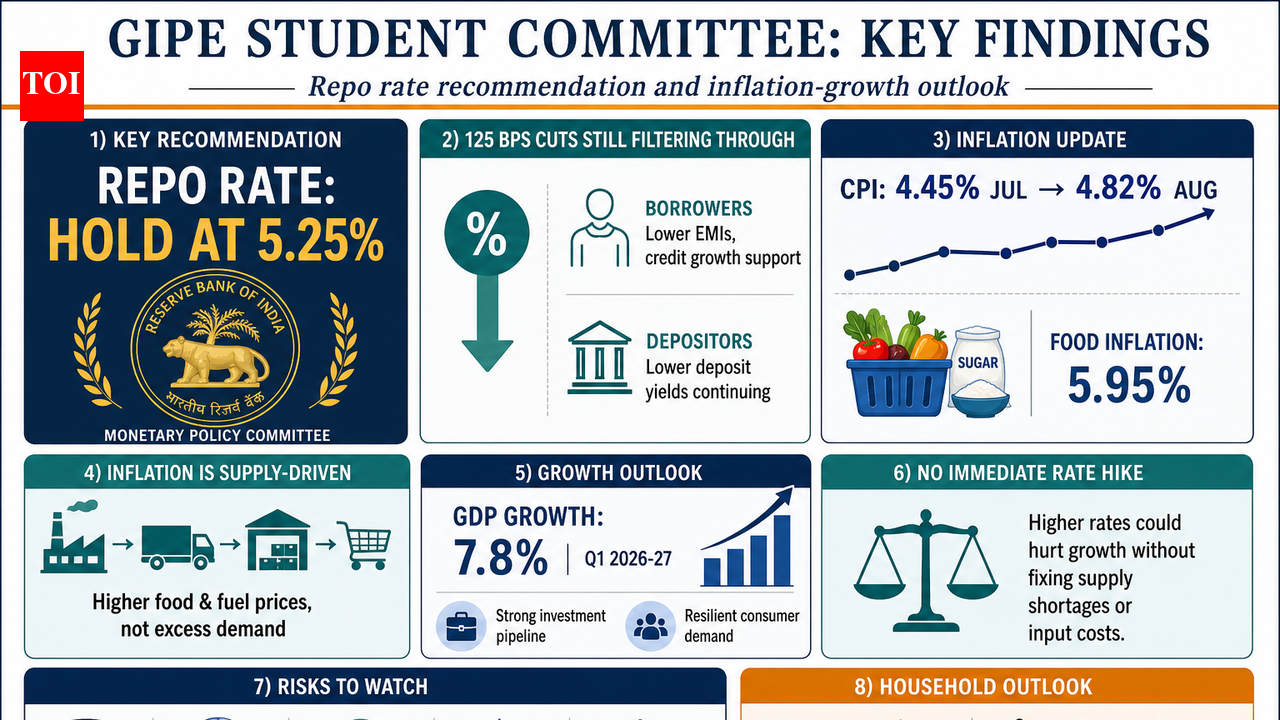
Pune: The benefits of RBI’s cumulative 125-basis-point (1.25%) repo rate cut since Feb last year had not yet fully reached borrowers and depositors, fifth GIPE Shadow Monetary Policy Committee (GSMPC)’s report released on Monday stated. It warned that a renewed rise in food and crude oil prices posed fresh risks to household budgets.“The rate cuts are reaching borrowers, but the full benefit has not yet reached everyone. Different loan categories are linked to different benchmark systems and reset cycles, slowing transmission. Fresh loans and deposit rates are still adjusting to the 125-bps reduction, leaving room for previous cuts to continue filtering through the economy,” committee chairperson Shreya Chopra said.The student-led panel, which simulates the Reserve Bank of India’s monetary policy process, recommended that the repo rate be kept unchanged at 5.25% and the policy stance remain neutral ahead of next month’s RBI review.The committee said economic growth remained healthy, while the recent rise in inflation had been driven mainly by food and fuel costs rather than excess demand. It, however, flagged mounting risks from rising crude oil prices, geopolitical tensions in West Asia, firmer global interest rates and pressure on the rupee.Consumer price inflation rose to 4.82% in Aug from 4.45% in July, while food inflation accelerated to 5.95%. Sugar prices emerged as a major concern, climbing from Rs 48.18 per kg in July to Rs 55.7 per kg in Aug due to lower domestic production, adverse weather, pest attacks and higher global prices.Despite the uptick, the panel argued that price pressures remain concentrated in a few segments. Its analysis showed that 63% of household consumption items recorded inflation below 4% in Aug. A household survey found consumers estimated inflation at 5.11% over the past three months and expected it at 5.02% over the next quarter and 5.29% over the next six months.Researchers Arshi Saina and Chaitanya Anand said the rise in inflation was largely supply-driven. “Higher interest rates would do little to address shortages or rising input costs, while potentially slowing economic growth,” they said.The committee expects GDP growth to moderate gradually but does not foresee a sharp slowdown. It also reviewed the banking system’s large liquidity surplus, aided by foreign currency inflows, and said the RBI could continue managing excess liquidity through bond sales and short-term absorption measures.Inputs from two expert groups informed the deliberations, with one focusing on geopolitical and energy-market risks and another examining monetary transmission and the persistence of inflation.The panel will soon submit its recommendations to Union govt. Chopra said monetary policy must strike a balance between inflation control and growth. “Act too quickly and growth could suffer. Wait too long and temporary increases in food and fuel prices could spread into broader inflation,” she said.“The GIPE Shadow Monetary Policy Committee gives students the opportunity to engage with real-time economic developments, listen to different perspectives, deliberate and experience the challenges involved in making a monetary policy decision,” GIPE VC Umakant Dash said.


