






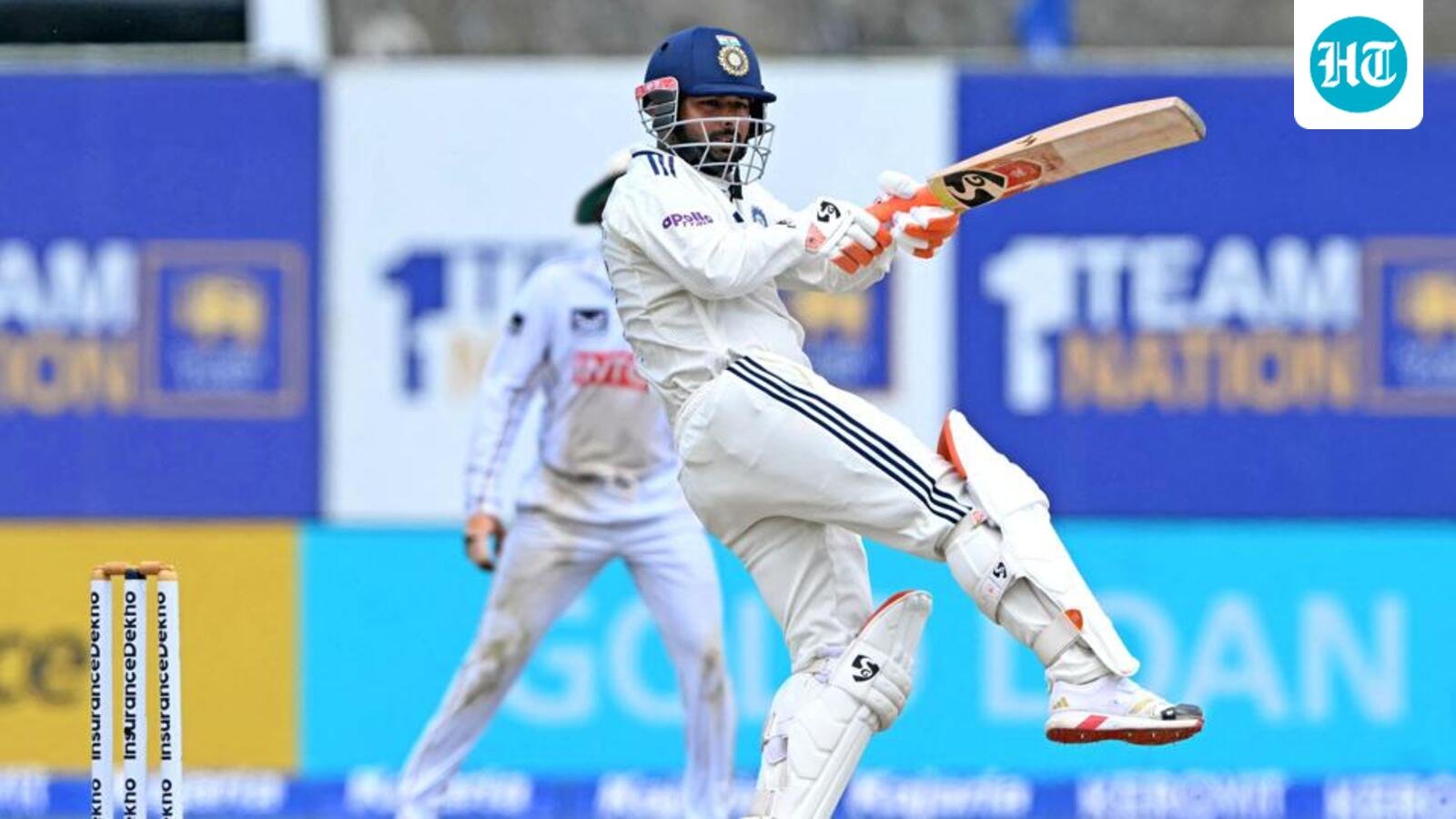
Kolkata: Rishabh Pant dazzled with a whirlwind fifty before India’s bowlers struck on a worn Galle pitch to leave themselves six wickets from a deserved victory in the first Test against Sri Lanka on Tuesday.
The hosts still needed 288 runs to win on the fifth day, but it is more likely that India will better them, provided the weather holds to give them enough time to bowl out the hosts. At stumps, Sri Lanka were 84/4 with skipper Dhananjaya de Silva (31*) and first-innings centurion Sonal Dinusha (25*) together.
India had begun Day 4 with a lead of 178, but the possibility of leaving themselves too little time to bowl Sri Lanka out remained, particularly with the rain threat in this southern Sri Lankan venue. Instead, India’s lower middle order took the decision out of their hands.
Pant was central to this effort, hitting 66 off just 69 balls while entering Test cricket’s six-hitting elite by becoming the first Indian to reach the 100 mark. Currently level with Adam Gilchrist and behind Ben Stokes (138) and Brendon McCullum (107), Pant reached the mark in only his 51st Test, almost half the time taken by the others. He is also the fastest by elapsed time from Test debut, though only by 14 days over Gilchrist.
Pant’s innings, however, was an aberration given how Sri Lanka’s fast bowlers had made India work throughout the day.
Asitha Fernando and Lahiru Kumara kept peppering India with the short ball and shared six wickets, while Prabath Jayasuriya returned 3/43. India didn’t begin well as Yashasvi Jaiswal was caught behind off the second delivery of the second innings. Although KL Rahul and Devdutt Padikkal added 65 for the second wicket, wickets began to fall with uncomfortable regularity. Pant provided the acceleration India needed, ensuring that the innings didn’t become an exercise in attrition, and India eventually reached 193, still a huge overall lead of 371.
It wasn’t a fluent effort though with the last six batters contributing only 34 runs, and the innings often getting stuck without Pant’s urgency. It still left Sri Lanka with a formidable target. With their lead, India’s chances of winning are solid. Only once before has a team successfully chased more than 300 in a Test at Galle — Pakistan’s 342/6 in 2022.
Sri Lanka therefore entered their final innings needing to make history as well as exceptional batting. They were soon made to understand how difficult that would be.
Mohammed Siraj began with movement and discipline, while Manav Suthar exploited the surface with the kind of control that made Sri Lanka’s top order increasingly tentative. Nishan Madushka was bounced out by Siraj for the second time in the match, pulling a short delivery to Prasidh Krishna at long leg.
Then came a sequence that changed the atmosphere entirely. Pasindu Sooriyabandara, introduced as a concussion substitute for Dinesh Chandimal — he was ruled out after he was injured while fielding — was trapped lbw by Suthar first ball. Kamindu Mendis, whose extraordinary early Test record has cooled dramatically since, followed for two when he slashed at a short ball from Krishna and edged to Rahul at slip.
The pressure wasn’t built through extravagant turn or constant wicket-taking. It came from India making Sri Lanka earn the runs. Krishna was particularly effective because he committed to the short-of-a-length method without becoming predictable. Of his 48 balls, 33 were pitched in the bouncer zone, costing him only eight runs and getting him a wicket at an economy rate of 1.45. His second spell of 5-2-9-1 captured the value Krishna brings — not merely dismissing Mendis, but not releasing the pressure.
Suthar complemented that approach from the other end. He removed Sooriyabandara and later Lahiru Udara, who had survived 58 balls for 16 before edging a flighted delivery to Dhruv Jurel at gully. The catch required close scrutiny, but the third umpire judged Jurel to have held it cleanly. Sri Lanka were 42/3 when Udara departed, by then the chase starting to look more a fight for survival.
In Dhananjaya and Dinusha however Sri Lanka found the resistance they were desperately looking for. Dhananjaya absorbed 69 balls for his 31, while Dinusha applied himself with a determined defence and the occasional release shot, like a swept boundary against Ravindra Jadeja and a lofted drive against Suthar.
India kept up the pressure though. Jadeja, Kuldeep Yadav and Suthar operated with close catchers around the bat, while Krishna continued to make the batters uncomfortable with bounce. Even when wickets didn’t come, India ensured the singles were hard-earned and boundaries felt like events.
On a day of extended sessions, Sri Lanka finished on 84 for four, still facing an improbable victory target. The arithmetic of the hosts surviving is not high on a pitch moving steadily towards the abrasive, unpredictable surface Galle tends to become late in a Test. The equation is simple from here — India need six wickets, Sri Lanka a mountain to climb at this coastal venue.


