



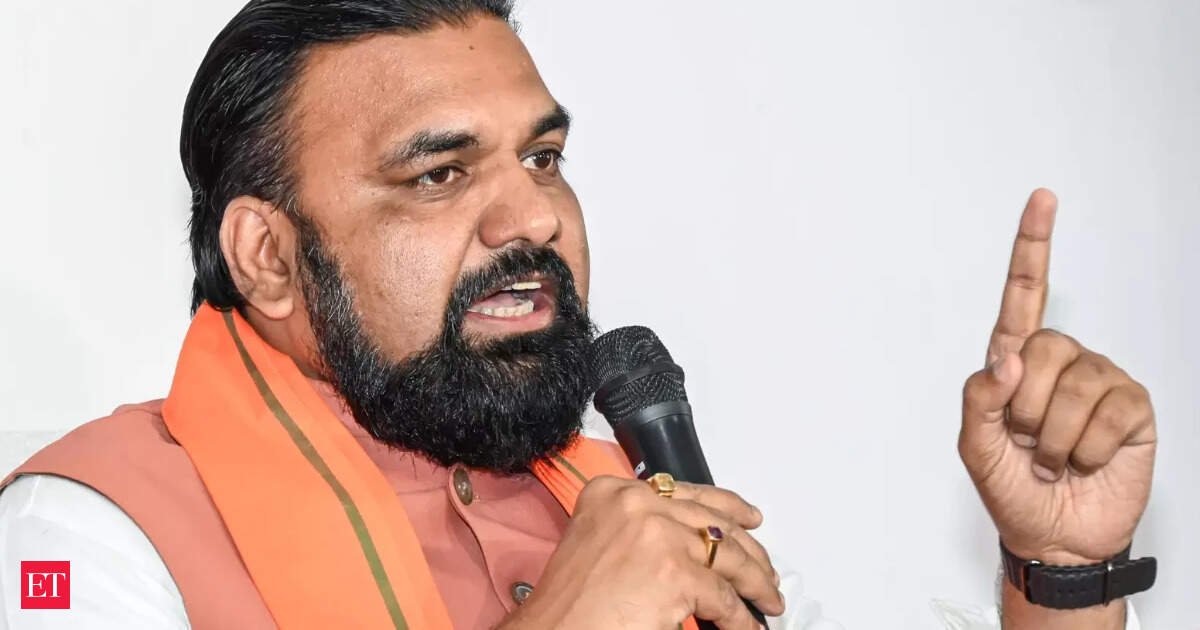
Things seem to have come full circle for the 57-year-old leader, whose meteoric rise in the BJP after joining it nine years ago culminated in becoming the party’s first chief minister in the state.
Choudhary, earlier known as Rakesh Kumar, had first hit headlines in 1999, when the then chief minister Rabri Devi inducted him into her cabinet.
Also Read: Bihar Deputy Chief Minister Samrat Choudhary to take oath as new CM on April 15
The cabinet berth for Samrat Choudhary was said to have been a reward for his parents, Shakuni and Parvati Devi, MP and MLA respectively of Samata Party, who had agreed to shift their loyalty to RJD.
However, a complaint soon reached the Raj Bhavan (now Lok Bhavan) that Choudhary, who was then not a member of the state legislature, had not completed 25 years of age.
Accordingly, the then Governor Suraj Bhan ordered Choudhary’s sacking, in a rare instance of the removal of a minister being effected without the government not recommending the same.After his unceremonious dismissal, the RJD, headed by Rabri Devi’s husband Lalu Prasad, fielded him in the assembly polls of 2000, and Choudhary was re-inducted as a minister, this time to enjoy a full term.
In 2005, the RJD lost power to the JD(U)-BJP combine, but Choudhary remained with the RJD and was appointed as the chief whip of the party five years later.
By 2014, Choudhary seemed to have been disenchanted with the RJD, and he led a split in the party and joined the JD(U) government, then headed by Jitan Ram Manjhi.
Manjhi stepped down months later after Nitish Kumar, his patron, decided to make a comeback as the chief minister. This caused Choudhary to lose his ministerial berth.
In 2017, he joined the BJP, and, by virtue of being a Koeri, a powerful OBC group which the party has always sought to woo, rose to become the state vice president a year later.
Choudhary then transformed from a staunch critic of Nitish Kumar, while the JD(U) supremo was out of the NDA, to a trusted aide of the alliance partner whose backing was vital for his own rise to the top.
More than six feet tall, Choudhary, till a few years ago, was always seen in public with a turban on his head. In private, the BJP leader used to joke that he would take off his headgear only after unseating the JD(U) supremo from power.
In 2024, when Nitish Kumar returned to the NDA “for good”, Choudhary, who had by now risen to be the state BJP president, superseding many old party hands, was named as a Deputy CM.
The naming of Choudhary and Vijay Kumar Sinha, another vocal critic of Nitish Kumar, as Deputy CMs was viewed by some political commentators as the BJP’s attempt to offer reconciliation, while cynics saw it as an attempt to slight the JD(U) supremo.
Choudhary took to his new role as fish to water and, in a span of less than two years, emerged as a leader whom Nitish Kumar could trust enough to part with the crucial Home portfolio, which he had chosen to keep with himself since 2005.
Also Read: Meet Samrat Choudhary, Bihar’s new ‘king’ who started his political career under Rabri Devi
Besides the Home portfolio which was allocated to him in November last year after the NDA won a stunning victory in elections, another episode had helped Choudhary catch public attention in the thick of the assembly polls.
While canvassing in Tarapur, an assembly seat represented by his father Shakuni Choudhary for a record number of six times, Union Home Minister Amit Shah urged the people to vote for his son, promising that he would be made “a big man”.
Choudhary, who had returned to direct elections after spending nearly a decade in the legislative council, won Tarapur by a comprehensive margin of 45,000 votes.
The new CM was born in a village in Bihar’s Munger district to Parvati Devi and Shakuni Choudhary, an army man-turned-politician who had started as a Congress man and later switched allegiance to Lalu Prasad and Nitish Kumar.
Choudhary now faces the daunting challenge of transforming Bihar into a BJP stronghold like the rest of the Hindi heartland, while accommodating allies like the JD(U), which is likely to feel a tinge of resentment over no longer being “the party of the chief minister”, and smaller allies which have been prone to change loyalties over trifles.
Warding off attacks from critics like Jan Suraaj Party founder Prashant Kishor, who had raised issues like discrepancies in his age as stated in different election affidavits and his alleged involvement in criminal cases, will be another challenge that Choudhary shall have to contend with.


