



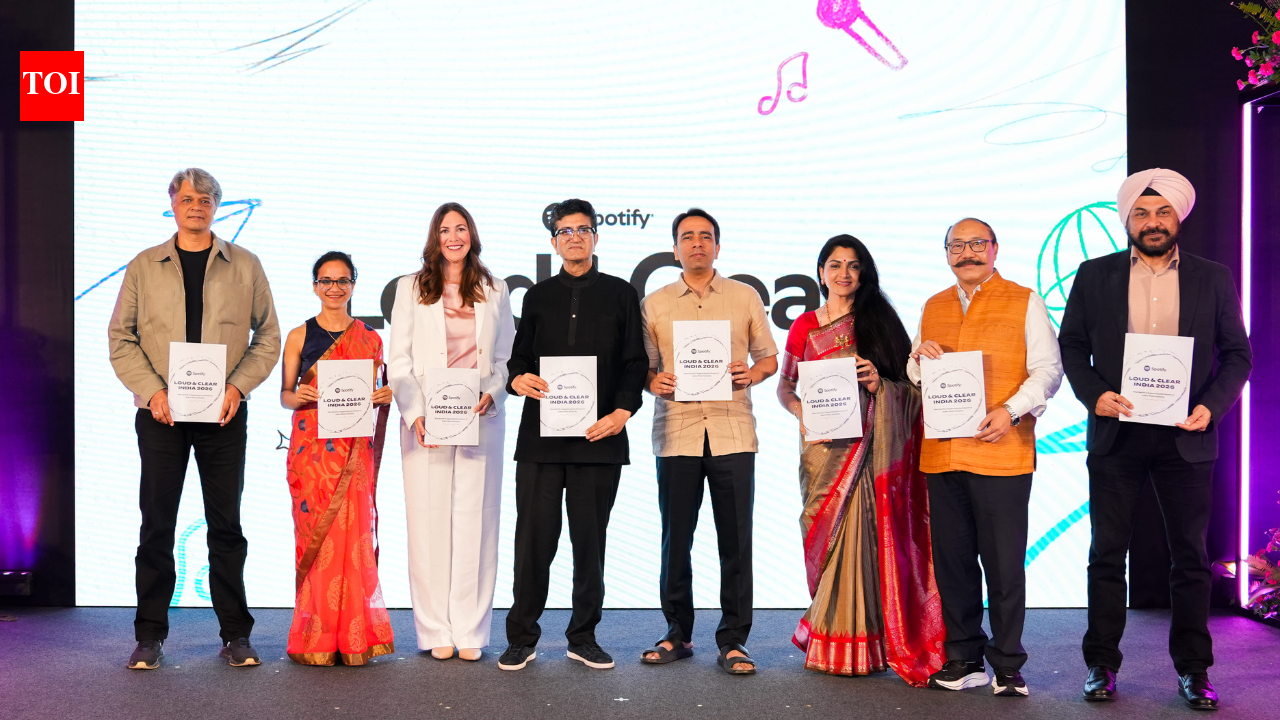
Independent artists, regional-language music and streaming’s growing influence on the music economy became talking points at Spotify’s first Loud & Clear report launch in Delhi recently. Bringing together musicians, industry leaders and policymakers, the event explored how streaming is helping artists reach wider audiences, build direct connections with listeners and find opportunities beyond traditional music industry gatekeepers.Discovery, fandoms and artist-first cultureKicking off the event, Amarjit Singh Batra, MD, Spotify India said, “Streaming has increasingly become about discovery. Personalisation, playlists, and recommendations, help listeners find artists, songs, genres, and languages that they may have never searched for themselves. Those first time artist discoveries are important because discovery is not simply a product feature. Discovery reads audiences. Audiences create fans, and fans create economic value. We are now seeing the next important shift – the willingness to pay for music. When we ask Indian listeners why they choose streaming, the strongest signal isn’t about the future. It’s not about features. In a 2025 survey, 96% of Indian users told us they feel a deep connection to their favourite artists and creators through Spotify. Fandom is becoming an economic engine for music in India. We are seeing the rise of artist-first culture.”
(L-R) Kushboo Sundar, Prasoon Joshi, April Boyd
Audiences got a rare opportunity to hear lyricist and chairman of Prasar Bharti Prasoon Joshi sing live. During a panel discussion, he recited lines from his famous song, ‘Maa’ from Taare Zameen Par. Talking about soft power, he said, “We should let soft power be soft. Music has its own way of reaching out. What we are witnessing today is the democratisation of creation. Everybody can create and as a storyteller and poet, I feel that people are more interested in reciting their poems than listening to mine. We now have more storytellers than the actual audience. That is democratisation to a level which we never imagined. Music used to be very collective and collaborative. My understanding of music came from folk music which was always collective.”Regional languages take centre stageDhruvank Vaidya, Head of Music & Podcast, Spotify India, spoke about the rise of regional languages on the platform and said, “Two years ago, artists performing in Haryanvi or Malayalam didn’t have this kind of economic reach. The audience was always there; what Spotify built was the infrastructure to surface it, monetise it, and ensure artists earned from it. When two brothers, Banjaare, from a village in Haryana can reach number one on a global chart, or a 22-year-old, Aksomaniac, from Thiruvananthapuram can break into one, that infrastructure is delivering. Half of our year-end top ten in India last year came from outside film soundtracks. The music that’s travelling furthest is the music artists made on their own terms, in their own languages.”Jayant Chaudhary, Minister of State (Independent Charge), Ministry of Skill Development and Entrepreneurship, who was a panelist, said, “India’s music economy reflects the extraordinary creativity, diversity and entrepreneurial spirit of our artists. The growth in royalties, supported by strong gains across Indian languages, shows how digital platforms are enabling talent from every region to find audiences, build sustainable livelihoods and participate in the global creative economy. It is particularly encouraging to see independent artists succeeding on their own terms and taking music rooted in their languages and identities to listeners around the world. As technology reshapes the creative industries, we must continue to strengthen the skills, digital capabilities and enterprise opportunities that enable young creators to convert their talent into meaningful careers. India’s linguistic diversity is not merely our cultural strength; it is increasingly becoming an economic strength and a powerful part of our global identity.”
L to R – Mehak Chauhan Bhullar (Spotify – Editor, Punjabi), Simran Choudhary , Aditya Rikhari, Dhruvank Vaidya (Head of Music & Podcast, Spotify India)
Artists reflect on their journeysOn the final panel of the evening, artists Aditya Rikhari and Simran Choudhary shared their experiences as artists who grew on streaming platforms. Speaking about his journey, Aditya Rikhari said, “Streaming changed the scale of what was possible for me as an independent artist. Songs that started from a very personal place were able to travel to listeners across the country, sometimes long after they were released. So to every fan of mine who aspires to become a musician – just put your music out. You never know where it might travel.” He added that while scrolling his stats, he once saw that there were some listeners from South Africa which surprised him.Independent artists are also shaping film music. Reflecting on the shift, Simran Choudhary said, “Streaming has completely changed what it means to be a Punjabi artist today. You no longer have to wait for a big label or a traditional industry gatekeeper to take your music to the world. I’ve experienced that first-hand with my own independent music and film songs like Lutt Le Gaya. What excites me most is that audiences are now discovering the artist behind the song, not just the song itself. For an independent female artist like me, that ability to build a direct relationship with listeners has been incredibly empowering.”Bringing the evening to a musical close, the two artists, who collaborated last year, sang a few lines for the audiences in a raw version of the song.


