



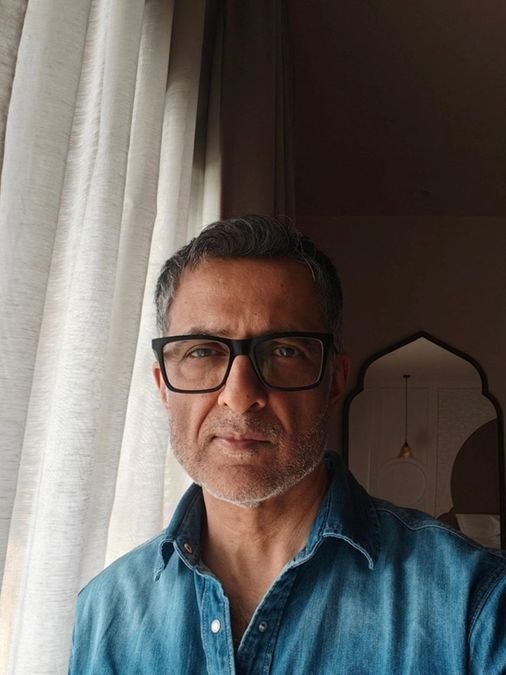
Srinagar, Oct 2: Bollywood actor-producer Sanjay Suri, who recently visited Kashmir for the International Film Festival of Jammu & Kashmir (IFFJK), has recalled his childhood in the valley, the circumstances that forced his family to leave in the early 1990s and his continuing emotional connection with Kashmir.
Speaking to Rising Kashmir, Suri said he was 19 when the situation in Kashmir deteriorated in 1989 and he was then pursuing his graduation at Gandhi College. He had earlier studied at Burn Hall School and also represented Jammu and Kashmir in sports at the national level.
“I remember playing basketball, trekking and doing many other things. Those were very different times,” Suri said, recalling his childhood and youth in Kashmir.
He said the turning point for his family came after his father was killed on August 1, 1990.
“My father was killed on August 1, 1990, without any warning. We were not leaving. We thought, why do we need to leave? But three boys came home and shot him,” he said.
Following the incident and the imposition of curfew, Suri said, his family decided to leave Kashmir.
“That was the day when the family thought that we should move out of the valley. I completed my final year at MAM College in Jammu and later moved to Delhi. After a short stint in Delhi, I moved to Mumbai and eventually entered films,” he said.
Reflecting on the changes Kashmir has witnessed over the past three-and-a-half decades, Suri said several generations have grown up experiencing curfews, school closures and prolonged periods of uncertainty.
“Kashmir has seen a lot. Whether you are a Kashmiri or someone who came from outside, people have suffered. I hope we are in better times now,” Suri said.
According to him, people across the valley primarily want peace, prosperity and opportunities.
Despite having spent decades outside Kashmir, Suri said he continues to visit the valley regularly.
Suri said his emotional connection with Kashmir remains strong, adding that he sometimes jokes with his children about eventually returning to the Valley.
“I threaten my kids that when you go to college, I will go back to Kashmir,” he said with a smile.
“When you have spent your childhood somewhere, you can’t leave that place, but the connection remains. In Kashmir, there can also be a good environment for script reading because the distractions are less,” he added.
Suri also travelled down memory lane while recalling the cinema culture of Kashmir before the 1990s.
“We had Palladium and Regal. English films were screened at Broadway, Neelam Cinema and other theatres. I watched films of actors like Dharmendra, Amitabh Bachchan, Vinod Khanna and Dilip Kumar,” he said.
Recalling the excitement surrounding popular films, Suri said, “I have watched films like Sholay, Coolie, Amar Akbar Anthony – there were big posters and long queues. Tickets were available for around Rs 5.”
He also remembered the ticket windows at Palladium Cinema and the presence of black-market ticket sellers.
Suri believes Kashmir has the potential to develop a vibrant regional film industry and tell its own stories to the world.
“Regional cinema is important because you tell your stories yourself. It is such a beautiful way to reach out to the world,” he said.
Pointing to regional film industries in Punjab and Tamil Nadu, he said Kashmir could also develop its own cinema rooted in its culture, people and stories.
Suri, who has worked in films including Raazi and Firaaq, also recalled his experience of shooting I Am in Kashmir.
“It was a great experience shooting in Kashmir. The permissions were also issued smoothly,” he said.
The actor-producer said his recent visit to Kashmir for the IFFJK gave him an opportunity to reconnect with the Valley’s evolving film ecosystem.
“I was happy to attend the film festival. It was a new experience for Kashmir,” he said.
Suri acknowledged that there were some glitches during the festival but said organising such an event on a large scale was itself significant.
However, he emphasised the need to ensure that local filmmakers and artists remain central to the development of Kashmir’s film ecosystem.
Suri suggested that a comprehensive database of local artists should be created and maintained so that filmmakers and festival organisers can easily identify talent from Jammu and Kashmir.
Suri also advocated establishing a dedicated film school in Kashmir to train young people in various technical and creative aspects of filmmaking.
He said such an institution could help create a structured ecosystem for local talent and provide young filmmakers with opportunities to acquire professional skills without having to leave the valley.
