





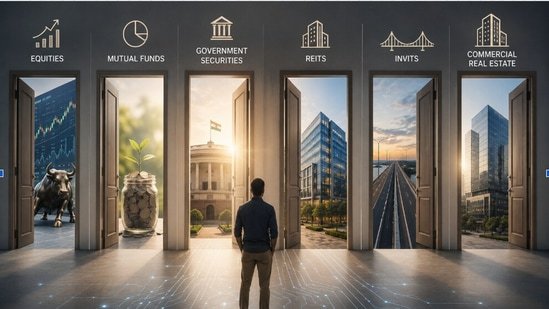
Investing used to be a two part puzzle – deciding what to buy and then figuring out how to buy it.


Opening a trading account involved paperwork and branch visits. Investing in government securities was largely associated with institutions or experienced market participants. Even something as routine as starting a mutual fund investment often meant filling out forms and waiting for the process to be completed. Over the past decade though, those barriers have steadily come down.
Today, an investor can complete KYC digitally, open a demat account online, start a SIP in a few minutes, buy exchange-traded funds through a smartphone or invest directly in Government Securities. The underlying investments haven’t changed but the way people access them has. That shift has been significant enough to reshape who participates in India’s financial markets.
According to the Economic Survey 2025–26, India added 23.5 million demat accounts during FY26 (up to December 2025), taking the total to more than 216 million. The country also crossed 120 million unique investors, while the mutual fund industry counted 59 million unique investors, including 35 million investors from beyond Tier-I and Tier-II cities.
These aren’t just milestones for the financial sector. They suggest that investing is becoming more geographically diverse and more widely accessible than it was even a few years ago. Technology is playing a central role in that change and not by reinventing investing, but by making participation simpler.
The investment itself hasn’t changed. The journey has.
Think about some of the biggest changes investors have seen over the past two decades. Online brokerages reduced the need for physical paperwork. Mutual fund platforms made systematic investing easier. Digital gold enabled investors to buy small quantities without worrying about storage. The RBI’s Retail Direct initiative gave individuals a direct route to invest in Government Securities without going through traditional intermediaries.
Each of these developments solved a different problem, but they shared a common objective: reducing friction. Technology hasn’t changed what a government bond represents or how a mutual fund works. Instead, it has made these products easier to discover, understand and access.
Regulatory reforms have reinforced this transition. Earlier this year, SEBI introduced measures to simplify several investor service requests by enabling the direct credit of securities into investors’ demat accounts. In applicable cases, the processing timeline is expected to reduce from around 150 days to approximately 30 days, improving the overall investor experience without altering the underlying investment framework. This combination of digital infrastructure and regulatory modernisation has gradually shifted the focus from ownership being difficult to access to becoming easier.
Convenience changes behaviour
Making investing easier doesn’t simply save time, it can also influence how people invest. An example is the rise of systematic investing. Rather than trying to predict short-term market movements, many investors now choose to invest a fixed amount every month through Systematic Investment Plans (SIPs). The process is largely automated, requiring little intervention after the initial setup.
The trend has continued to gather momentum. According to the Association of Mutual Funds in India (AMFI), monthly SIP contributions reached ₹31,781 crore in June 2026, while the number of active SIP accounts approached 9.78 crore. At the same time, SIP assets rose to ₹17.70 lakh crore, accounting for roughly 21.5% of the mutual fund industry’s total assets under management.
The broader industry has grown alongside that participation. As of 30 June 2026, the Indian mutual fund industry’s assets under management stood at ₹82.22 trillion, almost six times larger than a decade earlier. Total mutual fund folios reached 27.86 crore, reflecting the expanding investor base across the country.
Importantly, these figures don’t suggest that technology has made investing risk-free. Markets continue to fluctuate, and investment decisions still require careful consideration. What technology has done is remove many of the practical obstacles that may have once discouraged participation.
From financial products to broader investment opportunities
The idea of improving access is now extending beyond traditional investment products. Retail investors today can choose from listed equities, mutual funds, exchange-traded funds, government securities, REITs, InvITs and several other regulated investment vehicles through digital platforms.
The common thread across these products is not that they offer similar returns or carry similar risks, they don’t. The common thread is accessibility. Digital platforms have made it easier to compare products, complete onboarding, execute transactions, and monitor investments from a single interface. Investors who previously had limited exposure to financial markets now have a much wider range of options available to them.
The next stage of this evolution is beginning to focus on asset classes that historically required significantly larger capital commitments. Some technology-led platforms are exploring ways to improve access to these opportunities through digital onboarding and fractional participation, where permitted under applicable legal and regulatory frameworks. The objective is not to create new asset classes but to make participation in existing ones more accessible than it has traditionally been.
When more doors open, choosing the right one can become harder
Greater access has changed the investing experience in another important way. For many people, the challenge is no longer getting started. It’s deciding where to invest.
A decade ago, the average retail investor had a relatively limited menu of options. Today, the same investor can build a portfolio that includes equities, debt funds, exchange-traded funds, government securities, REITs, InvITs and other regulated products, all through digital platforms.
That wider choice is undoubtedly positive, but it also raises the importance of understanding what sits behind each investment. Technology can make an investment easier to buy, however, it cannot explain whether it matches an individual’s financial goals, liquidity needs or risk tolerance. This is where access and financial literacy need to grow together.
The Securities and Exchange Board of India (SEBI) has repeatedly emphasised investor awareness as retail participation has expanded, encouraging investors to understand products, assess risks and rely on regulated channels while making investment decisions. As access continues to improve, informed decision-making becomes just as important as the technology that enables it.
Accessibility is becoming part of the investment story
The conversation around investing has traditionally centred on performance. Which asset delivered the highest returns? Which sector outperformed? Which strategy worked best? Those questions remain relevant, but another trend is quietly gathering pace. Increasingly, innovation is focused on making established asset classes easier to access rather than creating entirely new ones.
Listed REITs are one example. Introduced in India in 2019, they allow investors to participate in income-generating commercial real estate through listed securities without directly purchasing an office building or managing tenants. As of mid-2026, India has five listed REITs on Indian stock exchanges, reflecting the gradual evolution of the country’s listed real estate investment market.
The same principle is visible elsewhere. The RBI’s Retail Direct platform gives individuals direct access to Government Securities, digital platforms have simplified investing in mutual funds and ETFs and online brokerages have reduced the operational effort involved in buying listed shares.
Each innovation has expanded access to an asset class that already existed. The underlying investment remains the same. The route to participating has become simpler.
Ownership is no longer the only way to participate
This broader shift is changing how investors think about ownership itself. In many areas of daily life, technology has gradually shifted the focus from owning an asset to accessing a service when needed. Investing is beginning to reflect a similar pattern in certain segments of the financial ecosystem.
Rather than requiring individuals to commit large amounts of capital to participate in every opportunity, technology is enabling investment structures that can lower entry barriers, digitise transactions and improve transparency, subject to the applicable regulatory framework.
Commercial real estate is one area where this evolution is becoming more visible. Investing directly in institutional-quality commercial property was beyond the reach of most retail investors because of the capital required. Listed REITs have already broadened access to this market, while newer technology-enabled platforms are exploring additional ways to improve accessibility through digital onboarding and fractional participation where permitted.
Platforms such as Alt DRX form part of this broader shift. Rather than introducing a new asset class, they illustrate how technology can simplify access to segments of the real estate market that have historically been difficult for individual investors to participate in because of high entry costs.
That differentiation is important. The story is not about replacing traditional investing or suggesting that one asset class is superior to another. It is about giving investors access to a wider opportunity set, allowing them to make choices based on their own financial goals, investment horizon and risk appetite.
The next chapter is likely to be about inclusion
Technology has already transformed the mechanics of investing. Opening an account, completing KYC, transferring money and tracking investments have become significantly faster and more convenient than they were a decade ago. The next phase may be less about digitising existing processes and more about widening participation.
As more asset classes become accessible through regulated digital channels and technology continues to reduce operational barriers, investors are likely to have more choice than any previous generation. That is undoubtedly a positive development.
At the same time, greater choice brings greater responsibility. Easier access does not eliminate investment risk, nor does it reduce the importance of diversification, due diligence or understanding how an investment works.
Technology can open the door. Deciding whether to walk through it and which opportunities deserve a place in a portfolio will always remain an investor’s responsibility.
Note to the reader: This article has been produced on behalf of the brand by HT Brand Studio and does not have journalistic/editorial involvement of Hindustan Times.


