



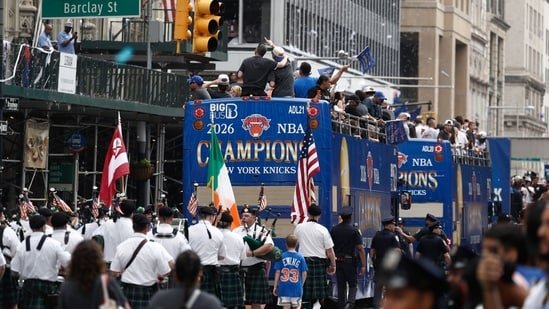
New York gave the Knicks a ticker-tape parade through the skyscraper lined ‘Canyon of Heroes’ street on Thursday, ending a 53-year wait for the city’s most heartbroken fan base. Confetti in Knicks blue and orange blew across Broadway as floats carrying Jalen Brunson, the NBA Finals MVP (most valuable player), and his teammates rolled through waves of fans.


The parade was New York’s 210th, a tradition that began in 1886 and has, since the mid-20th century, been reserved mainly for the city’s sports champions. Brunson, who helped close out the NBA Finals over the San Antonio Spurs, told the crowd: “Damn, New York, we really did it.”
The last Knicks team to win a National Basketball Association (NBA) title, in 1973, never got a parade. Then-mayor John Lindsay had already begun scaling back ticker-tape parades on cost grounds, but gave the team a reception at City Hall instead.
The procession, the trophy, the crowd lining the route, and the reception at the seat of government — are far older than ticker tape itself. It is, in fact, one of the oldest public rituals on record.
Also read: FIFA World Cup: Three things we learnt from a chaotic first week
Ancient roots: Olympia and Rome
The instinct to march a champion home through a cheering crowd dates back nearly 3,000 years. At the ancient Olympic Games, which began at Olympia in 776 BC, victors were not simply crowned with an olive wreath. They made a triumphal entry into their home towns, sometimes tearing down a section of the city wall, before being escorted to the town hall, where they could be rewarded with a free meal at public expense. In some cases, meals would be served for life, according to an account of the International Olympic Academy, the body that runs Olympic education for the International Olympic Committee.
The honour was captured in poetry too. Greek lyric poet Pindar composed 45 victory odes in the fifth century BC, in a genre called the epinikion, translated to ‘upon victory’. These odes are widely described by historians as having been performed at the athlete’s homecoming.
Rome built a similar ritual around military rather than athletic victory. Captured prisoners and plunder were paraded ahead of the general’s chariot, with his soldiers marching behind him as the procession made its way to the Temple of Jupiter — Zeus, in Greek — on the Capitoline Hill (now a popular square). When there was enough to display, the ceremony could stretch across two or three days, according to the classicist Mary Beard’s 2007 book The Roman Triumph.
The structure of that ceremony was the ancestor of the format most modern victory parades still follow.
Also read: From Messi to Mbappe: The joy of the GOAT debate
Wall Street’s accidental contribution
New York’s specific contribution — the ticker tape — began as an accident. The stock ticker, a machine that printed financial data onto narrow paper strips fed by telegraph wires, had been in use for barely two decades when Wall Street clerks threw the spent tape out of their office windows for the first time in October 1886, during the dedication ceremony for the Statue of Liberty, according to the New York City Downtown Alliance, which maintains the official record of the city’s ticker-tape parades.
The novelty caught on quickly, and the practice gave it the name, the ‘ticker-tape parade’.
By 1899, Time reported, two million people turned out to honour Admiral George Dewey, hero of the Battle of Manila Bay and the first individual to be feted this way. Former US President Theodore Roosevelt, too, got one in 1910, more than a year after leaving office.
But the parades didn’t become routine until 1919, when New York named Grover Whalen the city’s official greeter. Whalen organised 86 such parades between then and 1953, often at the urging of the US State Department, honouring guests such as Albert Einstein (1921), the US Olympic team (1924) and aviator Charles Lindbergh (1927), the Time report said.
Not everyone supported it. In letters to the press, some said the practice could spook horses involved in the parade and others urged the city to opt for the more “civilised” European custom of throwing flowers.
Still, one of the most iconic parades New York recorded was in 1945, when the Allies, including the US, won the Second World War. Nearly 5,500 tonnes of paper, confetti and cloth, as recorded by the city’s sanitation department, was flung in the celebrations that August.
New York held its first ticker-tape parade for a local team in 1954, for the New York Giants’ National League pennant. By the late 1960s though, the stock exchange had switched to electronic boards, making actual ticker tape obsolete. Shredded paper and confetti have replaced it since.
Also read: Mamdani mentions forgotten Knicks hero from 2011 in parade speech; brother gives ‘shout out’
The ritual evolves
British football adapted the same instinct, swapping ticker tape for the open-top bus.
Arsenal and Preston North End are recorded among the first English clubs to parade FA Cup wins through their hometowns by bus, in the 1930s, according to the UK’s Confederation of Passenger Transport, the trade body for bus and coach operators in the country.
Then, Manchester United, the first English club to win the European Cup, marked the feat with an open-top bus tour of Manchester after beating Benfica 4-1 at Wembley stadium in 1968. The victory was special because the trophy came a decade after the Munich plane crash nearly wiped out the team.
The same pattern – a bus, a trophy and a reception — has become standard across sports and countries.
Television, Brazil and the limits of crowds
The proliferation of television turned the victory parade into an even larger spectacle, one that needn’t remain limited to participants in a city.
Brazil’s 1970 World Cup squad, fresh off a 4-1 win over Italy in the first World Cup final broadcast in colour worldwide, came home to a reception that hundreds of thousands of people attended. In Brasília, the team that involved the legendary Pele was received by then president Emílio Garrastazu Médici and given medals, cash, cars and shares in the state electricity company, according to Americas Quarterly.
The celebration format has since run into problems of scale. In December 2022 in Buenos Aires, two days after Argentina beat France to win the Fifa World Cup, an estimated 5 million people filled the streets for the open-top bus parade. But the crowd grew so dense that the bus could not move, and players, including team captain Lionel Messi, had to be evacuated by helicopters. Argentina”s government later cited safety concerns for its decision to cut the parade short.
In India, a crowd crush for a cricket celebration turned fatal in Bengaluru just last year.
Eleven people died and dozens more were injured in a stampede outside the M. Chinnaswamy Stadium on June 4, after a crowd far larger than the venue’s capacity tried to force its way in to see the Royal Challengers Bengaluru (RCB) team celebrate its first Indian Premier League (IPL) title. The Karnataka government later told a court that the event had gone on without the required police permissions.The case is ongoing.


