





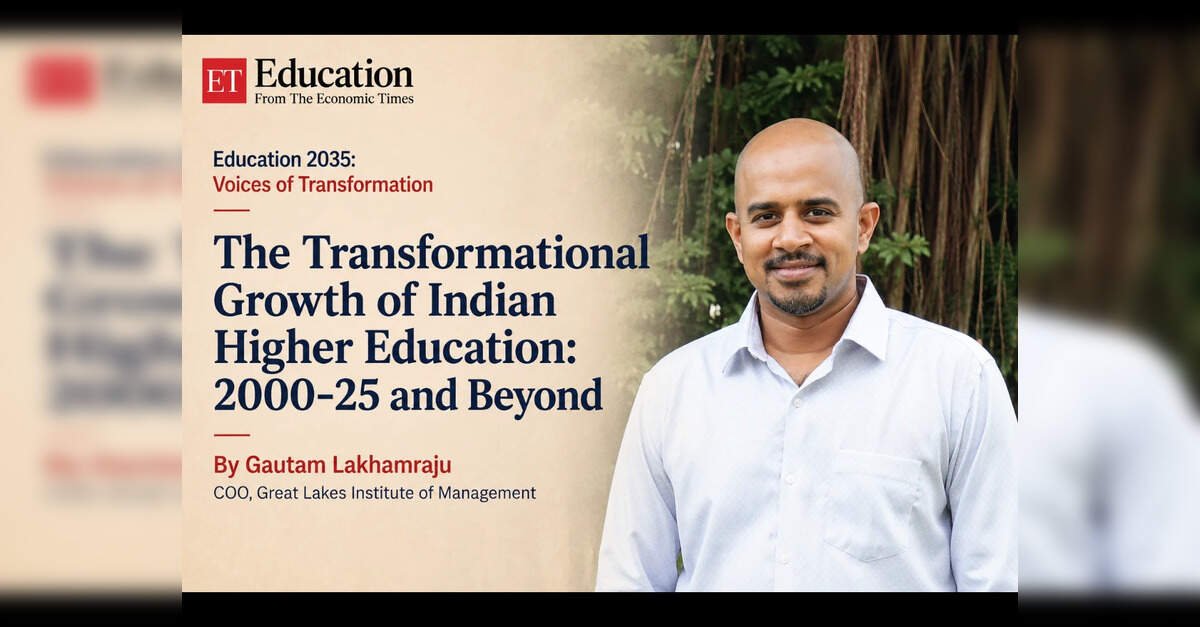
By Gautam Lakhamraju
India’s higher education system has undergone a major transformation between 2000 and 2025, evolving from a capacity-constrained model into a large, diverse, and increasingly market- and technology-driven ecosystem offering far greater opportunities for students.
In the early 2000s, despite economic liberalization, access to higher education remained limited. The Gross Enrolment Ratio (GER) was around 10%, and the system was dominated by a small number of premier institutions with limited seats and intense competition. Even meritorious students often struggled to secure quality education opportunities.
Over the next two decades, capacity expanded significantly, with a sharp rise in institutions across engineering, management, science, and medicine. However, this rapid expansion also exposed persistent concerns around quality and employability, particularly among lower-tier institutions.
From around 2015 onward, higher education began shifting toward digital learning and a skills-first approach. The growth of edtech platforms enabled large-scale access to industry-relevant learning, test preparation, and online degrees. This marked a move away from purely degree-centric education toward employability-focused learning, with increasing emphasis on analytics, coding, digital marketing, and management skills.
Simultaneously, the rise of liberal education and interdisciplinary programmes diversified the higher education landscape beyond traditional engineering-focused pathways.
A major turning point came with the National Education Policy (NEP) 2020, which introduced multidisciplinary learning, flexible degree structures, and academic mobility through credit systems, while setting a target of 50% GER by 2035. The COVID-19 pandemic further accelerated digital adoption, making higher education more accessible, technology-enabled, and outcome-oriented. By 2025, India’s GER is approaching 30%, reflecting this expanded access.
Looking ahead, the next phase of transformation will be driven by artificial intelligence, changing workforce demands, and India’s growing economic ambitions. As generative AI automates routine technical tasks, the focus will increasingly shift toward higher-order capabilities such as creativity, critical thinking, communication, design, and interdisciplinary problem-solving. Institutions will need to move beyond content delivery toward creating environments that foster innovation and adaptability.
AI is also reshaping entrepreneurship by enabling high-impact ventures with smaller teams, making entrepreneurship an increasingly important pathway alongside traditional employment. As job roles evolve rapidly, lifelong learning and continuous reskilling will become essential.
At the same time, research priorities must shift from publication volume toward meaningful innovation and societal impact.
To fully leverage its demographic dividend in the AI era, India must move decisively toward a capability-driven education system focused on adaptability, skills, and lifelong learning. This will require sustained investment in faculty, research, and learning infrastructure, along with wider adoption of experiential and work-integrated education.
Ultimately, India’s strength will depend not on the number of graduates it produces, but on how effectively it develops agile, innovative, and AI-ready talent.
The article is written by Gautam Lakhamraju, COO, Great Lakes Institute of Management.
DISCLAIMER: The views expressed are solely of the author and ETEducation does not necessarily subscribe to it. ETEducation will not be responsible for any damage caused to any person or organisation directly or indirectly.


