









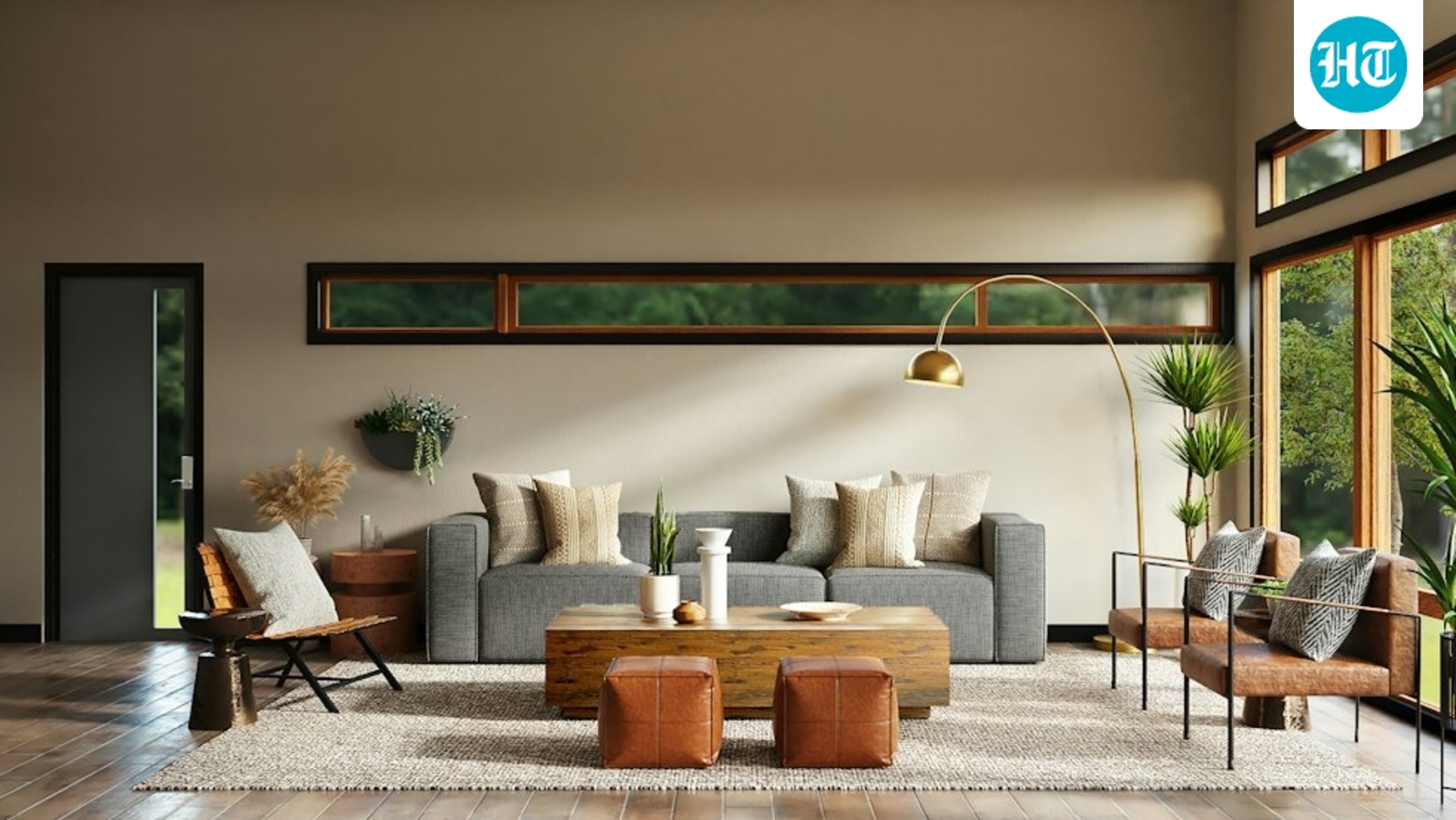
When a home looks dated, the problem is not always its colour palette or furniture. More often, it is the way different elements meet, the proportions of the room and the amount of visual information competing for attention. Instead of replacing everything, designers look for a few strategic interventions that change how the entire space is perceived. In an interview with HT Lifestyle, Harshita Agarwal, founder of Harshita Agarwal Interiors, shared design updates that can transform your home.
Also read | From clutter-free spaces to layered lighting: 4 hotel-inspired decor ideas for a peaceful home
1. Create one strong architectural gesture
Many older interiors contain several unrelated decorative ideas: an accent wall, patterned ceiling, elaborate partition and ornamental furniture all within one room. Harshita advises removing the competing elements and introducing one defining gesture instead. It could be a softly curved wall, a sculptural doorway, a timber-lined opening or a continuous material connecting two spaces. One confident idea feels more contemporary than multiple decorative statements.
2. Pay attention to the ceiling
The ceiling is often treated as a surface that simply holds lights. Bulky false ceilings with several levels, borders and concealed lighting can immediately reveal the age of an interior. “Simplify the design by retaining one clean plane, exposing selected services or introducing a single material feature,” Harshita highlighted. Even removing an unnecessary ceiling border can make a room appear taller and more architectural.
3. Update the edges, not necessarily the surfaces
According to Harshita, a dated appearance frequently comes from thick skirting, ornate cornices, rounded granite edges and heavy wooden borders. Instead of replacing an entire floor, wall or countertop, reconsider its edge detail. Slimmer skirting, cleaner junctions and sharper countertop profiles can modernise existing materials at a comparatively lower cost.
4. Reduce visual interruptions
Switchboards, air-conditioning trunking, exposed wires, internet routers and multiple appliance panels can make a room feel fragmented. Consolidate controls wherever technically possible, conceal cables and coordinate switch plates with the wall finish. Good design is often less about what is added and more about what the eye is no longer forced to notice.
5. Correct the scale of the room
Small rugs, short curtains, undersized artwork and several pieces of compact furniture can make a room appear visually unsettled. Designers often improve a space by using fewer but better-proportioned elements. A larger rug that anchors the complete seating arrangement or one substantial artwork can create far greater impact than numerous small accessories.
6. Break up matching furniture sets
A complete sofa set, identical side tables and coordinated dining furniture can make a home resemble a showroom from a particular decade. “Retain the strongest pieces and introduce contrast through one sculptural chair, a different table material or an inherited object,” Harshita recommended. A home feels current when it appears collected gradually rather than purchased as one matching package.
7. Improve the transitions between spaces
Doorways, passages and thresholds are frequently overlooked, yet they determine how smoothly a home flows. Replacing a heavy framed opening with a clean portal, extending one flooring material between connected spaces or repeating a timber detail across rooms can create continuity without changing the entire interior.


