






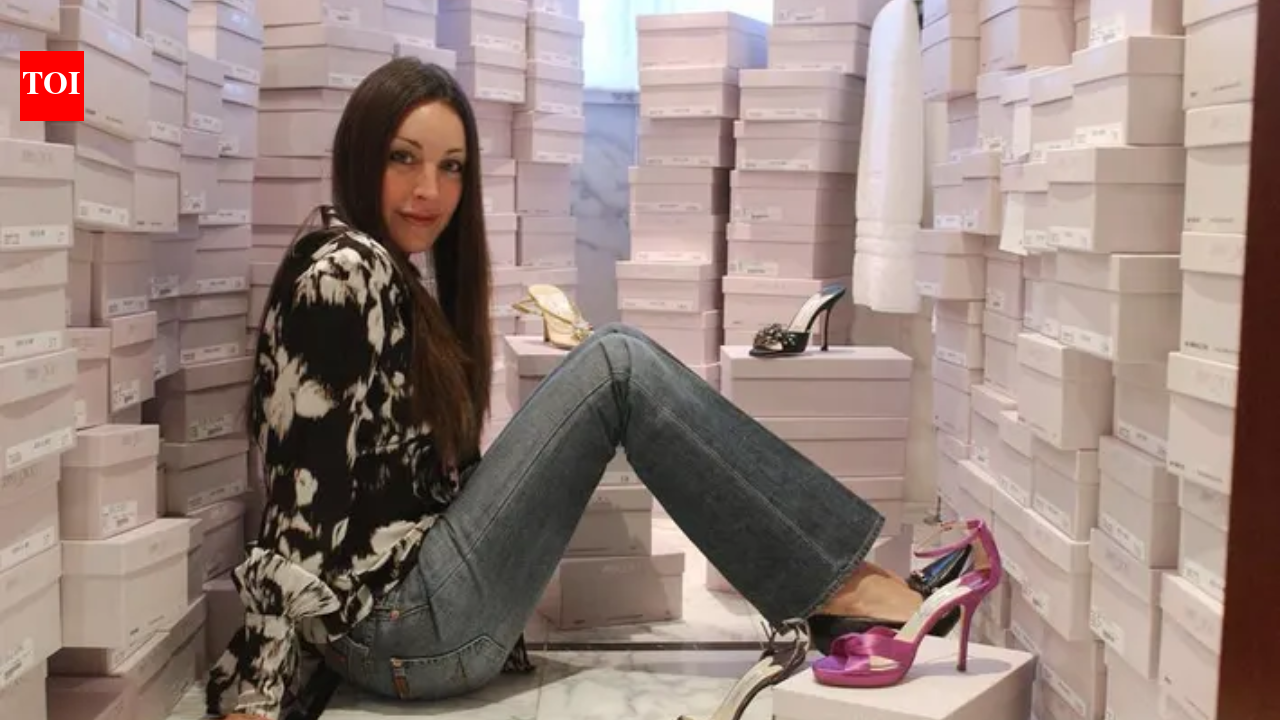
At 27, Tamara Mellon was at a difficult point in her career. In 1995, she had lost her job at British Vogue, had gone through rehabilitation for drug use and was living in her parents’ basement. A few years later, she would be at the centre of one of the biggest luxury footwear businesses of its time. Mellon went on to co-found Jimmy Choo with London-based shoemaker Jimmy Choo in 1996. The company, which began with a £150,000 investment from her father, grew from a small London operation into an international luxury label. As per the official website of Vogue, in 2011, Jimmy Choo was sold to Labelux for £525.5 million, roughly $800 million at the time. But the business began much more modestly.
The shoemaker she knew from Vogue
Jimmy Choo and Tamara.
Mellon had worked as an accessories editor at British Vogue. During those years, she regularly visited Jimmy Choo’s workshop in London’s East End to have shoes made for fashion shoots. In a 2011 interview with British Vogue, she recalled how she used Choo’s work for fashion shoots, saying: “I used to go down and I used to get Jimmy to make things for shoots. I’d go down to his studio in Hackney and I’d say ‘OK I want a gladiator sandal with studs, and I want it in metallic silver.'” Choo would make the shoes, she would photograph them and credit him in Vogue. “But that’s how his name became known – because I was doing that for five years,” she said in the interview.According to her, Choo was a skilled bespoke shoemaker, but his business was small. Mellon saw an opportunity to take his craftsmanship beyond individual clients and build a ready-to-wear luxury footwear company. The idea was that Choo would bring the shoemaking expertise, while Mellon would handle the business. In the same interview, she recalled approaching him: “OK we will be equal partners in this. I will run all the operations.” She then went to Italy, found factories and set up the production company. Getting Choo to agree, however, took persistence. According to Mellon, she spent months around his workshop trying to prove that she was serious about building a company with him.
Borrowed £150,000 from her father
Mellon’s father, entrepreneur Tommy Yeardye, eventually backed the idea with £150,000. Mellon herself has described the money as a loan. In a Forbes interview, she recalled: “I borrowed 150 grand [£150,000, or $230,000] from my father, and everything was set up.” The early company was far removed from the polished luxury image Jimmy Choo would later develop. Mellon and the team worked from a basement office. She had little experience running a shoe company, so she had to learn the manufacturing side as she went. In a British Vogue interview, she described doing almost everything herself in the early days: **”When I look back at the early days I was helping customers on the shop floor. I was cleaning the shop floor and then running downstairs to fax orders to the factories in Italy.”
Mellon understood the power of celebrities
One of Mellon’s biggest business decisions was to put Jimmy Choo shoes directly in front of celebrities. The strategy connected luxury footwear with Hollywood red carpets at a time when celebrity fashion was becoming increasingly influential. Jimmy Choo shoes began appearing with famous actresses and on major award-show red carpets. Mellon later explained that she recognised this shift early. In a 2013 interview with Vogue, she said: “That’s why I took the brand to the Oscars, because I saw that early.” She described the period as a time when ‘celebrity was exploding’ and magazines were increasingly putting actresses on their covers rather than models. The brand received another major boost from Sex and the City. Carrie Bradshaw’s attachment to Jimmy Choo shoes helped introduce the label to viewers far beyond the fashion industry.By the end of 2000, Mellon wrote in her memoir that Jimmy Choo was making about 3 million euros in annual profit, had its own London store and was represented in around 450 other stores, including Harrods and Selfridges.
Jimmy Choo eventually became an $800 million business
The company’s growth continued through a series of investment deals. Jimmy Choo was sold to Labelux in 2011 for 525.5 million euros, commonly reported as about $800 million. British Vogue reported that Mellon received an estimated 85 million euros from the sale. Mellon later spoke about what she had learned from building the company. In a Vogue interview, she gave a simple piece of advice: “Keep control of your business.“
The career setback she later called a wake-up call
She spoke openly about her drug and alcohol problems and her departure from Vogue.
Mellon’s difficult period before Jimmy Choo was not something she hid. In interviews around the publication of her memoir ‘In My Shoes,’ she spoke openly about her drug and alcohol problems and her departure from Vogue. In an interview about her life and career, Mellon recalled: “I got fired from Vogue and because I was my drug addiction started getting out of control. I was you know 26, 27 years old and I got fired from Vogue and I got scared.” She said she later returned to thank the woman who had fired her, Vogue editor Anna Harvey. “I actually years later I went back and I thanked the woman who fired me. I went back and I actually thanked her because it was the wakeup call I needed and I got scared enough to get sober and change my life.”
What came after Jimmy Choo?
Mellon left Jimmy Choo in 2011 and later launched her fashion label with her name. Looking back at her first company, she has described the early years as a period when she was involved in almost every part of the operation. In a 2011 British Vogue interview, she said: “What excites me most is the thrill of the next project, the next idea.”


