Presidents from George Washington to Franklin Roosevelt have built up America’s navy, but few American leaders have taken so keen an interest in ship design as Donald Trump. He loves “Victory at Sea”, a 1950s documentary about the American navy’s exploits in the second world war, with battleships firing big guns and planes taking off from the pitching decks of aircraft-carriers. During his speech at the Republican National Convention in 2024, the most important speech in his presidential campaign, he went off script to boast about his redesign of a warship’s bow in his first term so they “look like yachts”. The reaction in the shipyard, he claimed, was “This guy sort of knows what he’s doing.”
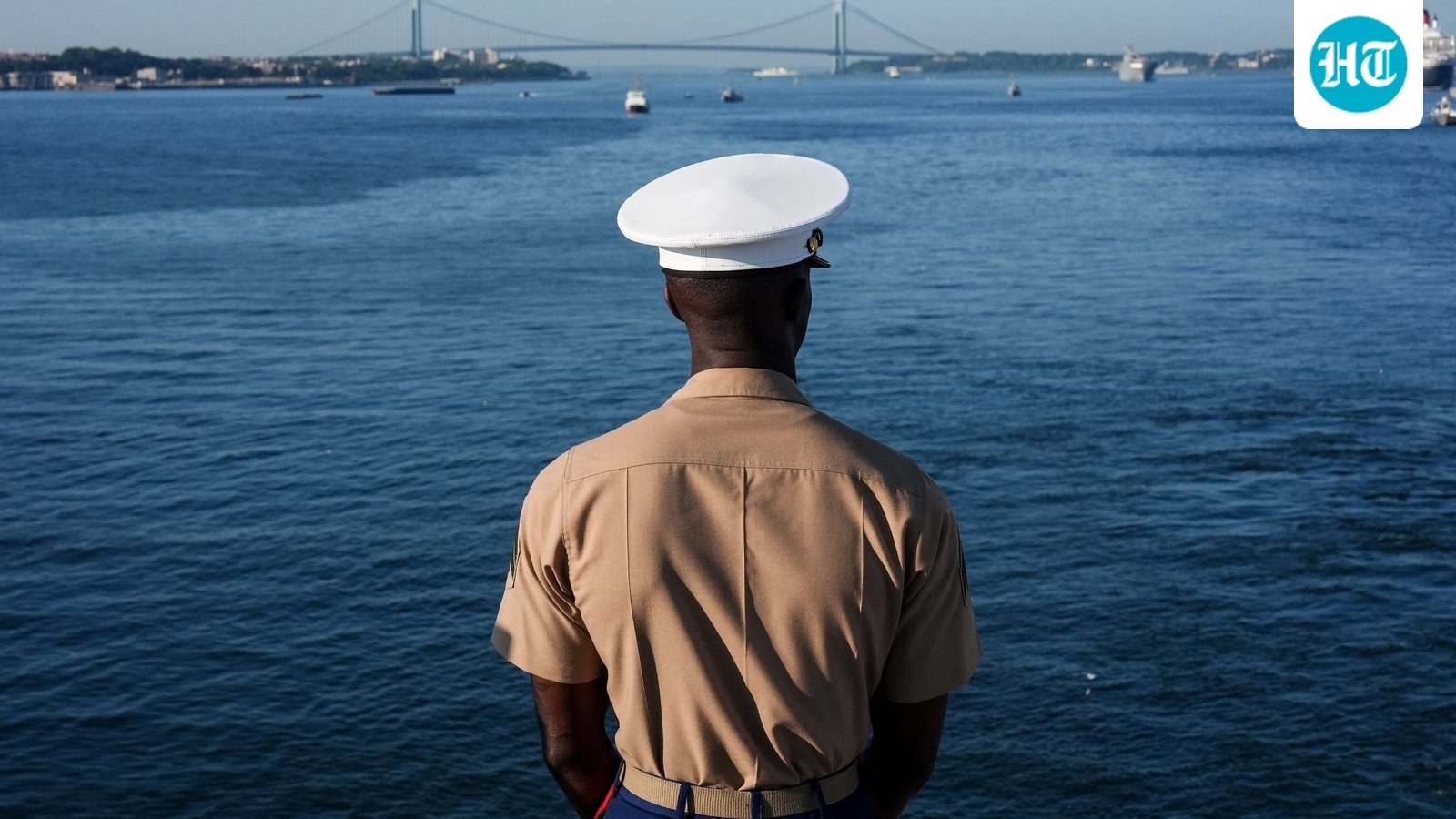
A member of the U.S. Marine Corps looks at the sea from aboard the Wasp-class amphibious assault ship USS Kearsarge Navy ahead of the Sail 250 parade of ships in New York Harbor, (Reuters)
That is debatable. The navy has a ship problem, with fewer than 300 operational despite a congressional mandate to have 355. China has more than 370. So Mr Trump is taking action. In December he ordered the construction of outsize new “Trump-class” ships, bristling with missile launchers, laser weapons and electromagnetic rail-guns. This design may not be wise—the size of each battleship in Mr Trump’s new “Golden Fleet” may make them a riskier bet than having a larger number of smaller vessels. But his newest demand, to replace electromagnetic catapults on new aircraft-carriers with outmoded steam-driven ones, is definitively retrograde.
On August 13th he issued a broad set of instructions, including the order that the Pentagon present a plan for steam-driven catapults within 60 days. He thinks EMALS, the electromagnetic catapult on Ford-class carriers, is too complex. The system has suffered teething problems, but appears to have stabilised. The USS Gerald R. Ford concluded a 326-day deployment, operating off Venezuela and Iran, with 12,000 successful launches. Bryan Clark of the Hudson Institute, a think-tank, reckons EMALS enables a sortie rate 20% higher than steam-based launchers. It delivers a smoother acceleration, reducing strain on aircraft, and can launch flimsier drones without the thump of a steam piston. China and France are fitting their new carriers with electromagnetic launchers.
In Mr Trump’s view, the fourth vessel of the Ford class, the USS Doris Miller, under construction, should be the first to revert to steam. This would require a redesign to run new pipework from the engine room to the catapult and rearranging internal spaces. If the weight and balance of the ship change—particularly if Mr Trump insists on moving the “island” on the deck, which houses the command post—further redesign will be needed. The nuclear-power plant, optimised for electricity, may not last as long if it must generate more steam.
The bill for the redesign alone would come to hundreds of millions of dollars, and the actual conversion could add billions to the $15bn cost of the USS Doris Miller, reckons Mr Clark. The admirals are quiet for now, perhaps hoping to slow-roll the process until Mr Trump departs.
As happens with Mr Trump, some good sense mixes with the bizarre. His memorandum allows foreign firms to build warships if they invest in, and later bring production to, American shipyards. It notes, rightly, that naval programmes suffer from “overly complex designs” and directs the Pentagon to use “proven, reliable, and affordable technologies”. Yet EMALS is now the proven technology, whereas steam would perpetuate the bad habit of continuously redesigning ships.
Most important, new ships would take longer to come online, creating a gap as older ships go out of service. The war in Iran has underscored the value of having floating air bases. But the fleet is stretched by successive deployments. The USS Abraham Lincoln is home-bound after more than 270 days at sea, amid reports of food shortages and attempted suicides. It will be replaced by the USS George Washington, which had been stationed in Japan, leaving the western Pacific without a carrier at a time of jitters about China’s power. Traditionally, the benefit of redesigning a ship had to clearly outweigh the costs of removing it from action. This master builder seems to have a different calculus.