


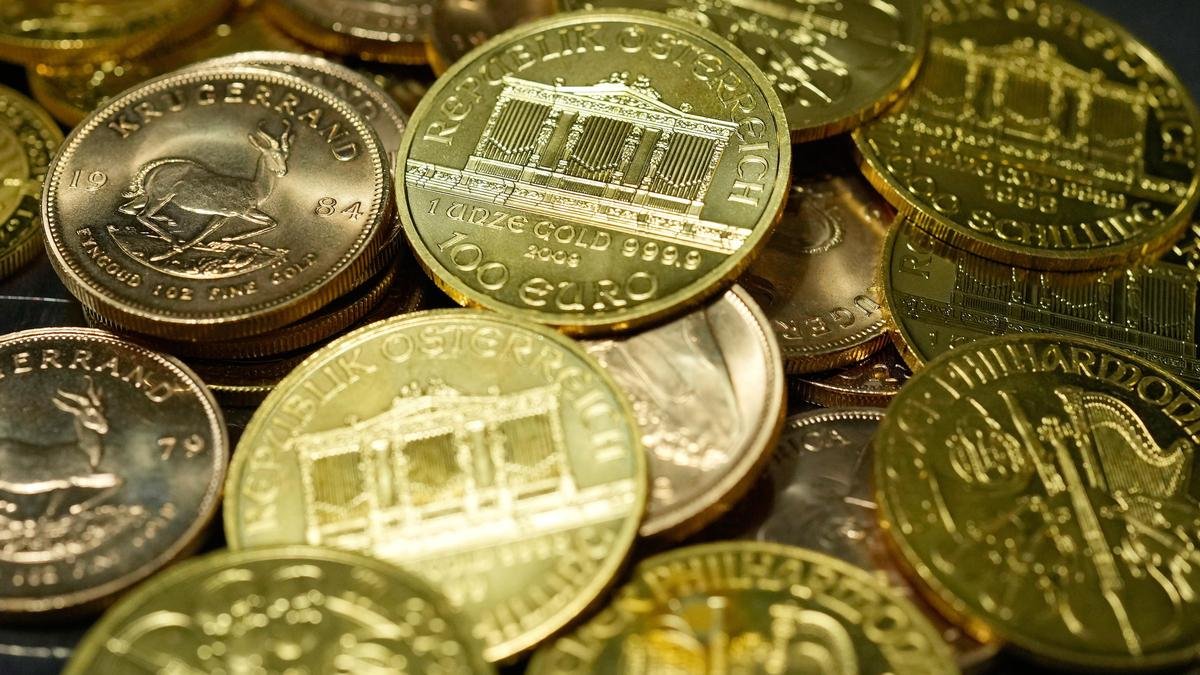
FILE – 1 Ounce Fine Gold Coins are displayed in the safe deposit boxes room at the Pro Aurum gold house in Munich, Germany.
| Photo Credit: AP
Gold (Aurum or Au) is a chemical element on the periodic table, and a metal known for its bright yellow colour and shine. A natural occurrence in use since ancient times, it has been considered precious by people for a long time. And the reason for that lies in a unique alloy (mixture of metals) of science, history, and human belief.
Gold bars
| Photo Credit:
Getty Images/iStockphoto
Science
There are various factors that make gold the precious metal it is. Let’s go through them.
Rarity: Gold is very hard to extract and produce, and occurs very rarely, only forming during neutron star collisions and supernovae (the colossal, luminous explosion of a star during its final evolutionary stages). This limited supply made it a precious metal, much like any limited edition goodies you might want to get your hands on.
Durability: Unlike other metals, gold doesn’t rust, corrode, or tarnish. At worst, it may lose its lustre, but that can be regained by polishing it. It is also highly malleable (can be bent without cracking) and ductile (can be stretched into thin wires without getting fractured). It is also non-reactive, remaining unresponsive to even water and air.
Economic safety: When currencies or stocks reduce in value, gold acts as a backup as it retains value, providing security during times of inflation and economic uncertainty. It can also be liquidated (converted to cash) easily.
Industrial utility: This might sound hard to believe, but hear us out. Gold finds its way into industries such as aerospace, electronics, and even medicine. Gold is also an excellent conductor of electricity.
Bars of gold and silver.
| Photo Credit:
Getty Images/iStockphoto
Historical significance
Gold was first smelted in Egypt around 3600 B.C. Egyptians would describe it as something which was “more plentiful than dirt”. But, what makes it so precious is something shaped less by belief and more by circumstance. It became a reliable store of wealth and could also be transported across long distances without loss, making it ideal for expanding trade networks. By the medieval period, it became an essential part of transcontinental commerce, linking various countries across the globe. Notably, in the 14th Century, the Empire of Mali in West Africa, controlled some of the richest gold sources. And with a man named Mansa Musa, came some big-time disruption in its value. During his pilgrimage, he distributed so much gold across Cairo, that demand surpassed supply. The abundance of gold only dropped its market value. Eventually, the price rose, and purchasing power fell, changing the value of gold for a very long time. Even today, the value of gold fluctuates with scarcity, circulation and control.
Some fine jewellery.
| Photo Credit:
Getty Images
The gold standard
The gold standard was a monetary system that tied the value of a country’s economy to gold. It was established in 1821 after Napoleonic wars and was formalised by the U.S. in 1900. Several countries fixed the value of their currency to gold, which meant that paper money could be exchanged for the precious metal and economic growth was tied to the amount of gold reserves. This gave countries like U.S. and France a huge advantage as they had large gold reserves to spare. Its preciousness was no longer based solely on scarcity, but on its role as a guarantor between nations. Its usage eventually declined with global conflict and economic crises.
All in all, gold is valuable not just because it’s rare, but because humanity believes in it. All that glitters may not be gold, but there’s no denying just how valuable it is.
Published – February 18, 2026 12:50 pm IST


