



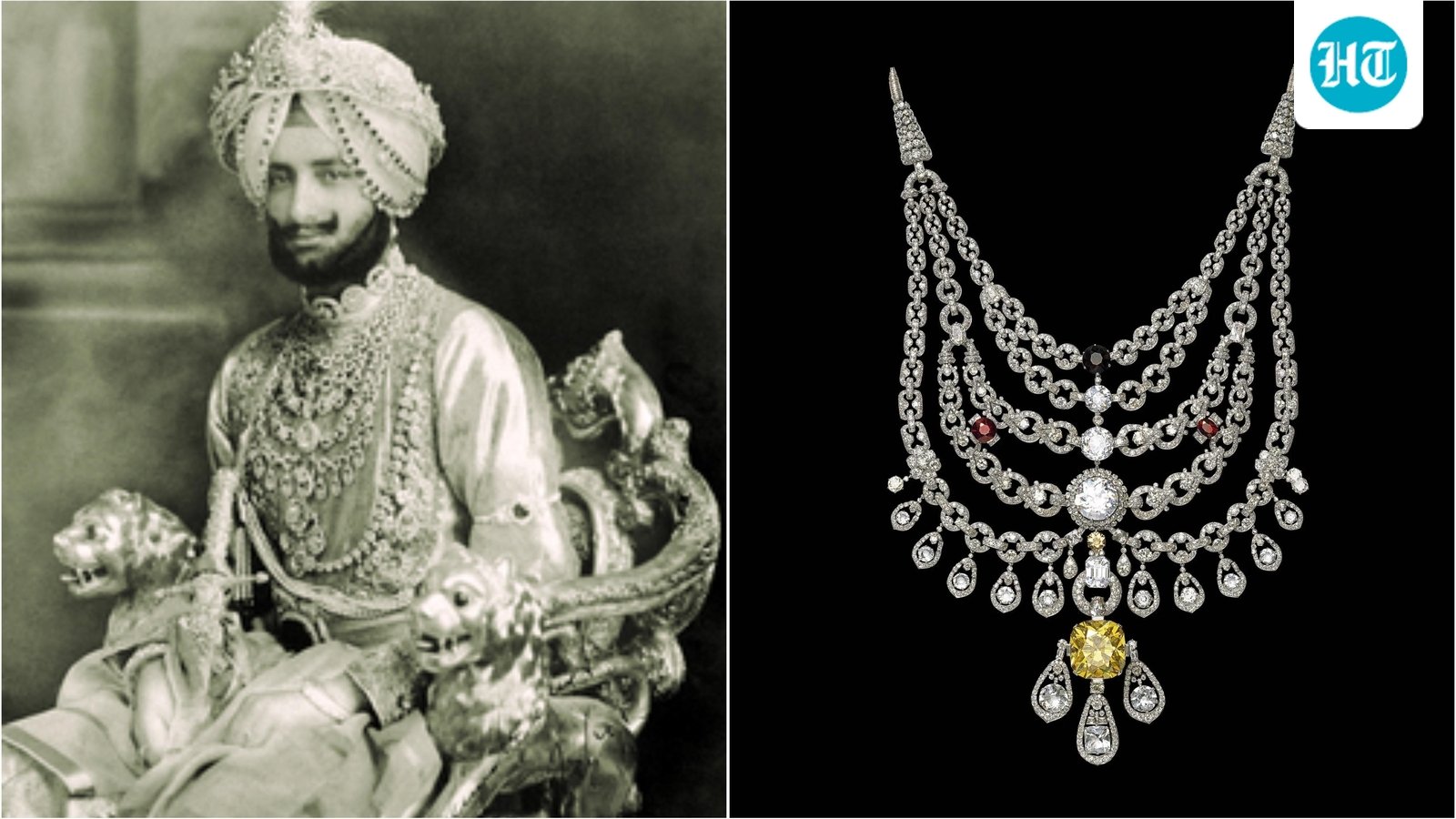
For Friday Fashion Flashback, we revisit the fashion moments, extraordinary creations and stories that have stood the test of time. This week, we travel back to the royal courts of Patiala and the extraordinary world of Maharaja Bhupinder Singh, whose love for jewellery, luxury and grandeur resulted in one of the most spectacular creations in Cartier’s history, the legendary Patiala Necklace. (Also read: Friday Fashion Flashback: This ‘world’s most expensive silk saree’ features 11 Raja Ravi Varma paintings, gold, diamonds )
The Maharaja behind the legendary necklace
Maharaja Bhupinder Singh became the ruler of Patiala in 1900 at the age of nine and reigned until 1938. According to Cartier‘s own historical archive, he was among the most extravagant Indian princes and became one of the French jewellery house’s most significant clients. Cartier’s history of Maharaja Bhupinder Singh
His relationship with Cartier went far beyond buying individual pieces. Christie’s notes that Bhupinder Singh frequently travelled to Paris with trunks of diamonds and gemstones from his treasury for Cartier’s workshops, where the stones were reset and redesigned into elaborate jewels.
One of the most ambitious creations to emerge from this relationship was the legendary Patiala Necklace.
2,930 diamonds and a 234.65-carat centre stone
Commissioned in the 1920s and completed in 1928, the Patiala Necklace was an extraordinary Art Deco jewel created by Cartier for the Maharaja.
According to Christie’s, Bhupinder Singh inherited some of the most important gemstones in the Patiala treasury, including the enormous De Beers yellow diamond, which he later had mounted by Cartier as the centrepiece of the Patiala Necklace.
The necklace contained 2,930 diamonds, with the stones weighing nearly 1,000 carats in total. At its centre was the 234.65-carat De Beers yellow diamond, which was considered one of the world’s largest diamonds at the time.
The spectacular jewel was built in multiple layers of platinum-set diamonds and incorporated other precious gemstones, including Burmese rubies.
Christie’s describes Bhupinder Singh as a key patron of leading European luxury houses and notes that he preferred platinum over gold for his jewellery commissions. The scale of the necklace was extraordinary even by the standards of Indian royal jewellery. It was not merely an accessory but a dramatic expression of royal wealth, status and the Maharaja’s taste for excess.
The necklace that disappeared
The Patiala Necklace’s story became even more fascinating after the Maharaja’s death. The original necklace eventually disappeared from the Patiala royal treasury. When surviving portions resurfaced decades later, several of the necklace’s most valuable stones were missing.
According to Cartier’s historical account, parts of the necklace were recovered in the late 20th century, but the original piece had lost many of its principal gemstones. Cartier subsequently restored the surviving sections, replacing missing stones with replicas and other substitute gems. Cartier’s historical account of the Patiala Necklace
The disappearance added another layer of intrigue to an already extraordinary jewel: a necklace created from the treasury of one of India’s wealthiest princely states had effectively been broken apart.
From Maharaja’s jewellery box to Met Gala
Nearly 100 years after Bhupinder Singh commissioned his famous necklace, its visual legacy returned to the world’s biggest fashion stage.
For his 2025 Met Gala debut, Diljit Dosanjh embraced the look of a modern Punjabi royal in a custom ivory-and-gold ensemble by Prabal Gurung, featuring a jewel-studded turban, a cape embroidered with the map of Punjab and Gurmukhi script, and a lion-headed kirpan.
His jewellery carried a strong link to Patiala’s royal history. Vogue India reported that Dosanjh wore a layered jewellery set by Golecha Jewels, designed to emulate Maharaja Bhupinder Singh’s iconic Patiala Necklace by Cartier. Vogue India
Importantly, Dosanjh did not wear the original Cartier necklace. Instead, Golecha Jewels created a contemporary interpretation inspired by the historic piece.
The Patiala legacy in global fashion
The Patiala Necklace is part of the larger relationship between Indian royalty and European jewellery houses in the early 20th century. Christie’s describes Bhupinder Singh as one of Cartier’s important Indian clients, noting that he brought trunks of gemstones from his treasury to Paris to be transformed into elaborate jewellery.
Another creation from this association was the Patiala Ruby Choker, made by Cartier in 1931 using Burmese rubies, pearls and diamonds set in platinum. According to Christie’s, the piece has been displayed at institutions including the Victoria and Albert Museum in London and The Metropolitan Museum of Art in New York.
Nearly a century later, Dosanjh’s Met Gala appearance gave this royal jewellery legacy a contemporary global spotlight.
Stay tuned for next week’s Friday Fashion Flashback, as we uncover another fascinating story from the world of fashion, heritage and style history.


