






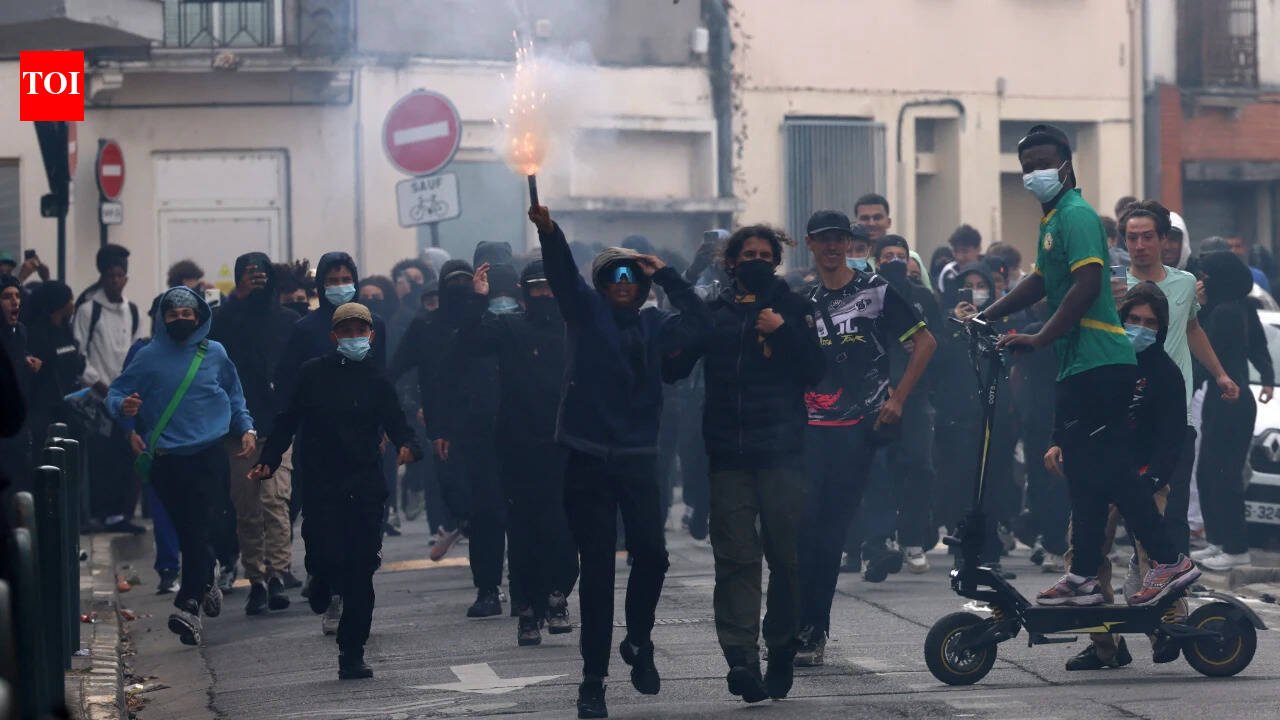
French protests continued to escalate on Friday, with around 400 schools and other educational establishments expected to remain closed as high school students blocked access to buildings, clashed with police and, in some cases, set fires.The movement, which began in the Paris region last month over teacher shortages, long school hours and poor building conditions, has spread nationwide. The protests have increasingly turned violent, with dozens of people injured and around 2,000 people taken into police custody since the unrest began, Justice Minister Gerald Darmanin said.“There is an active and violent minority (participating in the protests) … We’re not entirely sure that they are even high-school students themselves,” Darmanin told RTL radio on Friday.“We have gone from high-school student demonstrations to a public-order disturbance. When people target buses and set schools on fire, it is no longer simply a protest issue,” he said.Education minister Edouard Geffray said on Thursday evening that “a little over 400 schools and other educational establishments” would remain closed on Friday. On Friday, he said that nearly 400 high schools out of the 3,700 in France were expected to be closed.The protests have been driven by students in their final years of schooling, who have complained that school hours are excessively long, classrooms are inadequately equipped, including being overheated, and staff absences are too frequent.The government has acknowledged the grievances but condemned what it described as “urban violence”.In Paris on Friday, fire damaged the entrances of two high schools — Leonard de Vinci in the south of the city and Gaston-Bachelard in the southeast — with firefighters called to extinguish the blazes, an AFP photographer reported.Geffray said the legitimate concerns of students were being overshadowed by violence.“The high school student movement is being held hostage by ultra-violent fringe groups,” he said, adding that at least 65 staff members, including 40 high school principals, had been injured since the movement began. Around 170 students had also been wounded, while more than 100 high schools had suffered “severe damage”, he told BFMTV.“Parents must clearly step up and tell their children not to go” to the protests, Geffray said. “What matters now is ensuring our children are no longer out on the streets, because they are in danger.”Darmanin said he had asked prosecutors to hold parents liable for damage caused by their children during the protests and “pay for repairs”. Around 2,000 people have been taken into police custody since the movement began, he told RTL, with “90 percent of whom were minors”.The protests have also led to confrontations between students and police. Students have accused officers of using excessive force, including the use of tear gas to disperse demonstrations.In the western city of Rennes, tension was reported outside the Jean-Mace high school, where students dressed in black and wearing balaclavas gathered near a heavy police presence.“As far as we’re concerned, we’ve won — our school is closed this morning,” 16-year-old student Lola, who declined to give her last name, told AFP.She also criticised the police response, saying: “It makes us even angrier — the police have no right to hit us or use tear gas on us.”Police used tear gas at the Kerichen high school in Brest, in western France, an AFP photographer reported.The unrest has also taken on a political dimension, coming just over half a year before France’s presidential elections. The government has accused the hard-left France Unbowed (LFI), whose leader Jean-Luc Melenchon is again standing for the presidency, of being behind the movement.Senior LFI official Manuel Bompard rejected the accusation, accusing the government of “descending into conspiracy theories”.As authorities seek to contain the unrest, Geffray said he would meet education unions and high school student associations on Friday to seek common ground for dialogue.


