



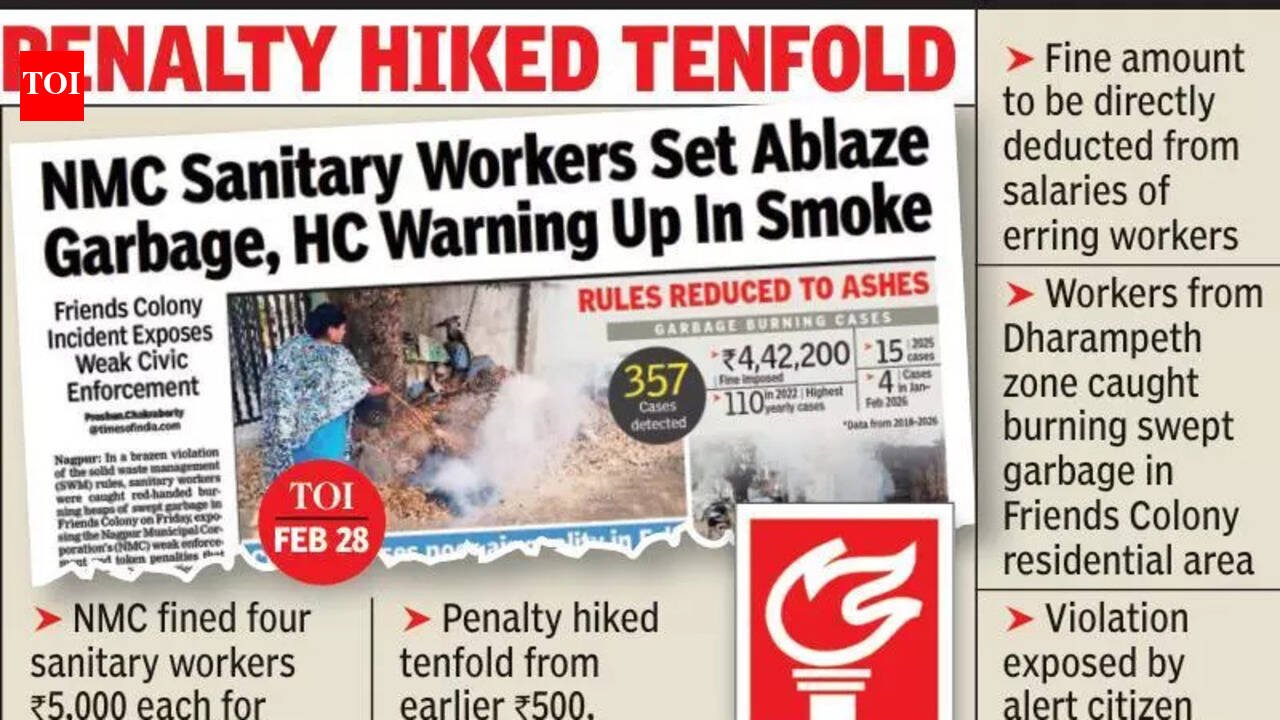
Nagpur: Acting swiftly after a TOI report about the rampant garbage burning by sanitary workers in its Feb 28, 2026 edition, the Nagpur Municipal Corporation (NMC) imposed a Rs5,000 fine each on four sanitary workers for burning garbage — a tenfold increase from the earlier penalty of Rs500.For years, sanitary workers caught burning garbage were let off with a nominal Rs500 fine, even as ordinary citizens faced a Rs5,000 penalty for the same offence under the solid waste management (swm) rules. The disparity raised serious questions about double standards within the enforcement system.Taking cognisance of TOI report, the solid waste management dept not only penalised the erring workers but also revised its fine structure bringing it on a par with that imposed on the general public.Chief sanitation officer Dr Gajendra Mahalle confirmed the development. “Henceforth, fines for burning garbage will be uniform for all. There will be no distinction between sanitary workers and citizens. The fine amount will be deducted from their salaries,” he said, signalling a tougher stance.The four sanitary workers — Gajra Gause, Bharti Bagde, Saroj Khare and Sunanda Khobragade — are attached to Dharampeth zone. They were caught red-handed burning heaps of swept garbage in prabhag 11 of Friends Colony by alert citizen Yogita Khan, who immediately flagged the violation.As per civic norms, sanitary workers are required to sweep their designated stretches and put the collected waste at specified lifting points, from where it is transported to authorised processing facilities. Instead, the workers allegedly set the garbage ablaze, releasing toxic fumes into a residential locality.The incident once again exposed how burning is often used as a shortcut to avoid the logistical effort of waste transportation.While the imposition of Rs 5,000 fine marks a significant policy shift on paper, questions remain over consistent enforcement. Garbage burning has long been described by officials themselves as “rampant” across city limits, yet only a fraction of cases are formally booked. Whether this crackdown continues beyond media glare will determine if the move translates into real deterrence on the ground.


