



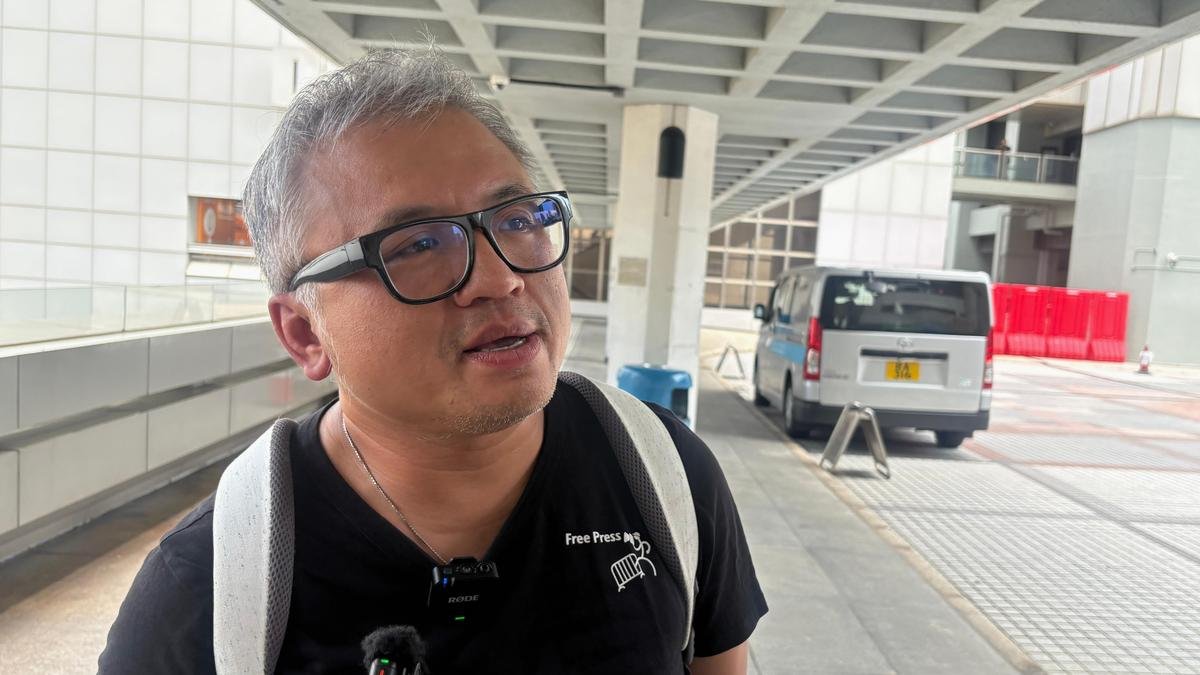
Ronson Chan, ex-chairman of the Hong Kong Journalists Association, speaks to reporters outside the High Court in Admiralty in Hong Kong before a ruling on his appeal against his conviction for obstructing a police officer, on May 29, 2026.
| Photo Credit: AP
A prominent Hong Kong journalist began serving a five-day prison sentence on Friday (May 29, 2026) after losing an appeal against his conviction for obstructing a police officer in a case that sparked concerns about the city’s declining press freedom.
Hong Kong was once a bastion of media freedom in Asia, but news outlets have been forced to close, several journalists have been arrested and those still working are operating in a narrower space since authorities began cracking down on activist voices following the mass pro-democracy protests in 2019.
Ronson Chan, a former chairman of the Hong Kong Journalists Association, was arrested in September 2022 on his way to a reporting assignment. He was accused of refusing to show the plainclothes officer his identity card upon request.
A lower court sentenced Chan to five days in prison in 2023, ruling that he had failed to take out his identity card in a timely manner and kept asking the officer questions “recklessly.” He appealed the decision and was granted bail.
Deputy High Court Judge Lily Wong upheld Chan’s conviction and sentence Friday and ordered him to be sent to prison.
Ahead of the hearing, Chan, who wore a black T-shirt printed with the words “Free Press,” told reporters that he felt uneasy and complex.
He said he stayed in Hong Kong to continue to pursue his journalism career because press freedom was promised by the city’s mini-constitution, the Basic Law.
“If I end up losing today, I feel it would be quite a big irony for me personally,” he said.
In the crackdown following the 2019 protests, two vocal Hong Kong media outlets — Apple Daily and Stand News — were forced to shut down in 2021.
Two former top editors at Stand News were convicted of conspiracy to publish and reproduce seditious publications in 2024. One of them was sentenced to 21 months in prison.
In February, Apple Daily founder Jimmy Lai was sentenced to 20 years in prison after being found guilty of conspiracy to collude with foreign forces and conspiring with others to publish seditious articles.
Six other newspaper staffers, who were also convicted under a national security law like Lai, received jail terms ranging from six years and nine months, to 10 years.
In other newsrooms, journalists are facing more red lines and increasing self-censorship. The erosion of press freedom parallels a broader curtailment of Western-style civil liberties in the former British colony, which returned to China’s rule in 1997.
The Hong Kong government insists the security law is necessary for the city’s stability.
The city ranked 140th out of 180 countries and territories in Reporters Without Borders’ latest World Press Freedom Index.
Published – May 29, 2026 02:38 pm IST


