



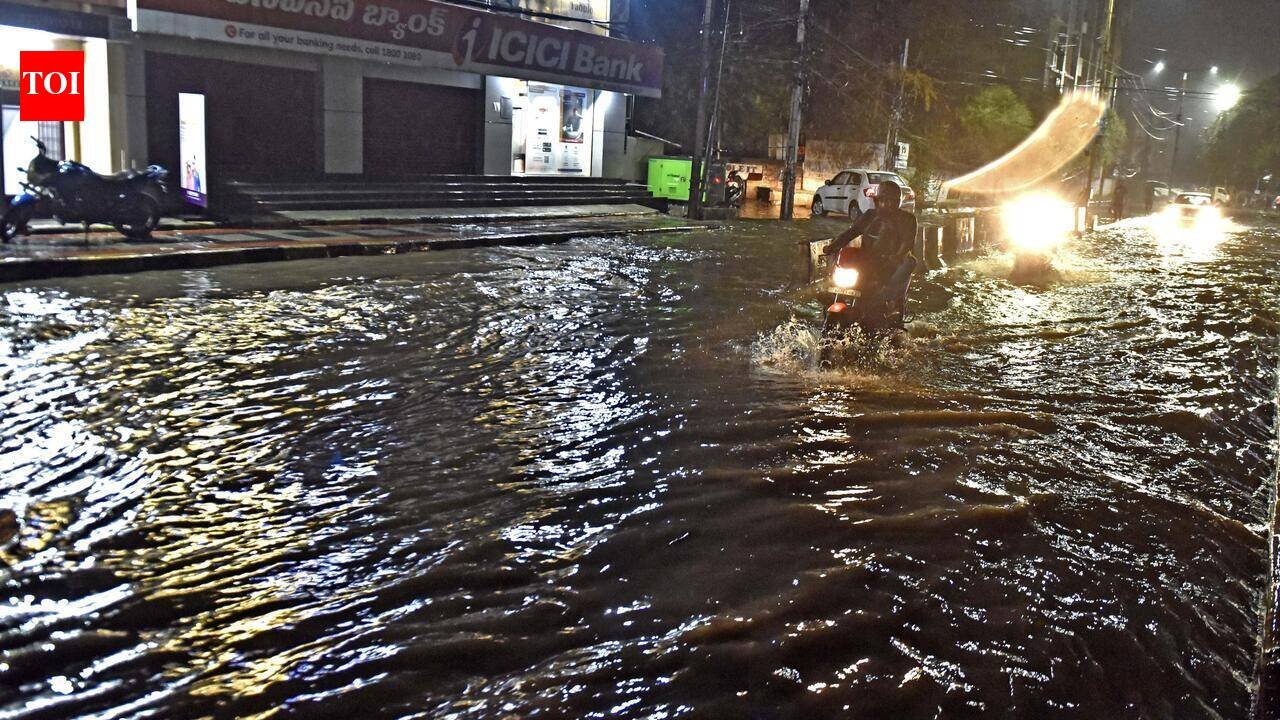
Hyderabad: Weather forecasts for Hyderabad are more reliable than those for many neighbouring districts, with a new study finding that the city’s rainfall patterns are among the easiest to predict in southern Telangana.The study, published in the Springer Nature journal ‘Discover Hazards‘, analysed 43 years of daily rainfall data (1981-2023) across 12 districts in southern Telangana using advanced statistical methods and explainable artificial intelligence (XAI). Apart from examining rainfall variability and extreme weather events, the researchers assessed how accurately rainfall can be forecast in each district.Hyderabad emerged as one of the best performing districts, consistently recording high forecast accuracy. Researchers found that the city’s rainfall closely mirrors weather patterns in neighbouring Rangareddy and Medchal Malkajgiri districts, giving it one of the highest rainfall synchrony scores (0.69) in the study.According to the researchers, this strong regional coherence allows weather models to track monsoon systems more effectively, leading to more dependable rainfall forecasts.Machine learning models used in the study also showed Hyderabad had one of the lowest median forecast errors — about 12 mm. In practical terms, predicted rainfall was generally within 12 mm of the actual rainfall received, reflecting a relatively high level of forecast accuracy.The city also recorded a prediction interval coverage probability (PICP) of more than 92%, meaning forecast models successfully captured the actual rainfall within their predicted range in more than nine out of every 10 instances.Another key measure, the continuous ranked probability score (CRPS), placed Hyderabad among the top performing districts. A lower CRPS indicates that forecasts not only predict rainfall accurately but also estimate uncertainty more realistically, making them more useful for operational weather services.Researchers attributed Hyderabad’s stronger performance to the nature of its rainfall. Unlike districts that often experience isolated thunderstorms, the city’s rainfall is largely driven by organised southwest monsoon systems that extend across the Hyderabad metropolitan region. These broader weather patterns are easier for forecasting models to simulate and predict.The study also sheds light on Hyderabad’s rainfall profile. Based on IMD data from 1981 to 2023, the city receives an average annual rainfall of 1,184.8 mm, making it one of the wetter districts in southern Telangana. The bulk of this rainfall occurs during the southwest monsoon season between June and Sept.However, the researchers cautioned that better forecasts do not necessarily mean lower risk.Their analysis shows that Hyderabad remains vulnerable to rare but intense rainfall events capable of triggering severe urban flooding. With rapid urbanisation replacing natural drainage channels with built-up areas, even accurately forecast heavy rain can lead to widespread waterlogging and flash floods if stormwater infrastructure is inadequate.The authors said the findings could help improve urban flood management, reservoir operations and weather advisories. More importantly, the study underscores that forecast confidence varies significantly across districts.While Hyderabad’s rainfall can be predicted with comparatively high reliability, districts with weaker rainfall synchronisation and greater variability may require more frequent forecast updates and denser weather observation networks.The researchers said incorporating district-level forecast skill into operational weather services could help authorities provide not only rainfall forecasts but also an assessment of forecast confidence, enabling city planners, disaster managers and residents to make better-informed decisions ahead of heavy rainfall events.


