



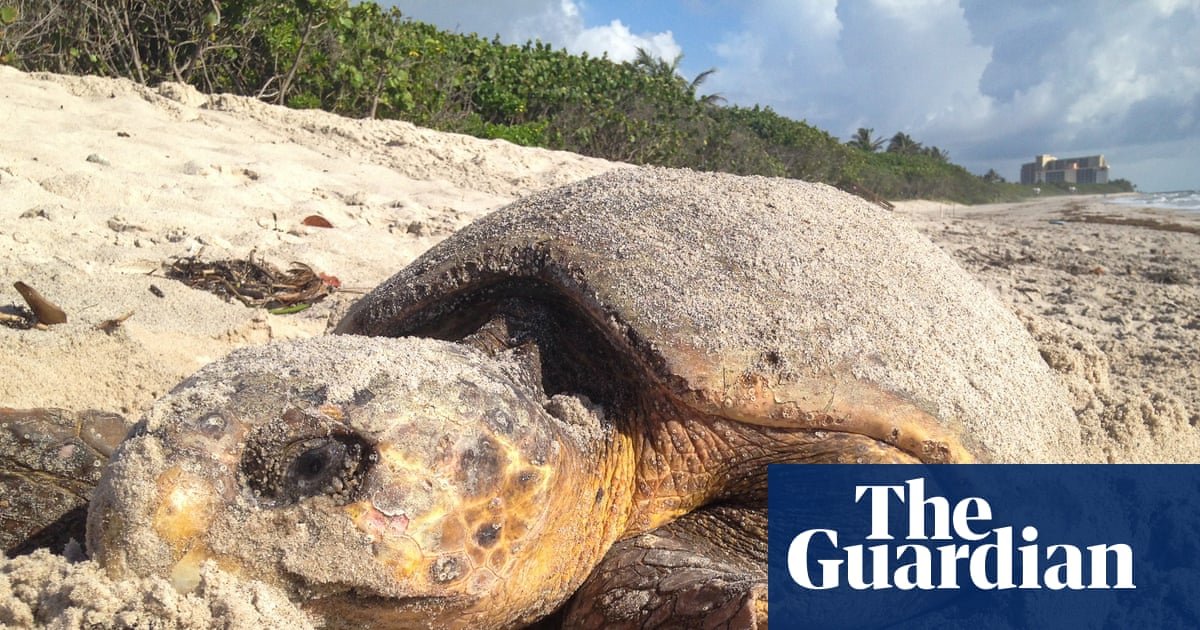
Wildlife groups in Florida are celebrating record numbers of sea turtle nests this season, but experts warn Donald Trump’s recent gutting of the Endangered Species Act (ESA) could reverse decades of their recovery from the edge of extinction.
With more than two months of the summer nesting season still to run, loggerhead turtles have already laid 13,770 nests, hundreds more than recorded in any previous year, along an 8.5-mile stretch of shoreline monitored by the Loggerhead Marinelife Center in Juno Beach, on Florida’s Atlantic coast.
The same record has fallen on Sanibel island, on the Gulf coast, where loggerheads have laid 922 nests so far this year, surpassing the 2023 total of 878, according to the Sanibel-Captiva Conservation Foundation.
The numbers reflect the ongoing revival of sea turtles since the 1970s, when overhunting, poaching and habitat loss pushed several species to the brink, including the loss of about 95% of the Caribbean’s population of green turtles.
The ESA, passed in 1973, enshrined protections that are paying dividends now because sea turtle hatchlings take years to decades to reach reproductive age. The loss of those safeguards, from Trump’s “death sentence” repeal last month of sections of the law to favor oil drilling, mining, logging and development interests, have some experts fearful that the recovery might have reached the high-water mark.
An alliance of environmental and wildlife groups is suing the Trump administration in part over a rule giving outsized deference to “economic considerations” when determining protections for endangered species and critical habitat.
“What we’re seeing is the result of several decades of sustained protection of these species under the ESA and various other measures to protect their habitat in different ways,” said David Godfrey, executive director of the Sea Turtle Conservancy, an advocacy group that is not a plaintiff in the lawsuit, but is supportive of it.
“It takes just about any species of sea turtle 20, 30 years to reach maturity, to come back and nest, to return to beaches where they were first protected as eggs or as hatchlings and afforded the opportunity to live without ending up in a fisherman’s net and on a table in a nice restaurant.
“So the recovery’s going on largely due to the ESA, which is one of the reasons why we’re all very concerned about the setbacks to the legislation.”
The ESA is credited with safeguarding more than 1,700 species and their habitats, preventing 99% of those listed from going extinct.
Godfrey said: “The detractors of the ESA sometimes say, ‘Oh, this thing is a failure. Look at all these animals that are still on the list. We haven’t removed a lot from the list.’ And I come right back and say, yeah, but look at all these animals that are on the list that we haven’t lost.
“They were put on the list because they were creeping toward extinction, and sea turtles certainly are still here because of the act and they are growing in numbers.
“The levels of nesting numbers of turtles aren’t quite where we would want them to be to completely take them off the list, but they’re going in that direction unless we reverse things.”
Justin Perrault, vice-president of research at Loggerhead Marinelife Center, said this year’s elevated nesting figures were the result of the years of those protections, as well as favorable environmental conditions, reduced pollution and education around marine conservation.
“It’s incredibly exciting and encouraging because the world needs some good nature stories, and it’s important to celebrate that we are doing some things well,” he said.
after newsletter promotion
“Being a mother sea turtle is very difficult, they do all the work, they don’t lay just one nest every season, they lay multiple nests, and that is very energetically costly and they usually take about two, three or four years off in between each time they come back to nest.
“And we are seeing increases across the years right now. We’re still cautiously optimistic about saying that they’ve recovered, but we can say stability.”
His center, a marine life hospital that treats and rehabilitates sick and injured turtles, has partnered with numerous groups and organizations around the country to share research data and collaborate on education efforts.
One of its most successful projects has been the Responsible Pier Initiative, in which anglers in particular are equipped with knowledge and tools to rescue stranded or injured turtles, or those entangled in fishing lines.
To date, 79 piers around the country, including in Virginia, Texas, North Carolina and Puerto Rico, have signed up, and more than 1,200 turtles have been rescued.
Valerie Tovar, the center’s conservation manager, said the program had saved the lives of multiple species of sea turtle.
“We’ve seen loggerheads, green turtles, olive ridleys, hawksbills,” she said. “We had two reports of hooking a leatherback sea turtle, and obviously that line broke very quickly, they’re massive animals.”
As well as the pier initiative and establishing protection zones, Tovar said other conservation projects under way, or planned, can help further fuel the sea turtles’ recovery.
“We’ve expanded our horizons. We’re getting into the world of water quality, habitat restoration, and outreach and advocacy, to really find the connections between water quality, human health and sea turtle health,” she said.
Perrault said that, as a conservation organization, Marinelife does not comment on politics or policies. But he said: “We support the Endangered Species Act here, and we believe in the Endangered Species Act.
“Every single animal we take into this facility is on the endangered species list so obviously we believe that the animals should be protected and continue to be protected in the ways that they have been since the ESA was enacted.”
He also pointed to Florida state regulations still in place that he said were “beneficial”.
“We’re starting to see record years more often, and that’s incredibly encouraging,” he said.


