






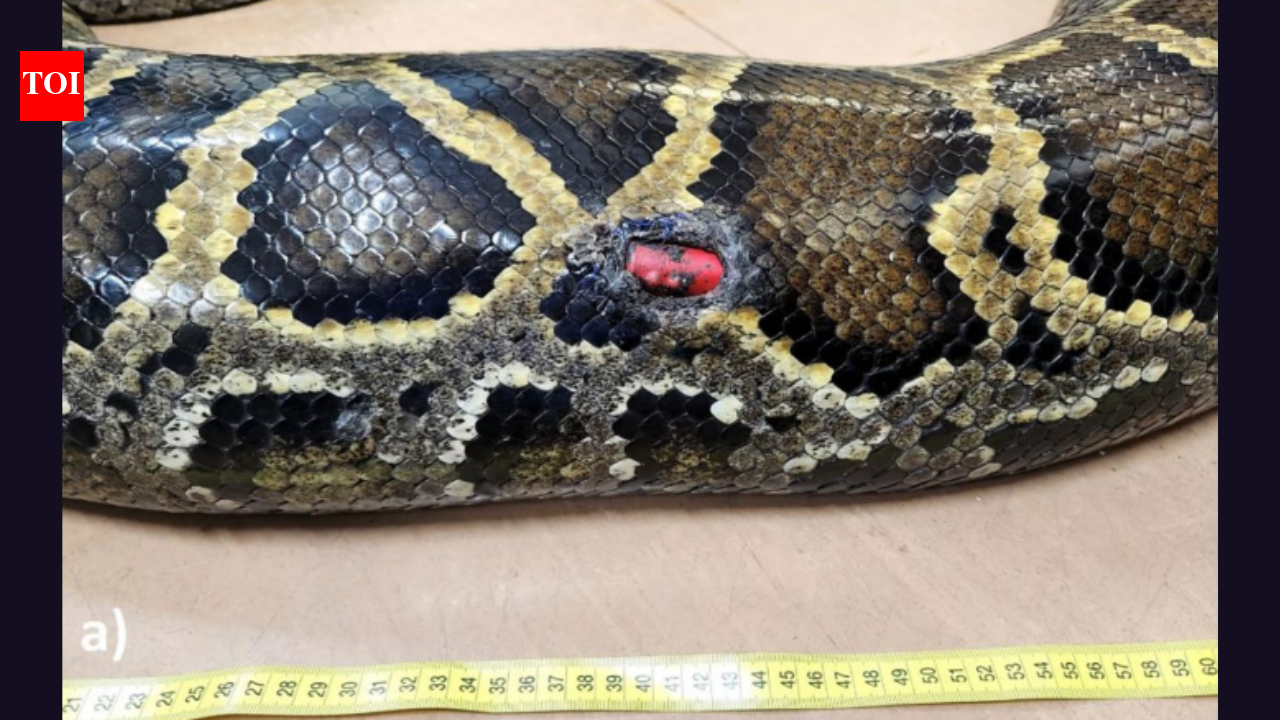
Scientists tracking invasive Burmese pythons in southern Florida recorded four cases of implanted tracking devices being expelled during a study spanning 2005 to 2024. The study examined 305 transmitters implanted in 142 adult snakes across Big Cypress National Preserve and Everglades National Park. According to the report published in the Journal of Animal Biotelemetry, titled ‘Case report: observations on expulsions from 20 years of radiotransmitter implantation in adult Burmese pythons’, the research found that all four expulsions involved gravid females with intramuscularly implanted transmitters. No transmitter-related deaths were observed. The researchers also examined whether reproduction and implantation methods could influence device retention, noting that both surgical techniques were effective for monitoring adult pythons.
How many Burmese python tracking devices were expelled in Florida
Of the 305 transmitters implanted during the study, 221 were placed intramuscularly, while 84 were positioned inside the coelomic cavity. The researchers reported that four transmitters were expelled, representing 1.3% of the total. All four cases involved intramuscularly implanted transmitters in gravid females, meaning females carrying developing eggs. No transmitter-related deaths were observed among the study animals.The four expulsions occurred in females that had received their implants in late January or early February, during the breeding season, which runs from December to March. The devices were expelled before the females laid their eggs. The researchers recorded the expulsions between 57 and 111 days after surgery, with a reported mean of 101 days. The paper’s abstract summarised the findings: “Overall, 98.7% of transmitters were retained, with a 1.3% expulsion rate (n = 4 transmitters).” The researchers also reported that the four cases occurred among 13 gravid females in the relevant group, while other gravid females retained their transmitters and subsequently laid clutches of eggs.
PC: Case report: observations on expulsionsfrom 20 years of radiotransmitter implantationin adult Burmese pythons
How did four Burmese pythons lose their implanted tracking devices
The paper describes four individual cases involving female pythons in Big Cypress National Preserve. In the first case, a female measuring 414 centimetres in snout-to-vent length and weighing 42 kilograms received two transmitters on 26 January 2006. When researchers recaptured her on 17 May that year, she had a clutch of 46 eggs, and one transmitter was lying on the ground nearby. Both devices had been detected at her previous location two days earlier. An examination found no abscesses or skin wounds, leaving the mechanism of expulsion unknown. The researchers recorded the event 111 days after surgery.The other three cases involved females implanted in January or February 2022. In one case, a female measuring 450 centimetres and weighing 81.2 kilograms had a transmitter visible through an open skin abscess on 1 April, approximately 80 days after implantation. The animal was removed from the field for surgery as the abscess enlarged. A replacement transmitter was implanted on 29 April, and the female laid 81 eggs on 23 May. In the fourth case, a female measuring 441 centimetres and weighing 73.6 kilograms had a transmitter visible through an open abscess on 1 April, 57 days after surgery. The transmitter was replaced on 29 April, and the python laid 96 eggs between 21 and 23 May. The researchers also documented an earlier case in which a transmitter was partially expelled through an open skin abscess 155 days after surgery. These observations show that the circumstances surrounding expulsion differed between individual snakes, including whether an abscess or visible wound was present.
Why might pregnant Burmese pythons be more likely to expel devices
The researchers said the low expulsion rate indicated that both intramuscular and coelomic implantation techniques were effective for monitoring adult Burmese pythons. However, they identified a possible association between transmitter expulsion and the reproductive status of females. In their discussion, they wrote: “This suggests that some gravid females may be at a higher risk for expelling transmitters, compared to males or non-gravid females.” They proposed that changes associated with reproduction, including possible changes in immune response and pressure within the body cavity, might contribute to the risk. These explanations were presented as possibilities rather than established causes.The study also found that all four expelled devices had been implanted intramuscularly. The authors suggested that placing transmitters inside the coelomic cavity might reduce the risk of expulsion in gravid females, but stressed that the number of recorded cases was small. They noted that the cause of expulsion could involve abscess formation at the incision site rather than the timing of implantation relative to egg-laying. Their conclusion stated: “We observed no mortality related to transmitter implantation and few instances of transmitter expulsion, indicating that both intramuscular and coelomic implantation techniques are effective for monitoring adult pythons in the wild.” The authors added that their findings may inform research on other large-bodied snake populations where radiotransmitter implantation is appropriate and feasible.


