



A 1931 photo of the Christ the Redeemer statue in Rio de Janeiro. Buckham had been commissioned by Fortune Magazine to capture photos from across the Americas. He travelled 19,000 miles from New York to Brazil to do so, flying over active volcanos and capturing spectacular images of mountains and monuments.
“This was an incredible feat for a man in his 50s who had a serious throat injury following the ninth crash of his military career,” says Louise Pearson, who is curator of an ongoing exhibition that showcases over 100 of Buckham’s images.
Buckham began his career as a photographer in London in 1905, after some failed experiments with painting. He survived nine crash landings as a pilot during World War 1, and served as the first head of aerial reconnaissance for the Royal Navy. He lived a life of adventure, dying in 1956, aged 76. The ongoing exhibition at National Galleries of Scotland marks 70 years since his death, and is titled Alfred Buckham: Daredevil Photographer.
Above, a 1920 photo shows Lochleven Castle, where Mary Queen of Scots was imprisoned in the 1500s.
The active volcano Popocatepetl sends up smoke in Mexico, in an image taken in the 1930s. “As if resentful of being photographed, (it) suddenly cast a cloud of choking, sulphurous gas upon us, an unpleasant experience which engendered greater caution in the next approach,” Buckham told The Morning Post, describing the shoot.
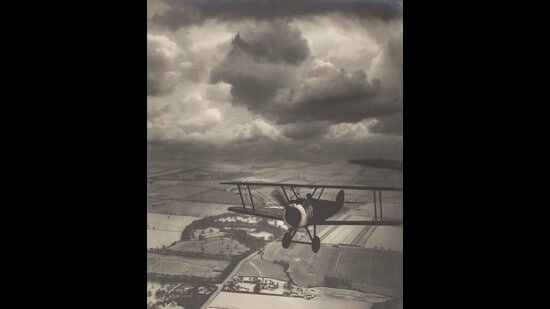
Buckham made effective use of a technique called combination printing to add elements such as clouds or even a plane, from other negatives in the same reel. He would selectively print parts of a negative using an enlarger, then combine it with other prints, to create and recreate multiple versions of the same scene, each paired with a different sky or added element.
In the 1920 image of Edinburgh seen above, for instance, “through technical analysis, we see that he used a tiny pinprick to mark out where he would add the aeroplane. I like to think he was putting together a darkroom jigsaw,” says curator Louise Pearson.
A 1920 photo by Buckham of the R100, a British rigid airship that ferried passengers on long-distance commercial routes. “It’s a really interesting moment to study Buckham’s photographs because we are all becoming much more used to questioning what we see,” Pearson says. “However, I think he would have been horrified by AI. He only ever used his own negatives to create his finished prints.”


