



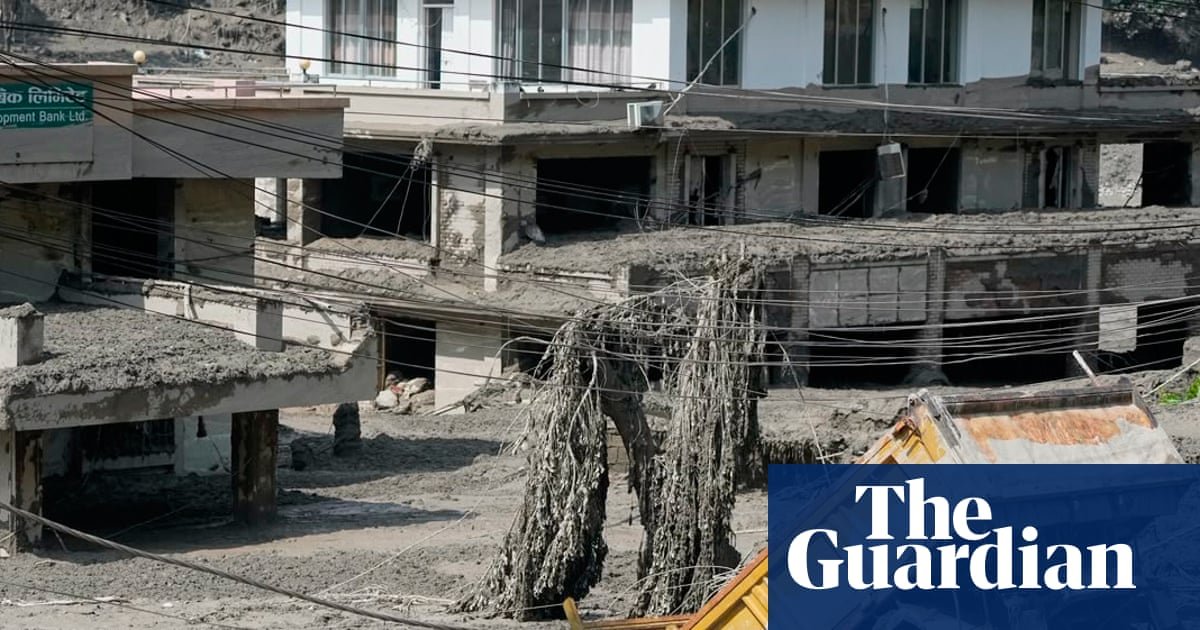
At least 98 people have died and hundreds are missing after flash floods hit the Himalayan border areas of Nepal and Tibet in China, with officials saying areas of India were also at risk.
The disaster was caused by a torrent of mud, water and debris that burst from the banks of a river that runs between China and Nepal. Homes, roads, bridges and power plants were swept away in Nepal, while officials in Tibet said they feared “major casualties”.
Authorities issued alerts urging residents in several districts to keep away from the Bhote Koshi, Trishuli and Narayani rivers in Nepal.
Officials in Nepal said 403 people, including 341 from foreign countries including India, the US, the UK, Australia, South Korea and Malaysia, had been reported missing in the country.
Nepal’s tourism board said more than 100 of those missing were religious tourists from India and the Indian diaspora on a pilgrimage to Mount Kailash in Tibet, a sacred site for Hindus. At least 62 missing Nepali citizens were among hundreds of locals trekking in Rasuwa, one of the worst hit districts.
In Tibet, China’s state broadcaster said at least three people were killed and 265 were missing.
Experts were still determining the exact cause of the disaster. The US Geological Survey reported a magnitude-4.4 earthquake in Nepal early Wednesday, near the border with Tibet. It is thought to have triggered a large chunk of ice to snap off from a glacier, which crashed into a mountain valley and caused a sudden downstream surge on the Lhende KholaRiver, a tributary of the Bhote Koshi.
Officials said the flooding could get worse because parts of the river remained blocked by ice rocks and debris.
Flood alerts were also issued in the Indian states of Bihar and Uttar Pradesh, which border Nepal and are downstream of the affected rivers.
Police in Nepal said they were still unable to assess the full scale of the damage. Rescuers said helicopters could not land in affected areas of Syapru Besi and Timure in the mountainous district of Rasuwa until the river waters had receded. Rescue efforts were also hampered by heavy monsoon rains.
Images of crumbled homes in the flood waters, floating cars and a metal bridge being washed away, and villages engulfed by water, mud and debris were broadcast on Nepali television.
“There could be heavy casualties or loss of property,” said the district administrator, Narendra Pariyar, who urged those living on the banks of the Bhote Koshi to move to higher ground.
“There is devastation everywhere we look,” said Tula Bahadur BK, a health worker in Rasuwa. “The settlements next to the river have been completely swept away. Five of my own relatives are missing.”
Nepal’s energy ministry said the country’s electricity supplies had been significantly affected, mostly as a result of destroyed hydroelectric plants.
Police and military officers joined in Nepal’s rescue effort, the country’s prime minister, Balendra Shah, said. “Instructions have been given … to move the people living in the lower areas to safer places. People along the river are advised to exercise extra caution and remain alert.”
The Indian prime minister, Narendra Modi, said he had spoken with Shah and offered Nepal “all possible types of humanitarian assistance”.
China’s official Xinhua news agency said the flash flood occurred on the Nepal side of the border and cut roads, communications and power links in the Shigatse region.
Chinese authorities were conducting large-scale search and rescue operations in the Tibetan border area of Gyirong, according to state broadcaster CCTV.
China’s president, Xi Jinping, urged “all-out” search efforts for the missing and better monitoring and early warning systems to prevent secondary disasters.
The Himalayan region, which spans Nepal, India, China and Bhutan, is particularly vulnerable to floods and landslides because it is warming faster than the rest of the world as a result of the climate crisis.
Research shows that extreme weather events such as heatwaves and torrential rains have become more frequent. Nepal’s snow-capped mountains had lost close to one-third of their ice in just over 30 years due to global warming, the United Nations said in 2023. Experts have called for greater surveillance and early warning systems across the Himalayan region.
Last year, a flood from the Bhote Koshi River killed nine people and washed away a “friendship bridge” linking Nepal and China, disrupting trade and transport for months.
Researchers in Kathmandu also found earlier this year that glaciers across the Hindu Kush region were melting at an accelerating rate. Ice loss rates have doubled since 2000.


