


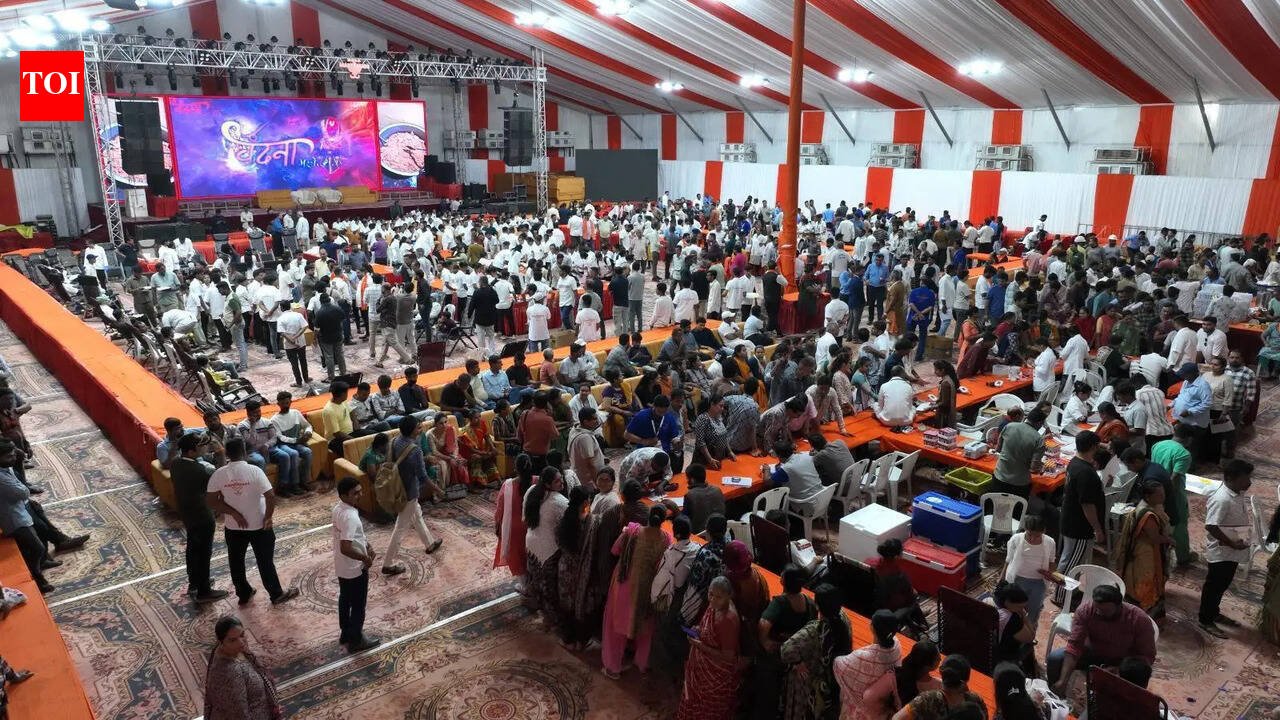
Ahmedabad/Surat: Compassion flows in the veins of Gujaratis, whose donations keep the state’s blood banks flush with lifesaving material — except in summer when the punishing heat makes it tough for donors to venture out.So, volunteer groups are trying to ward off any scarcity. Recently, the Bala Hanuman Group in Porbandar organized a camp at which 11,146 units of blood were collected. It was the highest for the organization, which has been holding such camps in March-April annually.Pradeep Goplani, a coordinator for the event, told TOI that in 2025, the collection was around 6,000 units.“Summer is often a difficult time for blood banks in the state as intense heat often prevents people from approaching blood banks or camps for donation,” he said. “Moreover, colleges have vacations and people travel.”Goplani said, “Thus, the idea was to mobilize as many people as possible for the cause.” He said the annual initiative is run by businessman Ketan Gajjar and others.The single blood camp has helped replenish stock in five districts of Gujarat, including Porbandar, Junagadh, Jamnagar, Rajkot, and Ahmedabad, where each district-based blood bank has received about 2,000 units each.For example, the Indian Red Cross Society (IRCS) Blood Bank in Ahmedabad received about 2,200 units from the camp.Several major camps have been held in the state with the express purpose of mitigating summertime shortages at blood banks. Each camp has collected more than 500 units.According to estimates, the collection in April-May nearly doubled from 12,000 units last year to 20,000 units this year.Dr Vishwas Amin, director of the IRCS Blood Bank in Ahmedabad, said that four camps have been held in the city over the past 20 days. He said banks, socio-religious organizations, and voluntary groups have collected 500 units each.“Ahmedabad requires about 12,000 units a month, and we supply about 5,000 units out of the total,” Amin said. “Ahmedabad is the blood donation capital of India with the highest concentration of Centurion blood donors and the highest per capita blood donation.”But to prepare for May, Amin said, “We have to ask people to donate blood systematically. For example, if one person is going to donate in March or April, we request him or her to donate in May.”He said, “For the past fortnight, we have been sending our vans even if five units of blood have to be collected. We have also started night collection of blood at our centre where a donor can walk in even at 10pm.”The primary requirement, said experts, is regular blood transfusions for children with thalassemia. Other units are utilized for medical procedures, including the treatment of road traffic accident victims and major operations.One of the reasons for the Porbandar camp to send blood all the way to centres such as Rajkot and Ahmedabad was the fact that often patients from Porbandar are shifted to these major centres for intensive care or operations.In other cities, too, the donation momentum is gathering pace. The Surat People’s Cooperative Bank (SPB) Ltd collected 1,468 units on April 21 from Surat, Bardoli and Vapi. Amit Gajjar, the SPB chairman, said that against the target of 1,000 units, the response was good. “Next year, we will target 3,333 units,” he said.Nitesh Mehta from Surat Raktadaan Kendra said that every summer, blood availability is an issue. “Police personnel of Zone III recently donated 773 units. Such major camps help manage the situation better,” he said.Surat-based diamond units have also donated about 960 units in camps organized by Lok Samarpan Raktadan Kendra (LSRK) over the past month. Jaysukh Jhalavadiya, the coordinator for LSRK, said that the camps’ timings are primarily associated with the summer shortage that they experience annually.Dr Nidhi Bhatnagar, professor and the head of the immunohematology and blood transfusion (IHBT) department at Civil Hospital in Ahmedabad, said that a training session was recently organized for students and doctors to manage the available blood.“The doctors were taught how to ensure optimal use through patient blood management (PBM), which includes early detection and treatment of anaemia to reduce the need for transfusion,” she said. “Also discussed were the focus on assessing bleeding risk with surgical and anaesthetic techniques, and improving patients’ tolerance to lower haemoglobin levels through optimized oxygen delivery.”
