


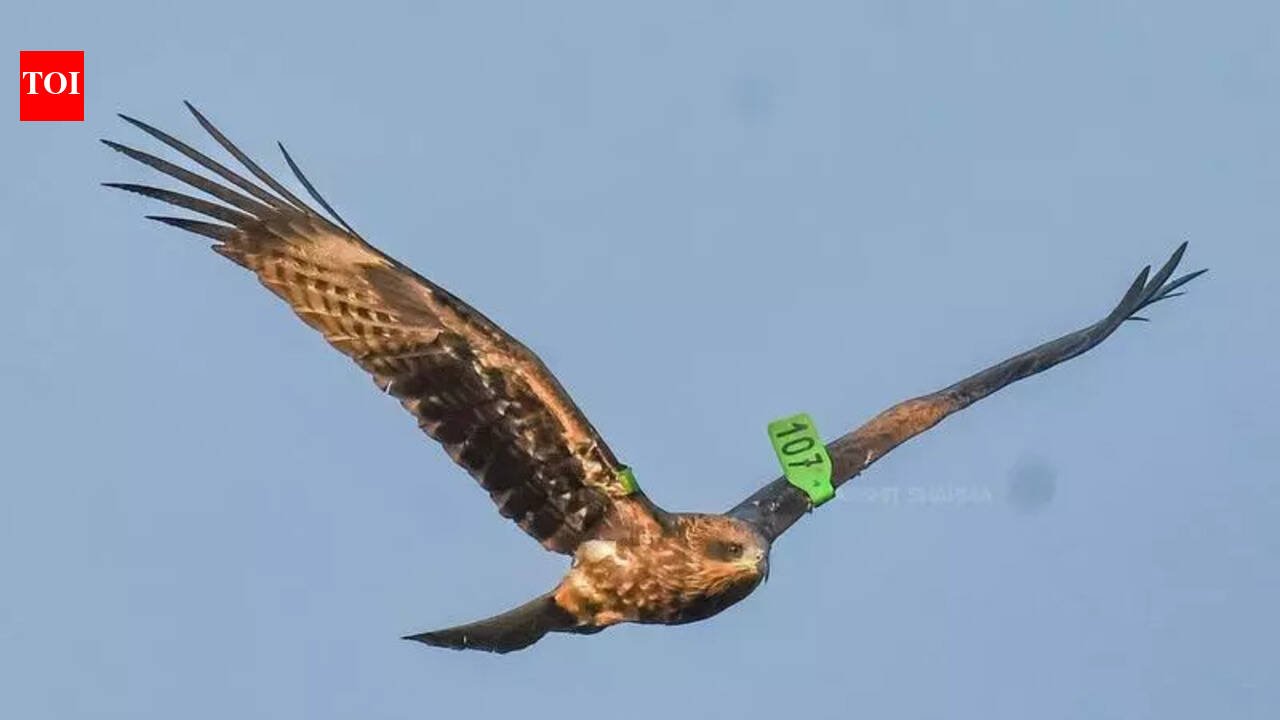
Jaipur: In a significant development for raptor research in the state, the first-ever wing-tagged Black Kite was recorded in Rajasthan, providing new scientific evidence about the species’ movement patterns and migratory behaviour.Though Black Kites are commonly seen and widely distributed across India as resident birds, conservationists said this was the first confirmed proof that some individuals visiting Rajasthan were migratory as well. Until now, no wing-tagged Black Kite was documented in the state, making this sighting a major milestone in avian monitoring.A forest official said, “The green wing-tagged bird (tag ID: 107) was recorded near Abheda Biological Park in Kota. The latest confirmed observation was made on Jan 18, at precise geographic coordinates 25°11’49.34” N and 75°47’10.02” E. Though in Jorbeer, Bikaner, ringed raptors in the leg are found, wing-tagged raptors were recorded for the first time.”Assistant foresters with the Rajasthan Forest Department, Harshit Sharma and Manoj Sharma, captured photographic evidence of the tagged bird, which helped in verifying the scientific record.Wildlife expert Dau Lal, associated with the International Union for Conservation of Nature, stressed the importance of safe waste management in protecting raptors. “The bird was found near an animal dumping site. Such areas must be secured and scientifically managed, as they strongly influence raptor survival and movement,” he said.Further analysis revealed that the same Black Kite was of migratory origin from Mongolia. According to ornithologist Michael Stubbe, the bird was originally ringed with identification number EA249127 on July 16, 2024, at the oasis Ovoony Ar, about 5km east of Sharga locality. Detailed ringing centre records are expected to provide deeper insights into its long-distance migration and survival.Experts said the resighting established an ecological link between Central Asian breeding grounds and Indian urban habitats, confirming that Rajasthan lay within an important migratory corridor for raptors. “The bird covered approximately 3,000kms of aerial distance,” said Bohra.


