






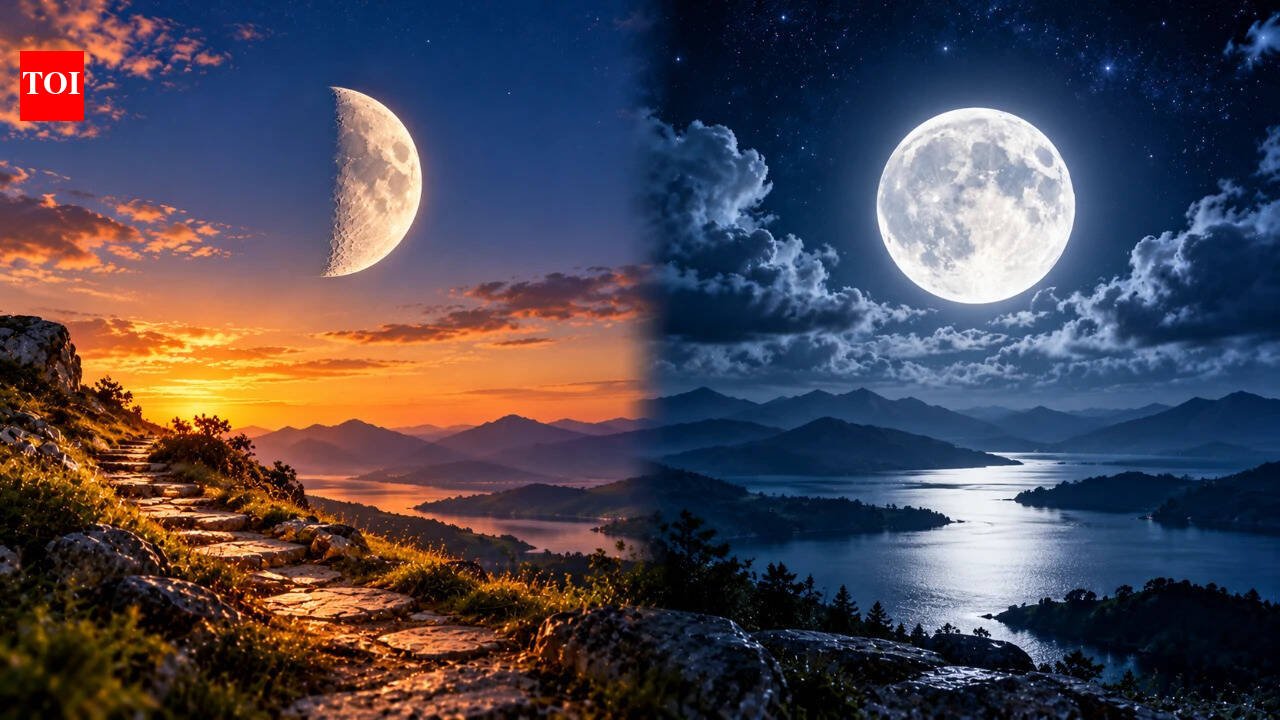
The Full Moon gets the attention. Photos fill social media, temples hold special pujas, and many people say they sleep badly that night. The First Quarter Moon, a week earlier, slips by almost unnoticed. Yet in astrology and spiritual practice, both phases matter. They simply ask for different things. One is about pushing forward. The other is about seeing clearly and letting go.
What Each Phase Actually Is
Both phases occur when the Sun and Moon are at right angles.At the First Quarter, the Moon sits 90 degrees from the Sun. That right angle is a square in astrology, an aspect known for tension and effort. Exactly half of the Moon is lit. It rises around noon and sets close to midnight.At the Full Moon, the two bodies stand 180 degrees apart, directly opposite each other. That’s an opposition. The Moon’s whole face is lit, and it rises around sunset and stays up all night.So one phase is a turning angle. The other is a face-off. Their spiritual meanings grow out of that difference.
The First Quarter: Effort and Commitment
Think of a seed planted at the New Moon. By the First Quarter, the shoot has broken through the soil but is still fragile. It needs water and protection, and it can still wither.That’s why spiritual teachers link this phase with commitment. Intentions set a week earlier now face real-world obstacles. A plan to wake up early runs into a late night at work. A resolve to save money meets a friend’s wedding expenses.The First Quarter calls for small, steady action rather than grand gestures. It is a good time to make a phone call that has been put off, sign up for a class or fix one practical problem. Doubts are normal in this phase. Pushing through them is the spiritual work.
The Full Moon: Results, Release and Emotion
By the Full Moon, the seed has become a plant, and you can see what grew. That’s the core meaning of this phase: revelation. Things hidden earlier come into view, sometimes pleasantly and sometimes not.Emotions also run high. The Moon governs the mind in Vedic astrology. With the Moon at its brightest, feelings tend to surface. Arguments can flare up, and tears can come more easily.For this reason, many spiritual practices treat the Full Moon as a time for release rather than new starts. People write down a habit they want to drop, offer gratitude for what has worked, or meditate under moonlight. The idea is to finish the cycle cleanly before the Moon starts to wane.This month’s Full Moon falls on October 26 in Taurus, a sign tied to money, food and comfort. It’s a natural moment to review spending habits.
How Indian Tradition Treats Ashtami and Purnima
The Hindu calendar follows the Moon closely. The First Quarter usually falls near Shukla Ashtami, the eighth lunar day of the bright fortnight. Ashtami is linked with fierce divine energy and discipline. Durga Ashtami of Navratri is a perfect example. Durga Ashtami October 2026 Around Navratri First Quarter Moon October 18The Full Moon day, Purnima, feels gentler and more devotional. People often hold Satyanarayan Katha on Purnima. Guru Purnima honours teachers, and Buddha Purnima marks the birth and enlightenment of the Buddha. Sharad Purnima, around this month’s Full Moon, is associated with Lakshmi puja and keeping kheer out under the moonlight.Fasting customs follow the same pattern. Ashtami fasts usually focus on strength and self-control. Purnima fasts lean toward gratitude and blessings for the family.So the two phases work as a pair. The First Quarter builds the effort. The Full Moon shows what that effort has produced.


