






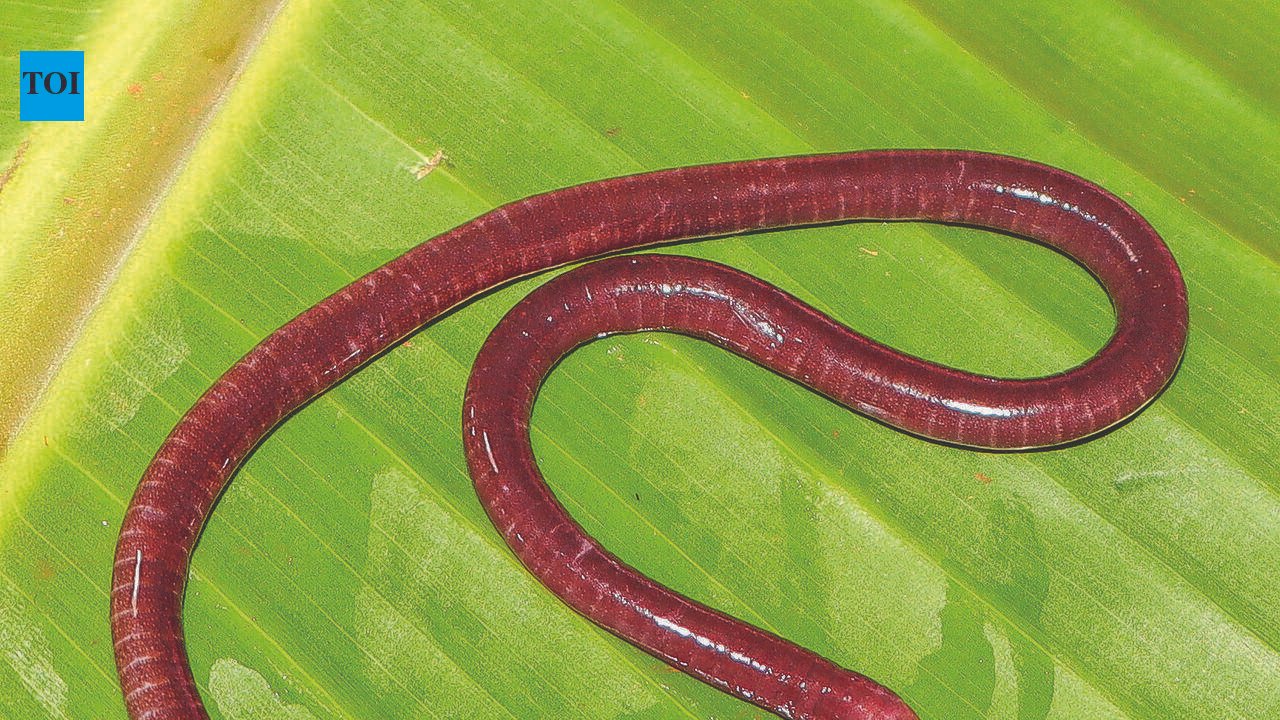
Panaji: Scraping the humus-rich soil in the Western Ghats itself could lead to the finding of unexplored biodiversity. Of late, researchers are doing it, as they have discovered a new caecilian species, Gegeneophis chandgadi—taking this group’s tally to a dozen, including four in Goa.Not far from the state’s border, this worm-like amphibian was found close to residential areas. Scientists formally described and named it in honour of Marathi’s Chandgadi dialect, predominantly spoken in this Kolhapur region.A team of researchers from the Zoological Survey of India WRC, Pune, Yashwantrao Chavan Mahavidyalaya, Halkarni, Chandgad, department of zoology, Savitribai Phule Pune University, Pune, and the Mhadei Research Centre, Goa, carried out the work in studying this subterranean legless amphibian.India’s current record of caecilians—which are worm-like invertebrates—is 42 (among 458 amphibian species). This includes 12 species of Gegeneophis, of which 11 are endemic to the Western Ghats. In Jan, a new species, Gegeneophis Valmiki, discovered earlier at Paneri, Palashi, in Maharashtra’s Satara district, had been described.The paper published on the ZSI website states that in addition to four undescribed lineages from the north Western Ghats, the discovery of seven Gegeneophis species strongly supports the role of this region as a hotspot of Gegeneophis species diversity.“Globally, 41% of amphibian species are threatened with extinction, while India’s caecilians remain poorly studied. The discovery (at Chandgad) highlights the hidden biodiversity beneath our feet,” said ZSI director Dhriti Banerjee.In Buzawade village, where one of the scientists found it, locals thought it was just another type of earthworm. Researchers picked six specimens under wood piles and bamboo leaf litter near a house.Caecilians mostly live a few inches deep in the soil, but emerge during rains to find new burrows. “They do come to the surface in the monsoons also in search of earthworms,” said Nirmal Kulkarni, a Goan herpetologist and team member.Although scientists said Gegeneophis species’ distribution in the Western Ghats is patchy, Buzawade locals informed researchers about the abundant occurrence of the new species in the village. Domestic chickens scrape the surface to search for juveniles and actively feed on them.The limbless amphibians, unlike others, do not make any vocal calls. “They wriggle a lot more than earthworms, but very little is known about their ecology and behaviour,” said Kulkarni.Conventional biodiversity surveys can easily miss these subterranean species, said ZSI WRC, Pune, head, Basudev Tripathy.“Documenting these hidden forms of life is essential to understand and appreciate the remarkable biological richness of the Western Ghats,” he said.Biodiversity research needs to be extended beyond protected forests to human habitation, agricultural and residential landscapes. “If we fail to identify species in time, we risk ‘silent extinction’, where organisms disappear before science even knows they existed,” said Savitribai Phule Pune University zoology department’s N Gramapurohit.Referring to the Buzawade experience, Yashwantrao Chavan Mahavidyalaya zoology department’s N C Hirgond said that locals’ knowledge can prove crucial for caecilian research. “Such knowledge can greatly assist researchers in locating and understanding species that are otherwise extremely difficult to detect.”


