


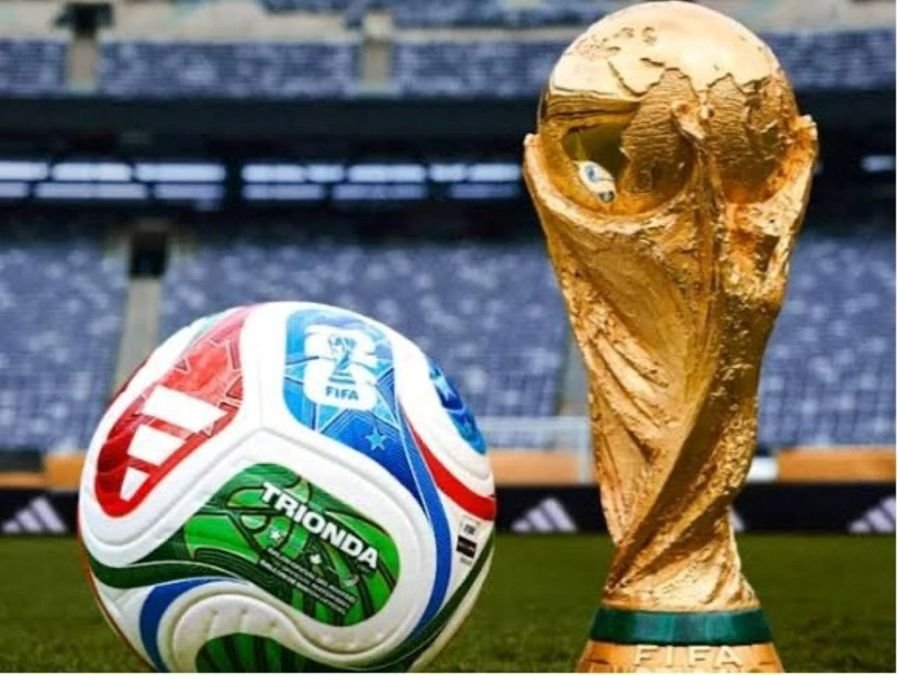
The FIFA World Cup 2026 may be viewed not simply as a tournament, but as a window into the future structure of economic activity itself
For generations, football has been described as the most popular sport on major part of this planet. As we witness the FIFA World Cup 2026, jointly hosted by the United States, Canada and Mexico, the attention of fans revolves around towards star players, tactical battles and championship ambitions. But beneath the excitement lies a far larger story—one concerning jobs, investment, innovation, tourism, media, public revenues and social value.
Global sports events like the football World Cup are increasingly becoming an economic phenomenon, a global marketplace, a technology platform, a tourism accelerator, and a branding exercise. A recent report released by the World Economic Forum (WEF) highlights this story within a broader global context and suggests that sports are becoming an increasingly significant component of the emerging global economy, one that intersects with several of the industries that are expected to drive growth in the coming decades. The FIFA World Cup 2026 may therefore be viewed not simply as a tournament, but as a window into the future structure of economic activity itself.
According to the World Economic Forum’s report Growth in the New Economy: Towards a Blueprint (2026), the industries that are expected to contribute most significantly to global growth between 2025 and 2030 include the IT services, advanced manufacturing, medical and healthcare services, accommodation and leisure services, and agriculture, forestry and fishing. At first glance, football or any other sports appear absent from the above list; however, a deeper insight tells a different story with a strong correlation of the modern sports industry with most of these listed growth sectors.
In this context, it is obvious that tourism and hospitality are directly linked to major sporting events, and the digital transformation of sports heavily relies on IT services. Similarly, as the areas of stadium construction and infrastructure upgrades largely depend upon advanced manufacturing, yet the athlete performance and fan well-being are felt to be increasingly intersecting with healthcare innovation. Even agriculture, which apparently seems less involved directly with the event, contributes through food supply chains serving millions of visitors. Modern sport is therefore not a standalone economic island; it is an intersection point where multiple growth industries converge. The World Cup exemplifies this convergence more dramatically than perhaps any other recurring global event.
The World Economic Forum’s analysis of the Sports Economy presents a compelling framework to understand things in real perspective. At its centre lies a broad ecosystem extending far beyond competitive matches. The core includes professional and elite sport, participatory sport and physical activity, sports tourism, and sporting goods. Around these are connected industries such as broadcasting and streaming, gaming, nutrition, sports services, wearable technologies and research institutions.
This entire system is surrounded and held in place by governments, investors, local communities, indigenous populations, philanthropic organisations, and the wider private sector. This typical layered structure reveals an important reality that every major sporting event, like the football World Cup, creates an economic activity with far-reaching effects beyond the stadium gates. The modern sporting ecosystem consists of diverse contribution components ranging from a tourist travelling for the tournament supporting airlines, hotels and restaurants to a football fan watching a match on a streaming platform contributing to digital revenues.
Similarly, among the other components, a company developing wearable fitness technology participates in the sports value chain while the Governments investing in transport and other infrastructure become the key economic partners for the event. Even Universities distantly conducting sports science research somehow become stakeholders with their knowledge and technical inputs. The boundaries between sport and economy in the present global world have become increasingly difficult to distinguish. Sports are increasingly becoming a platform through which technology companies, healthcare firms, tourism operators, media organisations, and investors pursue growth opportunities.
Perhaps the most striking finding in the World Economic Forum’s analysis quoted above is the projected growth trajectory of the global sports economy. It estimates the global revenue pool associated with sports as $2.3 trillion in 2025 and is projected to reach $3.7 trillion by 2030, with an annual growth rate exceeding 10%. The report further suggests that the projected figure could rise to about $8.8 trillion by 2050, on conservative estimates.
Such numbers challenge conventional perceptions of sport being seen merely as an entertainment. An economy approaching nine (9) trillion dollars would rival the size of some of the world’s largest national economies. The implications are profound as it would represent or potentially represent a substantial share of global consumption, employment, innovation and investment activity.
In many respects, the football stadium has become a marketplace as important as the global shopping mall or financial area of wider economic activity. The economic projections associated with the current FIFA World Cup 2026 illustrate this dynamic vividly. According to impact assessments officially cited by the World FIFA organisation, the tournament this time is expected to generate 6.5 million attendees, $13.9 billion in event-related expenditure, $80.1 billion in gross economic output, 824,000 full-time equivalent jobs, $9.4 billion in government revenue and $8.28 billion in estimated social benefits. These figures reveal the multiplier effect characteristic of any major sporting event.
The initial spending by visitors does not simply disappear after a ticket purchase but continues to circulate through hotels, transport systems, restaurants, retail businesses, local suppliers, media organisations, and other service providers. As the World Economic Forum identifies accommodation, food and leisure services among the major contributors to future economic growth via sports, the tourism and hospitality sectors are likely to experience the most visible benefit in such a case.
Besides, the positive fan experience can translate into repeat visits, investment interest and stronger international branding. The final score may be forgotten, but the memory of a destination often endures.
Football’s future (or any other global sport) is increasingly digital with streaming platforms, artificial intelligence, data analytics, gaming, wearable devices and fan engagement technologies becoming central to modern sports. This is where the sports economy intersects directly with the WEF’s identification of IT services as the leading driver of global growth.
The modern fan no longer experiences the World Cup solely through television but consumes a lot of data on mobile devices, engages through social media, participates in fantasy competitions, purchases digital content and interacts with real-time statistics. Every above interaction generates an economic value wherein technology firms and other related entities have the opportunity to showcase innovations at an unprecedented scale alongside the display of different emerging digital business models.
One of the most noteworthy aspects of contemporary economic analysis is football’s growing recognition that value extends beyond financial transactions. FIFA assesses the social benefits worth $8.28 billion from the World Cup 2025 at a 3.64 value of social return on investment through areas like community engagement, social cohesion, physical activity promotion, civic pride and other broader societal outcomes. The conventional accounting often struggles to capture these social parameters, and events such as the World Cup remind us that societies also generate value through shared experiences, cultural exchange and collective identity.
When millions of people from diverse backgrounds across the globe celebrate a common passion, something economically significant occurs even if it never appears on a routine balance sheet. The challenge for modern economics and economists is learning how to measure it. Having said all this, the World Cup is thus no longer only about who wins the trophy but more about understanding how the world’s most popular game has become one of the most powerful economic engines for global growth and development.
(The Author is Associate Prof. SKUAST-Kashmir)
