



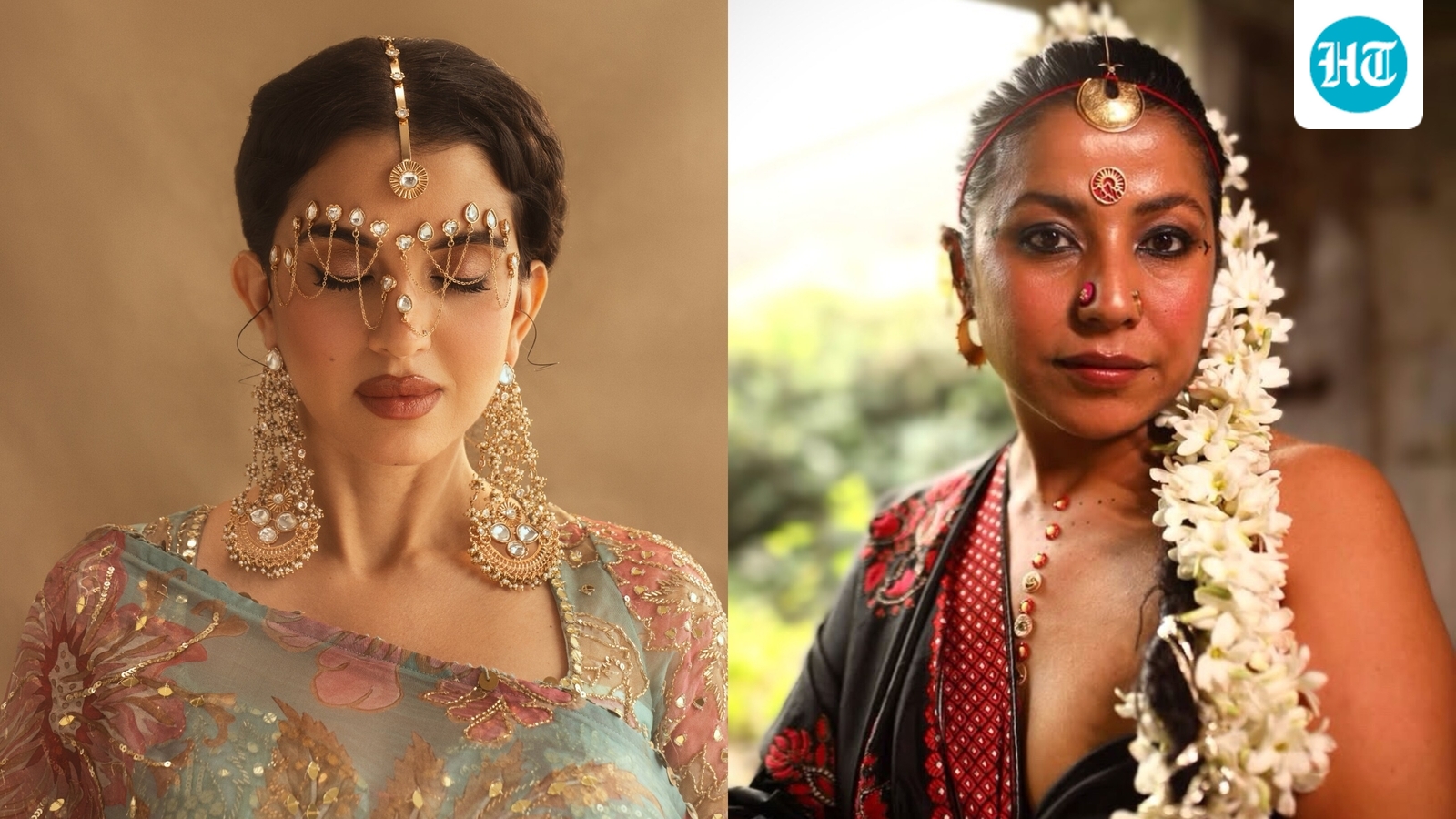
As the festive calendar fills up, minimalism is making way for a little more sparkle. The bindi, once the finishing touch to an Indian look, is now demanding to be the look itself.

Think metallic flowers clustered above the eyebrows, crystals tracing the forehead, sculptural spirals curling along the bridge of the nose and ornate pieces crafted from pearls, brass and semi-precious stones. The face is becoming a canvas, and the traditional bindi is being reimagined as jewellery for it.
The shift is not about abandoning the bindi’s cultural roots. Rather, designers believe a younger generation is becoming more confident about playing with Indian forms, while festive maximalism is creating the perfect setting for their return in a more elaborate avatar.
The forehead takes centre stage
For Nikita Gupta, founder of jewellery label AMAMA, the transition from bindi to jewel is a natural one. “A bindi has always been a form of adornment. It is such a small detail, but it can transform a look just like jewellery can,” she says.
The label’s Mogra Bageecha bindis are treated as miniature ornaments, drawing from the floral motifs, stones and detailing associated with Indian jewellery. Their reusable nature also changes the way one perceives them. Instead of peeling off a sticker and discarding it at the end of the evening, these pieces can return to the jewellery box, ready to be collected, restyled and worn again.
“When you can collect it, style it, reuse it and make it part of your personal expression, it begins to feel like jewellery,” says Gupta, adding, “A beautifully styled set of bindis can become the statement of the entire look. It does not always have to be an addition to jewellery. It can be the jewellery.”
Her label has even carried the idea beyond the face with hand bindis, conceived as a playful, temporary alternative to mehendi.
“Tradition and self-expression can coexist beautifully,” says Gupta, adding, “People are feeling more confident about embracing Indian aesthetics in their own way, and this generation is much freer in how they interpret and style traditional symbols.”
‘Forehead is prime real estate’
For Meghna Khanna, founder of The Bindi Project, the bindi’s new maximalist turn is also a cultural revival. Having worked with jewellery for 18 years, she now collaborates with karigars to create bindis using upcycled handloom scraps, leather, gold- and silver-plated elements and semi-precious stones.
“Forehead is prime real estate, why waste it? Why put a basic black dot when we have the culture and means to do more?” Khanna says, as she recalls learning about reusable gold bindis that were once treated as heirlooms and affixed using wax. Her contemporary versions revive that sense of permanence and value. The label’s Kundalini range, for instance, incorporates chakra-inspired forms and semi-precious stones.
“We are positioning bindis as jewellery for the forehead. They are collectors’ items. There is no place for basic,” she insists.
The appeal, she adds, cuts across age groups. While most of the label’s buyers are over 30, younger shoppers are pairing ornate bindis with jeans and everyday clothing, treating them less as occasion-bound accessories and more as a way of leaning into their roots.
Across the brows and beyond
The transformation is not limited to material or scale. The bindi is also refusing to remain confined to the space between the eyebrows. It now appears in clusters across the forehead, arcs over the brows, moves towards the temples and occasionally travels to the collarbones, hands, ears and nose.
Gupta points out that such placement is not entirely new. “Growing up, we saw bindis being worn on the temples and around the face, especially for weddings and celebrations, even in the early ’90s,” she says. “We have simply reinterpreted it in our own way.”
Vijal Haria, founder of Indore-based Comet Busters, has witnessed that appetite expand considerably. The label began with 10 designs in 2019 and now offers thousands, fashioned using velvet, PVC, brass, pearls, beads and other metallic elements.
“Younger people are using them as body jewels, too,” says Haria, adding that customers place the label’s stick-on designs along the collarbones, neck, ears and nose. The brand has consequently developed separate ranges of non-piercing ear and nose studs alongside its bindis and mehendi stickers.
The result is a form of adornment that can be arranged much like stacked rings or layered necklaces. One embellishment may sit between the brows, while smaller motifs frame the eyes or draw attention towards the temples. Particularly during the festive season, when beauty looks already make room for gold, colour and excess, the forehead offers an entirely new space to accessorise.
When the face becomes jewellery
Artist and fashion photographer Diya Johnson of HootsCraft creates flexible wire ornaments that spiral across the forehead and follow the contours of the nose. “I started experimenting with the idea of taking a simple wire and allowing it to travel across the face rather than restricting it to a conventional jewellery placement,” she says.
The intention was not to create a particular symbol, but to explore how a simple line could transform the face into something “whimsical” and “almost fantasy-like”.
Johnson describes her creations simply as ornaments, reflecting how the boundaries between jewellery, accessory and fashion are becoming increasingly fluid: “We are all a kind of canvas, and we can choose how we want that canvas to look.”
Globally, too, designers are questioning why jewellery should remain attached only to ears, necks, wrists and fingers.
Paris-based designer Mélissa Le Guen-Hector, who works under the name Unfortunately Unforgettable, similarly uses sterling silver to create nose, forehead and eyewear jewellery. Her pieces are developed through 3D modelling and can be attached using eyelash glue, medical-grade magnets or clip systems.
For her, decorating the nose began as a way of reclaiming a facial feature that people do not always appreciate. “Jewellery and accessories are used to materialise the version of ourselves that we have in our heads. They can really reshape the face and the body,” she shares.
WHERE TO GET YOUR BINDI BLING
Wired for drama
For a bindi that curls down the nose bridge, HootsCraft’s wired bindi-cum-nose-pin sets start at ₹399.
Shop: DM @hootcrafts93 on Instagram
Stick on the sparkle
Comet Busters offers sticker bindis from ₹449, while its stone, brass and Indira ranges start at ₹999.
Shop: DM @cometbusters_india on Instagram, visit the brand’s website or find it on Myntra, Flipkart and Amazon
Jewels for the forehead
The Bindi Project’s bundles feature stone, brass and gold-plated pieces, with prices starting at ₹1,000.
Shop: DM @the_bindi_project on Instagram or visit the brand’s website
A stone-studded statement
AMAMA’s stone sticker bindi bundles start at ₹1,200, bringing jewellery-like detailing to easy-to-wear pieces.
Shop: Visit amama.in or DM @amamajewels on Instagram
Bridge the gap
Paris-based Unfortunately Unforgettable’s sculptural nose-bridge rings and pins start at €150.
Shop: Visit unfortunately-unforgettable.com
For more, follow @htcityshowstoppers


