


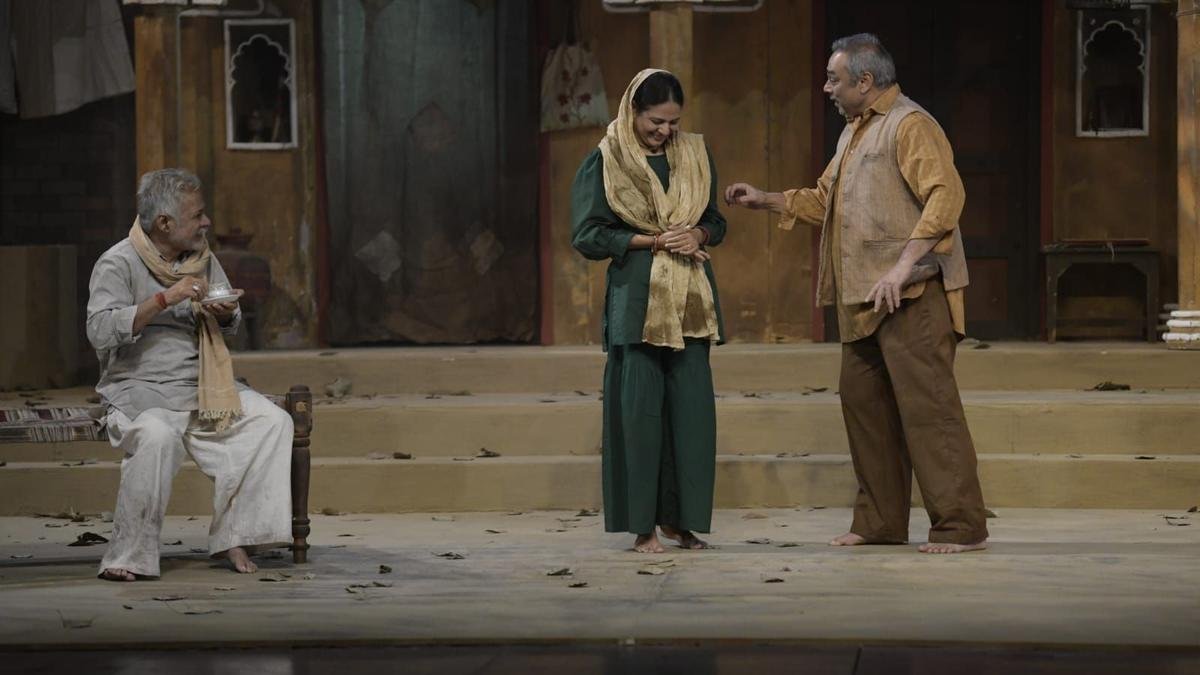
A scene from Feroz Abbas Khan’s latest play Hind 1957.
| Photo Credit: Special Arrangement
Expressing the unspoken, Feroz Abbas Khan’s Hind 1957 makes us reflect on humanity. Hind 1957, staged at the Bharat Rang Mahotsav, is about a Muslim family that chooses to remain in India post-Partition. It is a sensitive and thoughtful Hindustani adaptation of August Wilson’s Pulitzer Prize-winning play Fences (1985), by Vikas Bahari. The play transposes the 1950s African-American experience in Pittsburgh to the Muslim narrative in post-Partition India.
Spread over two acts, the play explores themes of patriarchy, prejudice, family secrets and the tension between a weary father’s cynicism and the optimisim of his sons for a better future. The poignant story makes you realise that classics don’t age.
The central character, Tabrez Ansari (evocatively portrayed by Sachin Khedekar), is a poet who participated in the freedom movement. He is wrongfully imprisoned after his father migrates to Pakistan. He is tired of being repeatedly interrogated by the police, and works in a bidi factory to keep the home fires burning.
Charged as a spy, Tabrez personifies the shattered dreams of a generation, poignantly captured towards the end through Abhishek Shukla’s verse, ‘Main ghar kahoon toh Hindustan samajh samjha jaye….’
Feroz Abbas Khan resists generalising the Muslim peeve or romanticising the laments of progressive writers. Tabrez is flawed in his understanding of society and family, and uses religion opportunistically. His poetry is progressive, but his behaviour within the four walls is far from forward-looking. For him, drinking liquor is being liberal, but when it comes to infidelity, he invokes the Shariat. He uses his brother’s pension to have a roof over his family’s head.
Tabrez tries to pass on his bitterness to his sons, who, in a departure from the traditional depiction of Muslim families, embrace India with all its imperfections. They are not chained by their father’s fears. Latif takes to his father’s poetic legacy while Kaif wears his love for the nation in his army uniform. They believe their father will get justice under the Indian Constitution, and the writer rewards their patience and optimism.
Sachin Khedekar and Sonal Jha in Hind 1957.
| Photo Credit:
Special Arrangement
It is not a propaganda of hope, though. Within its layers, the play holds tales of everyday discrimination that continue to bog us down as a society. Over a shared glass of country liquor, Banwari (Dadhi R. Pandey), a close friend of Tabrez, talks of his pain when he is not allowed to touch the bidis in the factory because he is a Dalit. Perhaps, that’s why Banwari understands Tabrez’s anguish at being othered despite not following his father’s footsteps to Pakistan.
Known for writing strong female characters, Feroz Abbas Khan takes a dig at deep-seated patriarchal mores. Sachin’s understated yet powerful portrayal of the flawed patriarch binds the play together, but it is Sonal Jha who emerges as its emotional fulcrum. As Razia, she confronts Tabrez when he uses family responsibilities as a cover for philandering. She says she has given as much to the family as he has, but she doesn’t have the option to grow tired of the relationship. The emotional showdown between Tabrez and Razia is the highlight of the play.
Feroz Abbas Khan makes generous space for tragicomic sequences like the one where Tabrez’s mentally impaired brother, Gulrez, turns up with a rose for Razia in the midst of a heated exchange spurred by Tabrez’s admission of an extramarital affair.
Feroz Abbas Khan uses Shukla’s shayari as a cultural bridge to convey longing, belonging and emotional depth, while the rich production design and lighting evoke a period in which broken parapets suggest fractured bonds, leaving viewers reflective in an emotional swell.
Hind 1957 will be staged on February 21 and 22 at NMACC, Mumbai.
Published – February 18, 2026 03:41 pm IST


