



At his first formal meeting since joining the Rastriya Swatantra Party as its “senior leader” and the presumptive Prime Minister, also ex-mayor of Kathmandu Metropolitan City Balendra Shah, asked rhetorically, “Isn’t Janakpur the capital of the province? Why go to Kathmandu if it is the capital? Why can’t all of the work be completed here?’ He then delivered the punchline to clarify his party’s commitment to federalism: “Therefore, the province should be strengthened so that residents don’t have to go to Kathmandu.” However, federalism is interpreted differently in different settings.
In the sanitised seminars of Kathmandu and the smoke-filled tea shops of Janakpur, federalism means different things. In the capital, it is often reduced to a question of fiscal transfers to “subordinate agencies” and administrative efficiency—in essence, not even devolution but mere decentralisation.
This article is a part of The Hindu’s e-book: Nepal’s new political moment
In the plains and the hills beyond the Ring Road, it is about identity, empowerment and dignity. The disjuncture between these two imaginations explains why, even a decade after the promulgation of the Constitution of 2015, federalism in Nepal remains a project under contestation rather than a settled compact.
Ex-mayor Shah’s commitment to stronger provinces is diametrically opposite to his earlier position of federalism. In 2022, he had voted in elections for the federal parliament but skipped casting his ballot for the provincial assembly. The Rastriya Swatantra Party, of which he is now a senior leader, hadn’t fielded its candidates in provincial elections. It seems that the party has realised that the constituency for federalism in Nepal is so strong that no political party with national ambition can afford to ignore it despite their centralist convictions.
Unitary Reflex
The demand for federal restructuring did not emerge from a donor’s toolkit, as some remnants of the monarchist order allege, nor solely from a Maoist manifesto, as its later proponents sometimes imply. Its intellectual genealogy reaches back to the 1950s, when Raghunath Thakur began articulating the structural marginalisation of the Madhesh—the northern extension of the Gangetic plains, stretching east to west along Nepal’s border with West Bengal, Bihar and Uttar Pradesh. In the brief democratic interlude following the fall of the Rana regime, Thakur argued that a highly centralised Kathmandu could not authentically represent a country defined by multiple languages, castes and regions. His call was not for secession, but for accommodation within a more inclusive state and justice for Madhesh.
Yet Thakur’s warnings were soon swept aside. The 1960 royal-military coup by King Mahendra buried the fragile democratic experiment under the weight of an authoritarian vision. The Panchayat regime’s catechism— “one language, one dress; one king, one nation,” reflecting the monoethnic dominance of the hegemonic Khas-Arya group—did more than dissolve parliament; it sacralised uniformity. The division of the country into 14 zones and 75 districts was an exercise in administrative cartography, not political devolution. Federalism was recast as treason. For two decades, even the very vocabulary of autonomy was erased from official discourse.
Cultural geography
The early 1980s cracked open this enforced silence. The Harka Gurung report on internal migration, though technocratic in intent, exposed the asymmetries between hills and plains. It offered empirical legitimacy to what the peripheries had long intuited: The state’s development model was structurally skewed.
Gajendra Narayan Singh, a committed cadre of the Nepali Congress, seized the moment. Through the Nepal Sadbhavana Parishad, he proposed a three-province model—Mountain, Hill, and Terai—breaking with his former party affiliation to pursue what he called a politics of dignity. His vision was modest in scale but radical in implication: a geographically grounded federalism that reflected the contours of culture across Nepal. From east to west, the lifestyles of the Himalayan region aligned closely with Tibetan practices; the peoples of the mountains and valleys of the Mahabharata ranges adhered to the Sanatan faith, which stretches from Himachal Pradesh and Uttarakhand in the west to Sikkim and Assam in the east. In the Ganga plains, the international border cuts through communities that share language, culture, and history. For the first time since Thakur, federal restructuring was placed firmly on the national agenda.
Yet the 1990 Constitution, born of the People’s Movement, opted for continuity over rupture. The restored multiparty system retained the unitary architecture. Even Singh, constrained by the demands of parliamentary arithmetic, tempered his federal insistence in favour of incremental inclusion. Liberalism arrived and sovereignty shifted from the king to the people, but the state’s structure remained Panchayat in all but name. Majoritarianism reduced parliament to an instrument of the Khas Arya elite—a group of Brahman-Kshetriyas from Gorkhali Court that had retained its hold over the polity and society of the country for 250 years and evolved into the Permanent Establishment of Nepal (PEON).
Renewed aspirations
The Maoist insurgency (1996–2006) detonated the debate. By linking federalism to self-determination, the rebels reframed it from an administrative reform to a question of historical justice. Their proposal of autonomous ethnic and regional units—modelled loosely on the Chinese system—was less about comparative constitutionalism and more about mobilisation. Janajatis and Madhesis heard, perhaps for the first time, a promise that the map of Nepal could reflect their names.
Ironically, the 2007 Interim Constitution, drafted in the euphoria of peace, initially omitted the word “federalism.” It was an extraordinary act of structural amnesia. The Madhesh uprising that followed, led by figures such as Upendra Yadav, forced a constitutional amendment committing Nepal to a federal democratic republic. Federalism was not gifted; it was extracted.
The first Constituent Assembly (2008–2012) became a theatre of irreconcilable visions. On one side stood proponents of identity-based federalism—Maoists and Madhesh-based parties—advocating provinces like Limbuwan, Tamsaling and Madhesh. On the other were the Nepali Congress and Communist Party of Nepal (United Marxist-Leninist)—better known simply as UML—insisting on “capability-based” demarcation grounded in economic viability and resource distribution.
An ethnic Madhesi man holds a banner that reads “Hail Madhesh Hail Madhesi. Black Day,” during a protest against the country’s new constitution saying lawmakers ignored their concerns over how state borders should be defined, in Birgunj, Nepal, Sunday, Sept. 20, 2015. The new constitution replaced an interim one that was supposed to be in effect for only a couple of years but governed the nation since 2007. Police said clashes between officers and protesters on Sunday left one demonstrator dead near Birgunj town in southern Nepal.
| Photo Credit:
AP
This was not a technical disagreement over boundaries. It was a battle over narrative ownership. Naming a province after an indigenous community signified historical recognition; basing it along artificially drawn boundaries to maintain the dominance of Khas-Arya signified a continuity of the state’s civilisational grammar. The deadlock proved fatal. The Assembly dissolved without delivering a constitution.
The second Constituent Assembly inherited the same fault lines. It took the 2015 earthquake and a decisive intervention by the Supreme Court of Nepal to compel the political class into compromise. The 16-point pact among the major parties had fast-tracked a seven-province model, postponing contentious issues of naming and boundary delineation. Federalism was institutionalised, but its ideological core was diluted. It took another order of the Supreme Court for the signatories of the 16-point pact to incorporate federalism with numbers instead of names in the constitution.
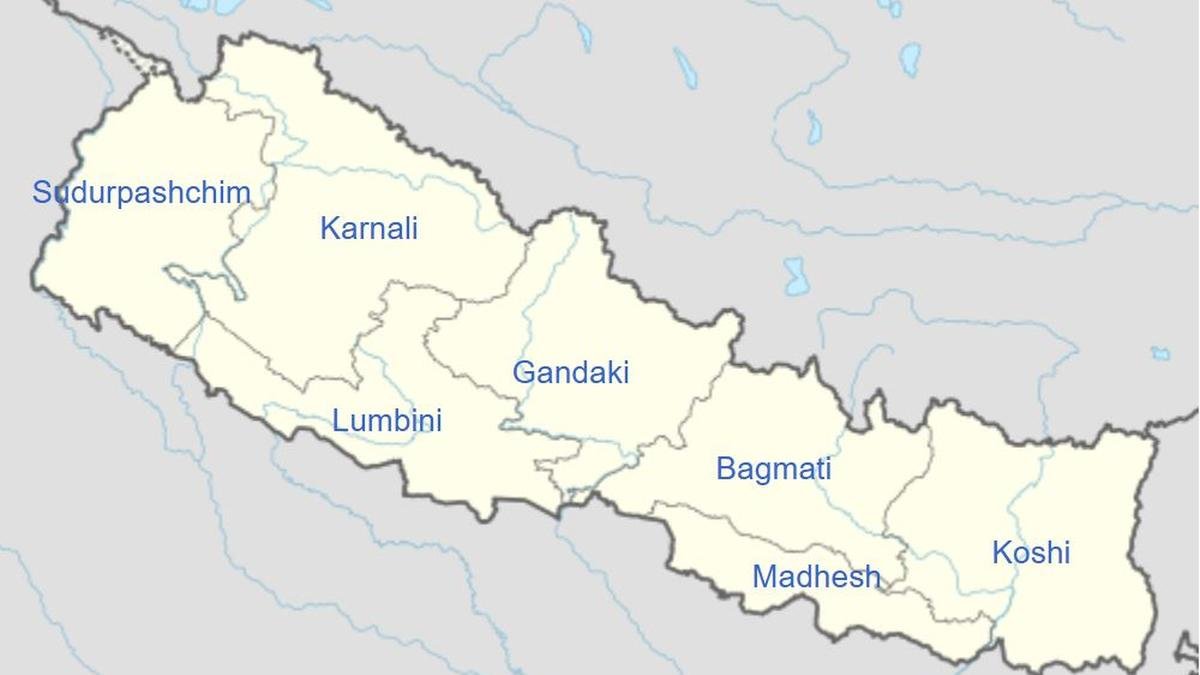
The provinces were born as numbered orphans—Province 1, Province 2, and so forth. The subsequent struggle over naming revealed that the identity-capability schism had merely been deferred.
River-based names such as Koshi, Gandaki and Karnali were celebrated by the establishment as neutral and pragmatic. For identity movements, they echoed the Panchayat-era preference for sacral geography over lived history. In Province 2, however, the adoption of “Madhesh” marked a rare triumph of political assertion over cartographic caution. Lumbini, invoking the Buddha’s birthplace, offered a civilisational compromise that avoided ethnic specificity while satisfying symbolic appetite.
These naming battles were not semantic indulgences. In a post-conflict society, onomastics is politics. To name is to claim.
The present unease with Nepal’s federal structure is palpable. A decade into implementation, the system exhibits a peculiar asymmetry: hyper active local governments, an assertive centre, and provinces suspended in jurisdictional limbo. The federal bureaucracy maintains a direct line from Singha Durbar to the 753 local units, often bypassing provincial authorities. Fiscal federalism remains centralised, while policing and civil service management are contested domains that continue under federal control despite constitutional provisions for provincial transfer.
This “middle-layer uncertainty”—a wineglass rather than even hourglass model of federalism where nominal provincial level have been given responsibility without corresponding authority—fuels contemporary populism. In the run-up to the March 2026 elections, leaders such as Balendra Shah spoke of empowered provinces while implying that the centre will remain the ultimate arbiter of identity and prestige. The rhetoric of efficiency—provinces are too expensive, too cumbersome—reframes a constitutional question as a budgetary inconvenience.
The clamour for a directly elected chief executive continues to reverberate, now fuelled by a new generation of political actors. Parallel to this, the demand for directly elected Chief Ministers is gaining traction in the provinces. While proponents promise this will cure the ‘coalition sickness’ and bring stability, critics fear the creation of seven mini monarchs—leaders who might replicate Kathmandu’s centralising impulse at a local scale. Without robust provincial legislatures and a culture of oversight, this shift toward executive personalisation risks hollowing out deliberative federalism, turning provinces into personal fiefdoms rather than democratic laboratories.
Putting Together
Comparative federalism distinguishes between “coming together,” “holding together,” and “putting together” models. Nepal’s experiment appears closest to the last: a structure assembled under pressure to pacify the street rather than the culmination of a consensual compact. The danger of such an origin is persistent fragility.
Three spectres haunt the current landscape. The efficiency trap reduces rights to accounting. The executive fetish privileges personalities over institutions. The identity deficit leaves the grievances that birthed federalism only partially addressed. If provinces become mere administrative outposts—responsible for service delivery but devoid of substantive autonomy—the system risks regression to a digitalised unitary state.
Yet federalism is not without resilience. Provincial assemblies have begun to cultivate distinct political cultures. Karnali asserts a narrative of organic marginality; Madhesh sustains a vigilant regional consciousness. Institutional habits, once formed, are not easily erased.
The future hinges on whether the outcome of the 2026 electoral cycle, which resulted in a decisive win for the RSP, will deepen provincial legitimacy or will reinforce central tutelage. Federalism’s promise was dual: self-rule for diversity, shared rule for unity. In practice, Nepal has achieved partial decentralisation without full partnership.
The question before the republic is therefore not whether federalism has failed, but whether it has been allowed to mature. If the centre continues to treat provinces as contractual employees rather than constitutional equals, the experiment will stagnate. If political actors embrace the friction of genuine power-sharing, federalism may yet evolve from a contested compromise into a lived reality. Nepal has moved from a unitary state to a state of provinces. The unfinished task is to become a federal nation—where Janakpur does not require Kathmandu’s permission to imagine itself, and where shared rule is not a ceremonial visit to the capital, but an institutional right embedded in everyday governance.
Opposition to federalism has acquired a distinct ideological spine. The most vocal critics emerge from three overlapping constituencies. First are monarchist nostalgics, who look back to the pre-1990 order as an era of certainties—one king, one command, one canon of belonging. For them, federalism represents not merely administrative fragmentation but the symbolic dethronement of a civilisational hierarchy in which the palace served as both fountainhead and firewall.
The second bloc is the Hindutva lobby, transnational in sentiment if not structure, which views Nepal’s federal and secular republicanism as a historical aberration from a putative Hindu Rashtra. In their narrative, provincial autonomy dilutes sacred geography and opens space for plural identities that compete with homogenised religious nationalism.
The third strand comprises cultural conservatives within the traditional elite who may publicly accept republicanism but remain instinctively wedded to a centralised state. Their discomfort with identity-assertive provinces—whether Madhesh, Limbuwan, or Tharuhat—stems from a deeper anxiety: political recognition of subnational identities permanently recalibrates social power.
These strands converge in a common refrain: federalism is expensive, divisive, and externally imposed. Provinces are portrayed as redundant intermediaries between a capable centre and dynamic local governments. The implicit proposition is clear: strengthen Singha Durbar, empower municipalities, and let the provincial tier wither into ceremonial existence.
This is not a frontal assault on the constitution; it is a strategy of attrition. Starve the provinces of fiscal autonomy, delay the operationalisation of provincial police, centralise the civil service, and federalism survives in text but expires in practice. Such “nominal federalism” offers the aesthetic of decentralisation without the substance of shared sovereignty.
Set against this scepticism stands a more grounded, if regionally concentrated, support base. Nowhere is the emotive investment in federalism stronger than in Madhesh. For many in the plains, the creation of a province named Madhesh was not a technocratic adjustment but a psychological rupture with centuries of condescension. Even where material transformation has been modest—industrial stagnation persists, youth outmigration continues—the symbolic capital of recognition matters. Seeing one’s linguistic and cultural idiom reflected in provincial institutions generates a sense of presence in the republic. Federalism, in this reading, is less about immediate distributive gains and more about constitutional dignity. It signals that the Madheshi citizen is not a peripheral subject petitioning the centre, but a co-owner of the state. Chief Ministers have begun not only to lament their powerlessness but to stake claims upon the constitutional order. The Kantipur Conclave in February, 2026 saw all seven Chief Ministers lamenting that they remain “orphans of the statute,” lacking control over their own police and civil servants while the centre remains obsessed with “administrative cartography.”
This asymmetry has profound electoral implications. While federalism remained on the ballot, the parliamentary elections were not a referendum on the abstract desirability of provincial structure but on the trajectory of federalism. A mandate shaped by monarchist nostalgia, Hindutva consolidation, and cultural conservatism would have likely accelerated the drift toward a strong centre flanked by competent local governments—
efficient municipalities delivering services while provinces remain fiscally dependent and administratively constrained. Conversely, a verdict rewarding parties committed to clarifying provincial competencies, completing fiscal devolution, and institutionalising provincial policing and civil service structures could have initiated a second-generation reform. But now with the RSP winning the elections, the outcome is unclear.
Ultimately, the choice before the electorate in the run-up to the elections was structural rather than sentimental. It was a decision about where sovereignty should reside in a multinational society: concentrated in a revitalised centre promising order or dispersed across constitutionally empowered provinces demanding negotiation.
Federalism in Nepal was born of struggle, compromise, and urgency. Whether it matures into a stable architecture of shared rule or regresses into a decorative appendix will depend less on rhetorical flourish and more on the arithmetic of the ballot.
The Fall Protests of September 2025—triggered by the social media ban— which toppled the previous government, introduced a new and impatient electorate. The digital rage of the TikTok generation lacks the tenacity of the slow, restrained, and historically grounded dignity sought by the Madhesh and Janajati movements. Nepal’s Gramscian interregnum has a twist: the new cannot be born, and the old is fighting to retain primacy. The outcome of the 2026 elections may not settle the argument definitively, but the RSP’s policies will determine whether the republic advances toward substantive federalism or retreats into a familiar, centralised comfort zone dressed in federal attire—participatory in form, but unitary in substance.
C.K. Lal is a senior journalist and political columnist in Nepal


