


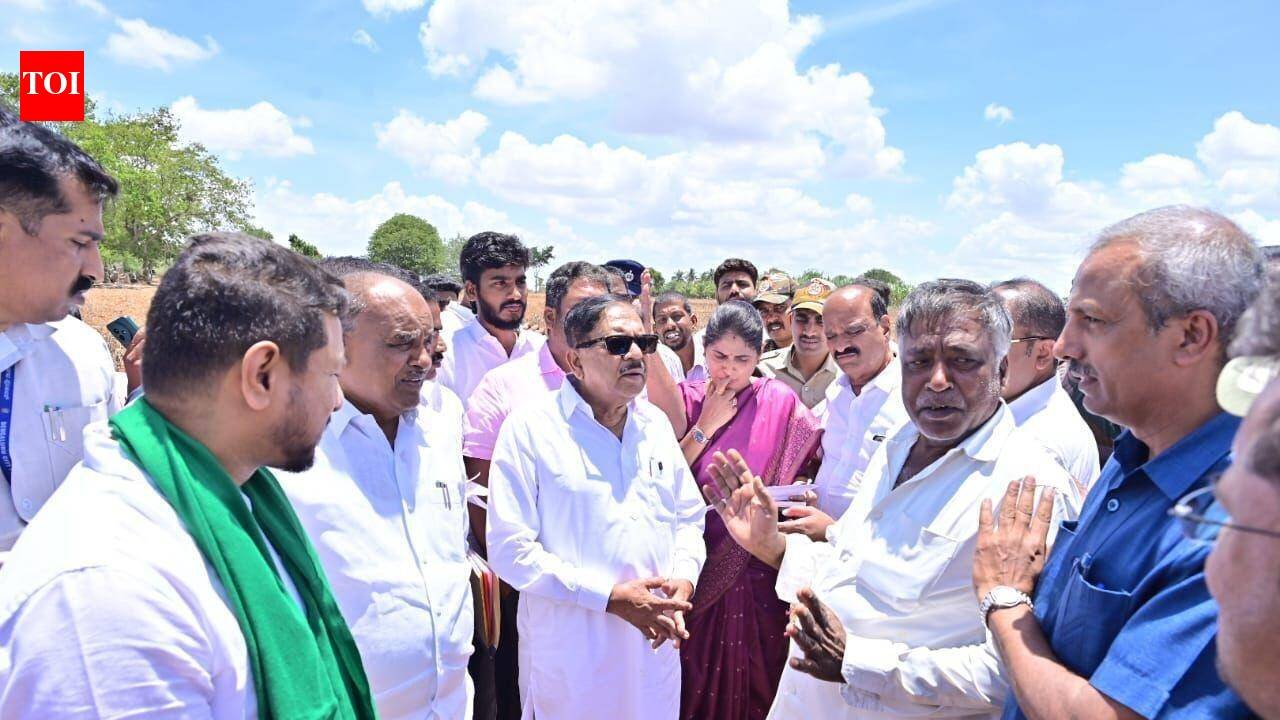
Mysuru: The severity of the drought and rainfall deficit in Chamarajanagar district came to the fore during a drought assessment visit by deputy chief minister G Parameshwara, who also holds the revenue portfolio.During the assessment at Somahalli, a farmer broke down while narrating his plight, saying he had been forced to sell his cow as he could no longer afford fodder for the animal.Parameshwara later visited Ranganathapura, Nittre and Shigevadi villages in Gundlupet taluk and Mukkadahalli and Heggothara villages in Chamarajanagar taluk to assess the drought situation. He inspected crop damage, fodder availability for livestock, and works being undertaken under the VB-G RAM G scheme to provide employment.Officials informed him there was enough fodder stock to meet requirements for around 16 weeks. DCM directed officials to ensure that there is no fodder shortage in the taluk.Karnataka Rajya Raitha Sangha and Hasiru Sene submitted a memorandum seeking a complete loan waiver and filling of all lakes in the district.At Mukkadahalli in Chamarajanagar taluk, a delegation led by Hallikerehundi Bhagyaraj, president of Karnataka State Sugarcane Growers’ Association, met the DCM urging the immediate stoppage of water release form Kabini reservoir to Tamil Nadu.Parameshwara said severe crop damage had been witnessed in Gundlupet taluk. “Maize, sunflower and sugarcane crops have been badly affected. Even the Nanjangud banana, which is popular in this region, has dried up due to the lack of rainfall,” he said.Chamarajanagar district in-charge minister Puttarangashetty, Gundlupet MLA Ganesh Prasad, Nanjangud MLA Darshan Dhruvanarayan and others were present.In Mysuru district’s Gattavadi village, Parameshwara visited the fields of farmers Shivabasappa and Mahadevappa, who had grown maize and sunflower, and saw crops that had withered due to the rain deficit. Farmers told him they had taken loans to raise crops and were now in distress, seeking govt help.Parameshwara sought details from officials, who informed him that annually, 4,500 hectares of cowpea, 4,200 hectares of black gram, 3,500 hectares of green gram, 3,400 hectares of maize and 8,000 hectares of cotton are cultivated in the taluk. However, due to the rain deficit this year, sowing was done only in 3,500 hectares, and even that crop has been destroyed by severe drought.Nanjangud MLA Darshan Dhruvanarayana, deputy commissioner G Lakshmikanth Reddy, ZP CEO Yukesh Kumar, the tahsildar and agriculture officers were present.
