



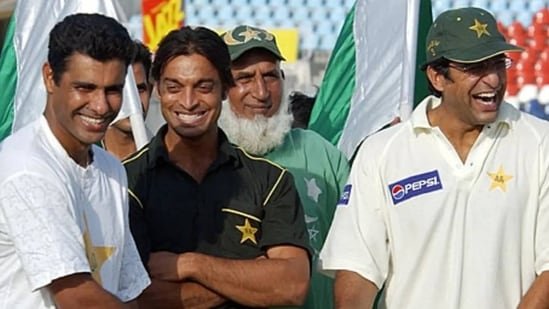
Time to take the bull by the horns. The Fakhar Zaman ball-tampering incident on Sunday has given us a massive opportunity to expose Pakistan’s dominance in the late 1980s and the 1990s, especially against India. The Pakistani media often speaks of their team’s superior head-to-head against India in ODIs and Tests. In fact, they gloat over it. Every time Pakistan have lost to India in the last 10 years or so, you always see a former Pakistani player — be it Mohammad Yousuf or Saqlain Mushtaq or Shoaib Akhtar — bring it up in an attempt to rub it in.
As of today, Pakistan have won 12 Tests against India’s 9 and 78 ODIs against India’s 58.
For a large part of the ongoing century, India have been a much better team, but sadly there has not been much cricket between both the teams. India and Pakistan haven’t played a Test series since 2007-08. They haven’t played an ODI bilateral series since 2012-13.
They mostly play each other at ICC events or Asia Cups, and India have dominated them overwhelmingly, but despite that, Pakistan continue to enjoy a superior head-to-head. Though it has to be said India have cut into their lead quite significantly — thanks to their 13 wins and 3 losses in T20Is — and it won’t be long before the western neighbours are left behind.
Anyway, the thing that we are discussing here is how Pakistan managed to win so many matches against India. Yes, they had some very talented players like Imran Khan, Javed Miandad, Wasim Akram, Waqar Younis, Akhtar and so many others, and they did impact the India-Pakistan encounters greatly, but there was a bigger reason that helped Pakistan to often beat India, rather unfairly. Yes, it was their ability to tamper with the ball and then get it to reverse-swing. On the dry pitches of Sharjah, particularly, they were head and shoulders above.
Readers will be shocked to know that it’s a standing joke among Pakistani players from those eras, like how they used to rough up the ball with impunity and wreak havoc on opposition teams. There were not many cameras back then, so they could have done it without the fear of getting caught. Shahid Afridi, Akhtar, Younis, Azhar Mahmood, all have been penalised at some point. The “great” Younis was the first player to be fined and suspended for ball tampering in 2000. His team-mate for many years, Aamer Sohail has said on record how the Pakistan bowlers of that era abused their know-how to tamper with the ball.
“When we had to win by ball tampering, we just had to do that. The ball used to swing. There were no meetings at all. Our technical aspect was absolutely zero,” Sohail told Geo News in an old interview.
The International Cricket Council (ICC) in the last couple of decades has become very sensitive to ball-tampering. The famous sandpaper case in 2018 involving Australia’s Steven Smith, David Warner and Cameron Bancroft is a classic example. Once it was proved that the trio had roles in meddling with the ball, the governing body came down really hard on them. Smith and Warner were banned for a year, while Bancroft received a nine-month suspension. Warner was even told that he would never captain Australia.
It’s considered a very serious offence now. Absolutely non-negotiable!
One of the reasons Pakistan are not as potent a team as they used to be is that they can’t do ball-tampering anymore. Zaman’s case serves as a great reminder of how the Pakistanis have always been at it. A leopard indeed can’t change its spots.


