



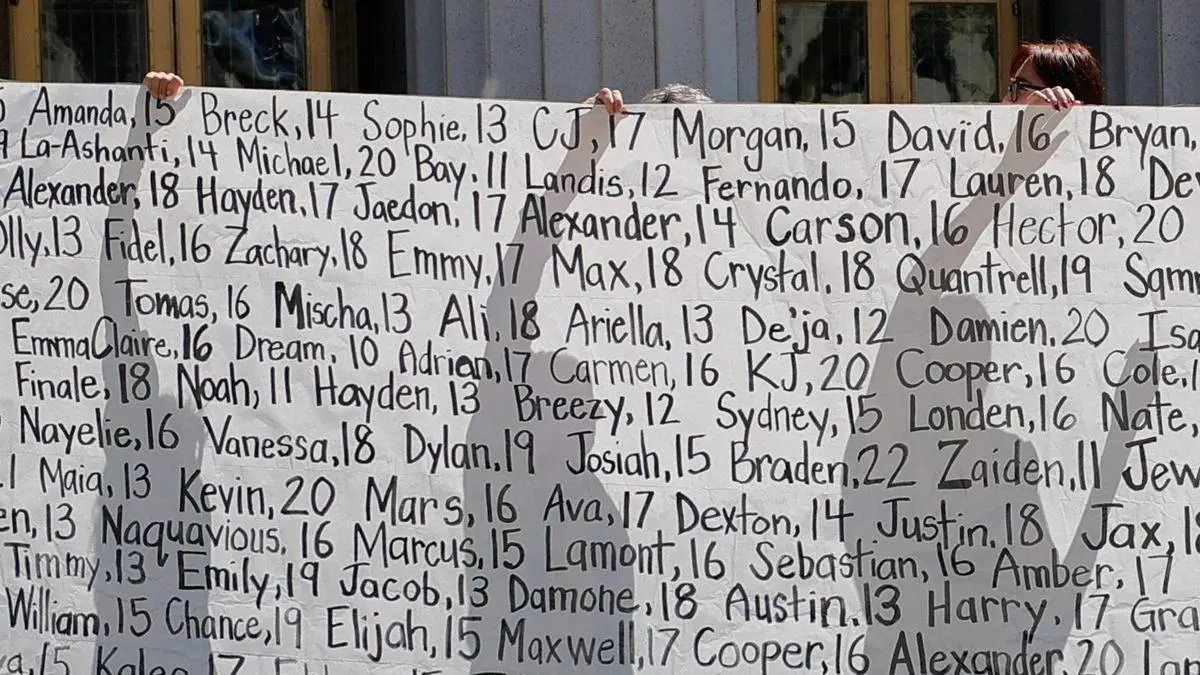
Parents who say they have lost their children due to social media hold up a banner with the names of the children outside the court after the jury found Meta and Google liable in a key test case accusing Meta and Google’s YouTube of harming children’s mental health through addictive social media platforms, in Los Angeles, California, U.S., March 25, 2026.
| Photo Credit:
REUTERS/Mike Blake
Recent jury verdicts in California
and New Mexico involving Meta Platforms and Alphabet’s
Google are sharpening scrutiny of social media
companies as plaintiffs advance legal theories aimed at holding
platforms liable for harm to children. Here’s a look at how the
cases could be an early test of how courts may handle similar
claims going forward.
WHAT DID THE LOS ANGELES JURY FIND?
The jury ordered Meta and Google on Wednesday to pay a combined
$6 million in damages to plaintiff Kaley G.M., a 20-year-old who
said she suffered from depression and suicidal thoughts after
becoming addicted to the companies’ platforms at a young age
because of their attention-grabbing design. The jury found that
both Meta and Google were negligent in designing their
platforms and failed to warn consumers about their risks.
WHAT HAPPENED IN NEW MEXICO?
Separately, a jury in New Mexico on Tuesday ordered Meta to pay
$375 million after finding the company misled users about the
safety of Facebook and Instagram while enabling child sexual
exploitation on those platforms in a lawsuit brought by the
state’s attorney general.
WHY ARE THESE TRIALS IMPORTANT?
The trials were the first to test whether Big Tech can be
held liable for the design of apps blamed for harming young
people’s wellbeing. Meta, Snapchat and parent Snap Inc.
, Google’s YouTube, and TikTok and parent ByteDance are
facing thousands of lawsuits in federal and state courts over
claims they knowingly designed their platforms with features
that addict children and teens, fueling a mental health crisis.
WHAT DOES THE VERDICT MEAN FOR OTHER LAWSUITS?
The Los Angeles trial is meant to serve as a bellwether, or
test case, for the thousands of similar lawsuits consolidated in
California state courts. Verdicts in bellwethers are often used
by judges and attorneys to assess the potential value of
remaining claims and guide settlement negotiations. Typically,
multiple bellwethers will be tried before a broader settlement
or resolution is reached.
WHAT OTHER KINDS OF LAWSUITS ARE PENDING?
Beyond the California state court cases, more than 2,400
lawsuits against Meta and other social media companies that make
similar claims have been centralized in the California federal
court. The federal litigation also includes lawsuits brought by
state attorneys general alleging harm to their states, as well
as cases by school districts that say social media addiction has
caused costly disruptions and problems.
While there can be some coordination between state and
federal courts overseeing similar claims, verdicts in state
court do not typically have a direct impact on the federal
litigation.
WHAT LEGAL QUESTIONS REMAIN?
Both the New Mexico and the California cases highlighted a
central legal dispute that is likely to shape future cases: how
much federal law shields social media companies from liability.
Meta, Google and other social media companies have argued
such lawsuits are barred by Section 230 of the Communications
Decency Act, which generally protects platforms from liability
over user-generated content. Plaintiffs counter that their
claims target the sites’ design features that cause harm rather
than the content itself.
The judges in Los Angeles and Santa Fe rejected that
argument when they allowed the cases to go to trial. The
verdicts could form the basis of appeals that would give higher
courts a chance to weigh in on the key question of whether
Section 230 applies to claims focused on platform design rather
than content.
WHAT COMES AFTER THE VERDICTS?
In May, the judge in New Mexico will oversee a second phase
of that trial where the state attorney general will ask for a
court order directing Meta to make changes to its platforms and
for additional monetary damages.
Meta said it will appeal both verdicts. Google said it will
appeal in the Los Angeles case.
In addition to the Section 230 question, the companies
could also base appeals on events surrounding the trial,
including the judge’s decision-making on evidence, or jury or
attorney conduct.
WILL THERE BE MORE TRIALS?
Yes, in both state and federal courts. A trial is scheduled
for June in federal court in a lawsuit brought by a school
district in Breathitt County, Kentucky, against Meta, ByteDance,
Snap and Google, according to court records.
In California state court, another trial is slated to begin
in July involving claims against Instagram, YouTube, TikTok and
Snapchat.
Published on March 26, 2026


