



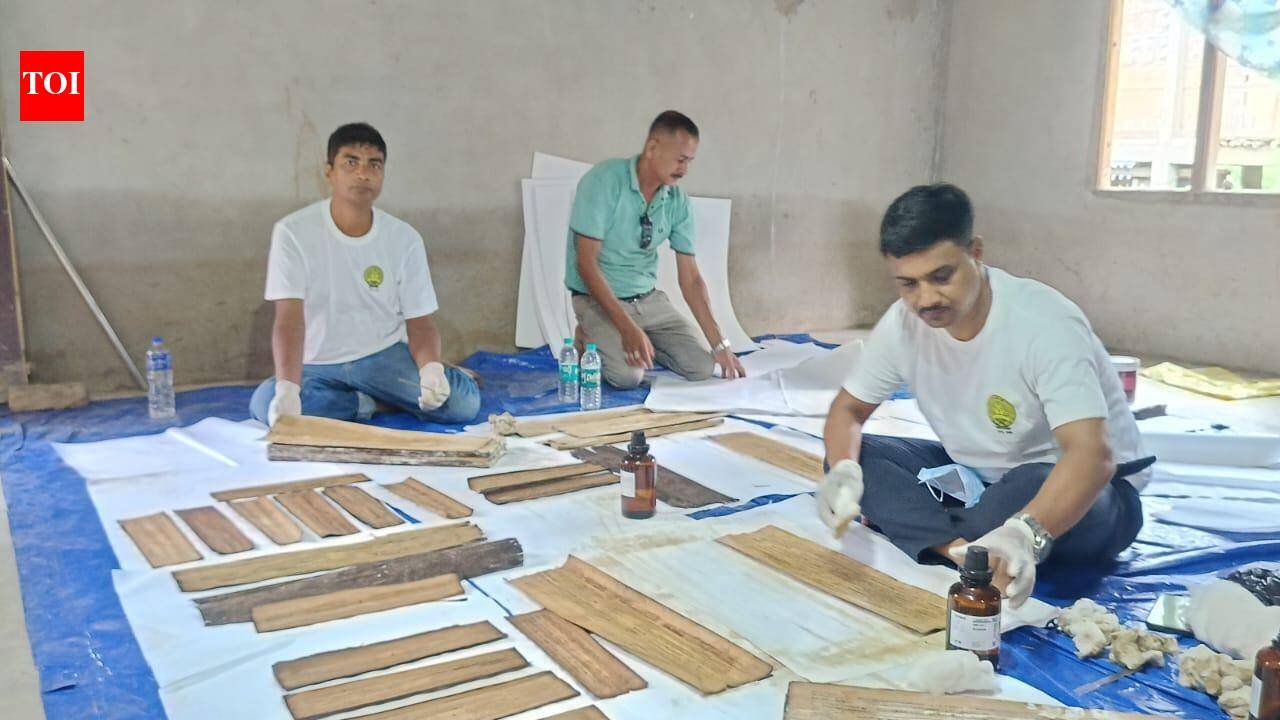
Guwahati: In flood-hit Medhijan village of Assam’s Sivasagar district, conservation experts are working to salvage centuries-old heritage from the ruins. Inside the historic Gajala Satra, a revered Vaishnavite monastery, a team from Gauhati University is restoring rare handwritten manuscripts on sanchi leaves — priceless relics of Assam’s literary and spiritual tradition now threatened by floodwaters and fungal decay.Armed with specialised antifungal solutions and delicate conservation tools, a team from the university has been working tirelessly to restore the manuscripts — written long before the printing press arrived in Assam.After reaching the satra on Saturday, the team completed restoration treatment of 38 of the monastery’s most significant manuscripts by Monday, meeting the initial target set for the project. But the collection extends beyond the monastery. Several manuscripts preserved by families traditionally associated with the satra have also suffered damage.The texts, estimated to be 250-300 years old, include sacred Vaishnavite works such as “Kirtan”, “Dasham”, “Namghosa”, “Bhakti Ratnawali”, “Bhakti Premawali”, “Ramayan”, “Vyakhyashram Kathasar”, “Gopal Atar Charit” and “Adi Charit”.“Water flooded suddenly and people were running to save their lives, while these manuscripts got submerged. People were crying after seeing the manuscripts when they came to the satra after the water receded,” said Medini Mohan Gogoi, scientific officer (Indian Knowledge System) at the university’s centre for Southeast Asian Studies.Established in the 18th century during the reign of Ahom King Lakshmi Singha, Medhijan Gajala Satra remains an enduring symbol of Assam’s Vaishnavite heritage.The rescue operation began after Sivasagar MLA Akhil Gogoi drew attention to the damaged collection, prompting university vice-chancellor Prof Nani Gopal Mahanta and registrar Prof Utpal Sarma to immediately dispatch a conservation team. Medini Mohan, accompanied by archival assistant Dhanjit Talukdar of the university’s KK Handiqui Library, has been painstakingly treating the fragile manuscripts since Saturday.“The manuscripts were partially damaged by muddy floodwaters and fungal growth. We have treated all 38 priority manuscripts since Saturday, but it is a long process, and restoring them to their original form is a major challenge,” Gogoi said.Among the oldest manuscripts found are a “Ramayana” believed to be over 300 years old, a 263-year-old copy of the “Kirtan” and an equally old “Dasham” (from the “Bhagavata”), all handwritten on sanchi leaves by traditional scribes.The restoration follows scientific protocols of the National Mission for Manuscripts and INTACH. Each page is carefully separated, cleaned and treated to prevent further fungal damage.“We are primarily carrying out antifungal treatment because fungal growth is the biggest threat after the flooding. The manuscript pages became stuck together almost like they were glued after remaining submerged in water, making the restoration process extremely delicate,” Medini Mohan added.


