



In his book Man-Eaters of Kumaon, Jim Corbett recounts following the alarm call of a langur — “khek-khek-khekerr” — to track a tiger. Today, almost every naturalist and self-taught wildlife photographer will tell you the same thing: your eyes, ears and nose are your best guides when searching for the bird or snake that drew you to the forest.
Wildlife tourism in India is booming. According to business consulting firm Grand View Research, the wildlife tourism market in India was valued at about $11.2 billion (over ₹1,100 crore) in 2023 and is projected to grow at around 10% annually until 2030.
During the peak season (November to April), national parks receive a steady stream of visitors. A jeep safari with armed forest guards is one way to experience the wild. But there is another approach: travelling with birders, naturalists and photographers who help visitors understand the flora, fauna and subtle signals of the forest.
In Assam’s Dima Hasao district lies Hajong Gajam (Hajong Lake), the only known natural habitat for rare and endangered freshwater turtles and hill terrapins. Reaching this biodiversity heritage site requires navigating narrow paths through dense bamboo thickets. The village headman, Joypen Kemprai, guides visitors along the route, helping them avoid the giant webs of tiger spiders that thrive in the damp forest.
From a watchtower overlooking the lake, we waited for a glimpse of a tortoise. Joypen used the pause to explain the forest. “The bamboo you see keeps this area moist, creating the right environment for tortoises,” he said. “Some of these trees are more than 200-years-old.” After about 20 minutes — and a short lesson in bamboo ecology — a tortoise finally emerged to sunbathe. Without Joypen’s knowledge, the moment would have meant far less. He charges nothing for guiding visitors. “Without understanding,” he says, “the forest remains hidden.”
The old trees at Hajong lake in Dima Hasao
| Photo Credit:
prabalika m borah
Inspired by such efforts, several young people in Dima Hasao now accompany visitors — not merely as guides but as educators. They introduce travellers to local experiences, such as sipping tea brewed and served in fresh bamboo tubes at the Bendao Baglai waterfall, one of the region’s distinctive treks. Trips here are often organised by Guwahati-based travel organiser Naushad Hussain (www.adventura.in), who works with local youth to help visitors understand the landscape.
Trekkers at Bendao Baglai
| Photo Credit:
Prabalika M Borah
If you are looking for adventure that is not confined to a park, mountaineer and certified instructor Shekhar Bordoloi (@jajabori_xibir_official on Instagram)hosts tourists at his wild retreat in Nagaon, Assam. “Nothing is fancy here, because the experience with the wild is all about closeness to Nature. We take visitors to a wild waterfall, on hikes, and rappelling in the natural environment. The cost for camping varies from ₹1,000 (without activities) to ₹2,500 with rappelling.”
Understand the terrain
In Ladakh, Hyderabad-based photographer Ismail Shariff (@ismailshariff on Instagram)has spent years camping at 3,600 metres in search of the elusive snow leopard. Using a Swarovski BTX spotting scope, which offers true-to-life images and the comfort required for long-term observation, he now hosts expeditions for visitors from Singapore, the UK, the US and Switzerland. Most are not photographers; they simply hope to glimpse the rare mountain cat.
Ismail with other photographers at a Snow Leopard camp
| Photo Credit:
Special Arrangement
Ismail began organising such trips after joining one himself in 2017. It took him nearly two years to see his first snow leopard. Today, his team includes experienced spotters who track the animal’s movements across the terrain. The cost involved in going on a snow leopard expedition can cost upwards of ₹1,75,000 for an 11-day expedition.
Spot the Snow Leopard, photos by Ismail Shariff
| Photo Credit:
Ismail Shariff
He also added, “Expeditions like these are multi-layered,” he says. “They’re not just about sightseeing.” Interest grew through requests on his Instagram page. “When the enquiries kept coming, I realised there was demand. Now, I organise expeditions to Spiti and Leh twice a year.” Ismail is clear about ethics: conservation, he says, should never involve baiting wildlife for photographs..
Spotting a snow leopard is extremely tricky because it blends well with the environment they are found in. Ismail explains, “Spotting a snow leopard is less about finding a cat, and more about convincing your eyes that the mountain has quietly grown whiskers.”
For Bengaluru-based wildlife photographer Koushik Chattopadhyay, koushiksphotos_graph on Instagram) the first lesson is learning to read the forest — listening to bird calls, watching subtle movements and understanding animal behaviour.
Koushik Chattopadhyay
For Koushik, who works in IT, photography began as a way to observe wildlife closely. Over time, friends and fellow enthusiasts began joining him on field trips. Those informal outings from 2022 gradually evolved into organised journeys centred on respectful wildlife observation and photography.
He keeps his groups small — never more than eight participants. “Planning begins with the season, animal activity and the skill levels of participants,” he explains. “I coordinate logistics, permits, safety measures and ethical guidelines so the experience remains respectful to wildlife.” Koushik’s favourite destinations include Wayanad and Munnar in Kerala for their biodiversity, and the tiger reserves of Madhya Pradesh for big-cat sightings. Internationally, he recommends Yala National Park (Sri Lanka) and Maasai Mara National Reserve (Kenya) for wildlife encounters.
Photos of wildlife captured by Koushik Chattopadhyay
| Photo Credit:
Koushik Chattopadhyay
Koushik does not charge for trips, as most participants are friends or colleagues. But he says if one were to sign up with other guides, costs may vary depending on the destination and duration. A four-day macro photography trip — or ‘herping’ — in Munnar or Wayanad may cost between ₹30,000 and 45,000 per person. A Masai Mara safari can cost around ₹1.9 lakh per person for a couple of days, while a series of tiger safaris in India may range between ₹30,000 and ₹40,000 per person for eight drives.
Off the beaten track
Such journeys often lead travellers to lesser-known landscapes — places that are neither sanctuaries nor safari parks. As Assam-based naturalist, wildlife biologist and conservationist Nilutpal Mahanta( @dr_nilutpal on Instagram) points out, these locations also avoid the practice of baiting wildlife for close-up sightings.
Birds of Northeast by Nilutpal Mahanta
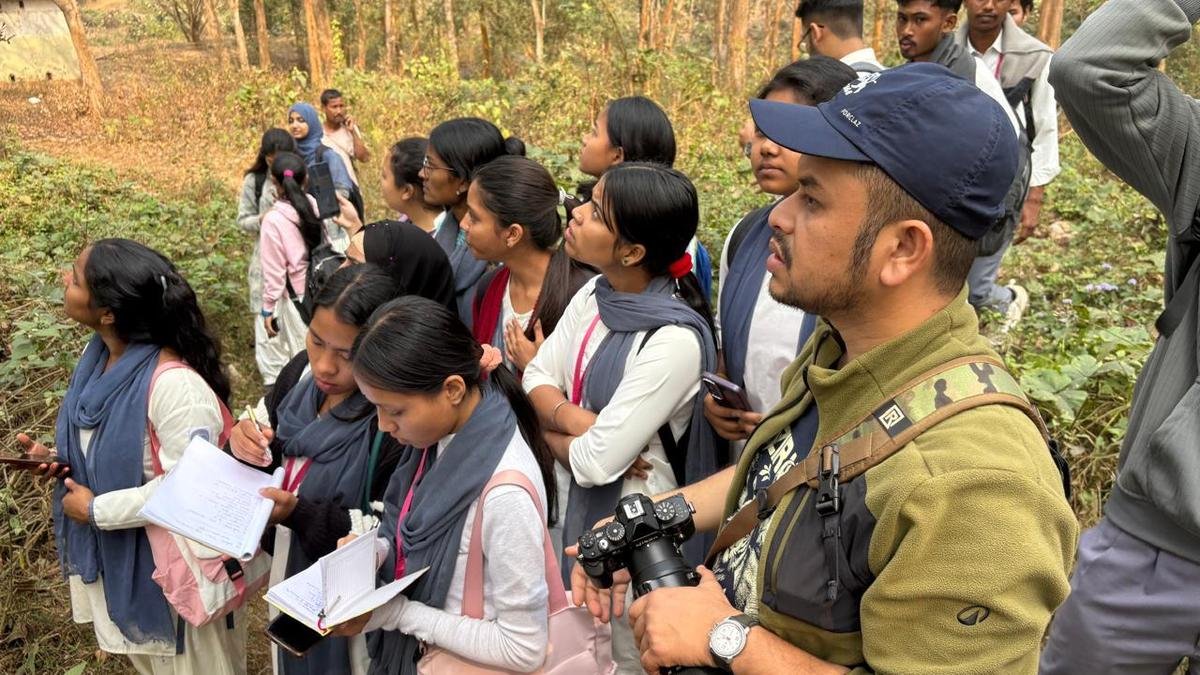
Nilutpal says the Northeast’s biodiversity is often overshadowed by its most famous species, the Indian rhinoceros. “Nearly 45% of migratory birds visit the Northeast, yet conversations focus only on rhinos,” he says. He frequently takes student groups and birdwatchers into the field — not to teach photography but to help them observe birds in their natural habitats.
He is glad that hide tourism — specialised setups offering close wildlife views for photographers — has not taken root in Assam. “I want visitors to feel the thrill of trekking eight kilometres to see the bird they have been hoping to find,” he says.
Grey Bellied Cuckoo
| Photo Credit:
Nilutpal Mahanta
Nilutpal’s treks often expand beyond birds. At Eaglenest Wildlife Sanctuary, in the Himalayan foothills of West Kameng District, Arunachal Pradesh, he introduced students to pteridophytes and bryophytes — primitive plants that help break down rock and form soil. “I asked them to touch the rocks,” he recalls. “When the sandy residue stuck to their hands, I explained how bryophytes work.”
Nilutpal Mahanta
| Photo Credit:
Special Arrangement
His favourite birding destinations include Eaglenest, Namdapha Tiger Reserve, Mishmi Hills, Dihing Patkai, Nameri, Panbari near Kaziranga National Park and Garbhanga near Guwahati — landscapes known for rare migratory birds. Naturalists leading such trips typically charge between ₹7,000 and ₹8,000 per person per day.
Travel with these storytellers, conservationists and educators, and you begin to see why those who understand a forest are more likely to protect it than those who merely pass through.


