






who made it all possible.
Dear Reader,
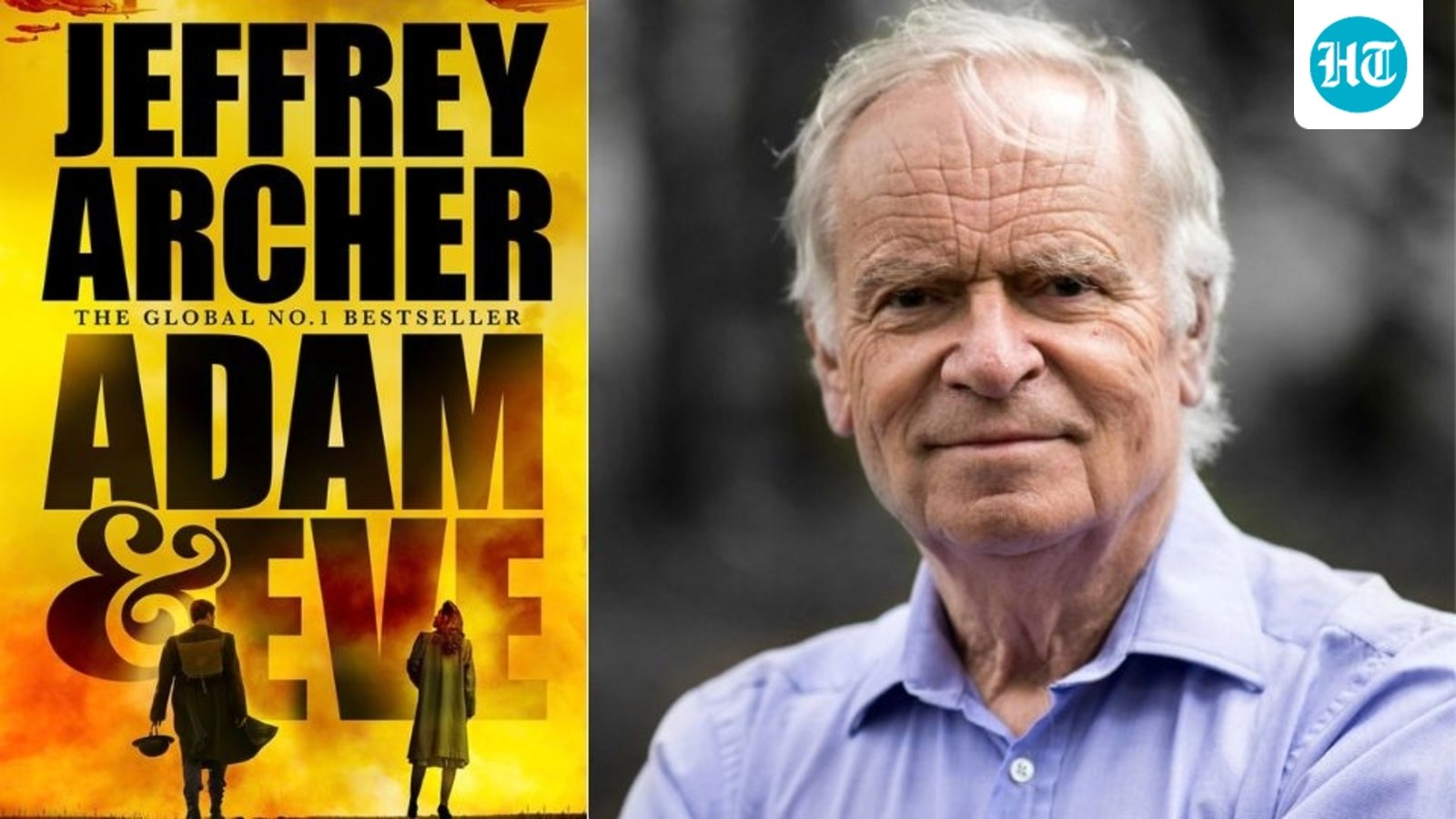
After fifty years of storytelling, I have decided the time has come to write my final novel.
I first had the idea for Adam & Eve when reading a speech Adolf Hitler made in 1940 that caused Winston Churchill to respond in kind in the House of Commons later that year.
Churchill’s words inspired me to read several more speeches by both war leaders, while at the same time seeking advice from two eminent historians, even before picking up my pen to write Adam & Eve.
The idea itself was simple enough: if Hitler hadn’t changed his mind, three times, on 15 September 1940, concerning Operation Seelöwe, could the Second World War have ended within days, and which side would have been the victor? If Hitler had stuck to his original plan, would history have taken a different course?
But, as a writer, how do you tackle such a momentous challenge? I decided to tell the story through the eyes of two young people who came from totally different backgrounds. One was the daughter of an earl, the other was the son of a shepherd, but they had one thing in common: they were both born on the eleventh day of the eleventh month in 1918, when the First World War ended.
You can follow their lives, from their birth on that day, to the fifteenth of September 1940, when they caused Hitler to once again change his mind, which not only changed their lives, but possibly all of our lives.
I’ve spent many happy hours over the past fifty years since writing Not a Penny More, Not a Penny Less in 1976 (3,000 copies sold in hardback), Kane and Abel in 1979 (now in its 132nd reprint), and more recently, from 2018, the William Warwick series. However, Adam & Eve has now proved to be my most satisfying writing endeavour, and I can only hope you will feel the same way.
Allow me to end by thanking all my readers from around the world, in 119 countries (translated into 51 languages) from Sydney to Toronto, from Buenos Aires to New York, from Mumbai to Tokyo, while not forgetting my homeland, which has allowed this simple storyteller the privilege of spending so many hours in your company. I should have been Prime Minister, captain of the England cricket team or won an Olympic gold for the hundred metres, but then we can all dream. As Marcel Proust reminded us:
‘We always end up doing the thing we’re second best at.’
I can only hope that you’ve discovered what you’re second best at.
Farewell, and thank you.
Jeffrey Archer
In the Beginning
Those who cannot remember the past are condemned to repeat it
-G. Santayana
Chapter 1
11 November 1918
He was dreaming when there was a knock on the door.
Bill Turner turned over and buried his head in the pillow, still hoping it was a dream, but the knocking ignored his wishes. If anything, it was louder and more persistent. He reluctantly opened his eyes and blinked at the bedside clock: 4.11. One of the perils of being a family doctor. He rested for a moment, but when he looked again the clock had moved on to 4.12, as if in agreement with whoever was knocking.
The doctor slowly pushed himself up, pulled back the covers and placed his feet gingerly on the carpet. He put on his dressing gown and slippers, padded across to the window and looked down to see the Earl’s butler staring up at him.
Mr Frampton had served the Brancaster family for the past three decades as a page boy, footman, under-butler and ultimately butler to the seventh, eighth and now ninth Earl. He was not a man who panicked under pressure, but the look on his face revealed an anxiety the doctor had not experienced in the past.
Pulling up the window, Dr Turner called out, ‘Good morning, Frampton.’
‘The Countess has gone into labour,’ said Frampton, without returning the salutation. ‘The Earl has asked if you could—’
Dr Turner turned back and began putting on yesterday’s clothes before Frampton could finish the sentence. The Countess of Brancaster would be giving birth at least six weeks early, so he didn’t have a moment to lose.
As the doctor pulled on his socks and shoes, he glanced across at his wife, who hadn’t stirred. But then, not even a world war could wake Edna.
He quietly closed the bedroom door behind him and jogged down the stairs while still doing up his waistcoat buttons. When he reached the bottom step, he grabbed his doctor’s bag from the hall stand and opened the front door.
The butler was holding open the back door of the Rolls-Royce, engine running – there wasn’t a moment to spare.
‘Good morning,’ repeated the doctor, as he climbed inside. ‘Good morning, sir,’ said Frampton, as he closed the door and joined the chauffeur in the front.
Dr Turner had barely sat down before the car took off, heading for the Hall at a speed he had not experienced before. As the Silver Ghost sped along the country lanes, the doctor took a handkerchief out of his top pocket, bent down and began to polish his shoes. He’d never been in the presence of the Earl unshaven and wearing yesterday’s clothes, even if they were his Sunday best. He sat back up, his thoughts returning to the more immediate problem. The Countess of Brancaster had already suffered two stillbirths – two boys who’d both entered this world, but had never seen the light of day. Dr Turner had advised the Earl against putting his wife through the same ordeal a third time, but, while his lordship had accepted his judgement, the Countess had insisted that, despite the risks, they should make another attempt to pro- duce the son and heir they both so desired. In fact, only a few months after being invalided back from the front and returning to Brancaster, the ninth Earl proudly announced to his assembled staff that the Countess was with child. He would never have uttered the word pregnant.
Everyone had rejoiced at the news, except for the doctor, who kept his counsel. Whenever asked, the Earl would just say the oft-repeated phrase ‘third time lucky’. After all, if Anne produced a son, the boy would, in the fullness of time, inherit not only Brancaster Hall, along with its eleven thousand acres of land, but, more importantly, he would succeed to the title as the tenth Earl of Brancaster. If not, the title and estate would eventually pass to the Earl’s younger brother, Dudley, who was described, both above and below stairs, as the black sheep of the family.
As the Hall came into sight, Dr Turner gazed out of the window at the magnificent Andrea Palladio mansion, which dominated the landscape as far as the eye could see, with its four identical façades and a portico of Ionic columns, crowned by a hemispherical dome, creating one harmonious whole.
The Rolls-Royce skidded to a halt on the gravel path outside the entrance, and Dr Turner leapt out of the car before Frampton could open the back door. He rushed up the steps to find the front door already open and, not breaking his stride, continued across the great hall and up the sweeping marble staircase, past portraits of the eight previous Earls of Brancaster.
The doctor could hear screaming coming from the bedroom long before he reached the ninth holder of that title.
Charles Clarence Arthur Pierpoint Brancaster was pacing up and down the corridor outside his wife’s bedroom, while two young Labradors remained stationed by the door.
Dr Turner glanced at the Earl. His usual air of self-confidence had been replaced with a look of anxiety that revealed his youth. Indeed, the ninth Earl of Brancaster was only in his early thirties, having acceded to the title following his father’s premature death from lung cancer.
The Earl came to an abrupt halt the moment he saw the doctor. ‘Thank God you’re here,’ were the only words he uttered.
‘Good morning, my lord,’ said Dr Turner, giving the Earl a slight bow before walking straight past him and entering the master bedroom.
He closed the door behind him and took a deep breath as he hastened towards his patient.
The scene before his eyes told the doctor all he needed to know. As the Countess let out a feeble moan, he turned to the midwife, who took him by surprise when she said, ‘I think it might be twins.’
The doctor nodded.
The next fifteen minutes were spent in a desperate attempt to save the Countess’s life, but her cries were growing fainter by the moment, until she finally fell silent.
Dr Turner checked her pulse, a pointless exercise as his patient had already departed this world, and his single purpose now was to save the twins.
He quickly extracted a scalpel from his bag and set about cut- ting open the womb. Carefully, gently, he removed a tiny, wrinkled, vernix-coated boy, whose eyes never opened, followed moments later by a girl whose eyes did open, but she was so tiny that Dr Turner assumed that, like her brother, she could not hope to live. Bill Turner waited for a few minutes before he stepped back out into the corridor to face the expectant father. How did he begin to tell the Earl he’d lost his wife and a son but should be thankful he had a daughter; not that he could be sure even she would survive.
Charles Brancaster stopped pacing, a ray of hope in his eyes. ‘I’m sorry to be the bearer of such sad news, my lord,’ said the doctor quietly, ‘but I was unable to save the Countess. However, I safely delivered one of the children.’
‘One?’ repeated the Earl in a daze.
‘Yes, a little girl, whom we must pray will survive.’ ‘And the other child?’ asked the Earl.
‘A boy,’ said Dr Turner, ‘who was sadly stillborn. There was nothing I could do to save him.’
When the Earl finally spoke, his words were barely audible. ‘A boy, you say?’
The doctor nodded.
No further words passed between them, as there was nothing more the doctor could do to alleviate the pain. He’d attended enough births that had ended sadly to be well aware what the Earl was going through.
If only the Earl and Countess had taken his advice, although he accepted he could never again mention the word ‘twin’ in his presence.
Another two hours passed before Dr Turner was finally able to leave the Hall, having done everything he could for his latest patient. He left the midwife in charge and was driven slowly back home to find that his wife was now awake.
As he took off yesterday’s clothes, Edna asked, ‘Who got you up at such an ungodly hour?’
He told his wife about the tragic death of the Countess and her son, and the birth of a girl. ‘However,’ he said, his voice almost a whisper, ‘I’ll be surprised if the little mite survives the day.’
‘How sad,’ said Edna. ‘If only the Earl and Countess had heeded your warnings—’
The doctor placed a finger to his lips. ‘I wish I’d been more insistent,’ he admitted. ‘Perhaps I might have been, with a less important patient. Let’s pray the girl will still be alive when I return to the Hall later today, but I wouldn’t count on it.’
His wife left to prepare breakfast, while he disappeared into the bathroom. He sharpened his cutthroat razor on the thick leather strap hanging from the wall, covered his face with lather and set about removing yesterday’s stubble. He cut himself while thinking about the newborn child and her chances of survival.
After a quick check in the mirror, he returned to the bedroom and dressed in a dark blue double-breasted suit and a white Van Heusen shirt with a starched collar that his wife had laid out for him.
As he came back downstairs, he spotted the morning paper lying on the mat. The front page brought a smile to his face.
He sat down at the kitchen table and began to read an article reporting that the armistice would be signed that morning. At last, something to rejoice about.
His wife removed a three-and-a-half-minute boiled egg from the saucepan and placed it in her husband’s egg cup. He picked up a spoon, tapped the egg firmly and deftly removed the top, to watch a dribble of yolk run down the shell.
‘Perfect,’ he announced, just as there was another knock on the door.
Dr Turner reluctantly put down his spoon and let out a deep sigh, assuming Mr Frampton had returned to confirm his worst fears.
When he hurried out of the kitchen and opened the front door, it wasn’t the butler he found standing on the doorstep but a farm labourer, cap in hand, head bowed.
‘It’s Preston, isn’t it?’ enquired the doctor.
‘Yes, sir. Sorry to bother you at this time in the mornin’, but I think my Maisie is about to deliver.’
The doctor was well aware that my Maisie worked at the Hall, under the watchful eye of Frampton, while her husband, Tom, was the Earl’s head shepherd. But then, almost every family in the village had someone who worked for the Earl.
Abandoning his breakfast, Dr Turner once again grabbed his doctor’s bag from the hall stand, stepped outside and closed the door behind him.
‘This will be your first, if I remember correctly,’ he said, as Preston joined him on the front seat of his Bullnose Morris.
‘Yes, sir,’ said Preston.
‘No doubt you’re hoping for a boy,’ said Turner. Like the Earl, he was about to add, but stopped himself just in time.
‘I’d prefer a girl,’ said Preston, ‘so she’ll never ’ave to go to war.’
‘Then you can’t have heard the news,’ said the doctor, as he headed for the farm labourers’ cottages on the far side of the estate.
‘What news?’ asked Preston, who never read a paper and didn’t possess a wireless.
‘Germany has finally surrendered, and the armistice will be signed in a railway carriage in the French Forest of Compiègne at eleven o’clock this morning.’
Preston shrugged. ‘But how long before those Krauts are at it again?’ he asked.
Dr Turner didn’t offer an opinion as he drew up outside Tom’s home.
The doctor’s first thought, as he got out of his car, was that the contrast between Brancaster Hall and the shepherd’s small thatched cottage couldn’t have been greater. No butler holding open the back door of a Rolls-Royce. No grand marble staircase to mount. No midwife waiting to assist. No Labradors on guard – just a sleeping collie lying by the bed, eyes closed, head resting between its legs.
Maisie Preston delivered her child at the end of the ninth month, and she didn’t scream once. The doctor proceeded in a calm and measured way to assist the birth, and was relieved when a little head popped out, eyes wide open. A baby boy appeared, looking as if he couldn’t wait to start his life. He began to scream just as a peal of bells started to ring out from the local church – the sign that the armistice had been signed and the war was over. The dog sprang up, stretched and wagged its tail.
Dr Turner didn’t leave Mrs Preston until the baby was cradled in his mother’s arms, contentedly asleep, having feasted on his first meal.
When the doctor left the cottage, he checked his watch: twenty past eleven. He decided to return to the Hall and check on his other patient. During the journey, he noticed that a couple of sheep had escaped from their pen and the birds were chirping at the tops of their voices, as if even they knew the war was over. He passed several farm labourers who were celebrating – one or two of them were already the worse for wear, although it was not yet midday.
As he approached the crested wrought-iron gates, he couldn’t fail to notice that the family standard on the roof of Brancaster Hall had been lowered to half-mast. He offered up a silent prayer in the hope he would not be signing a third death certificate that morning.


