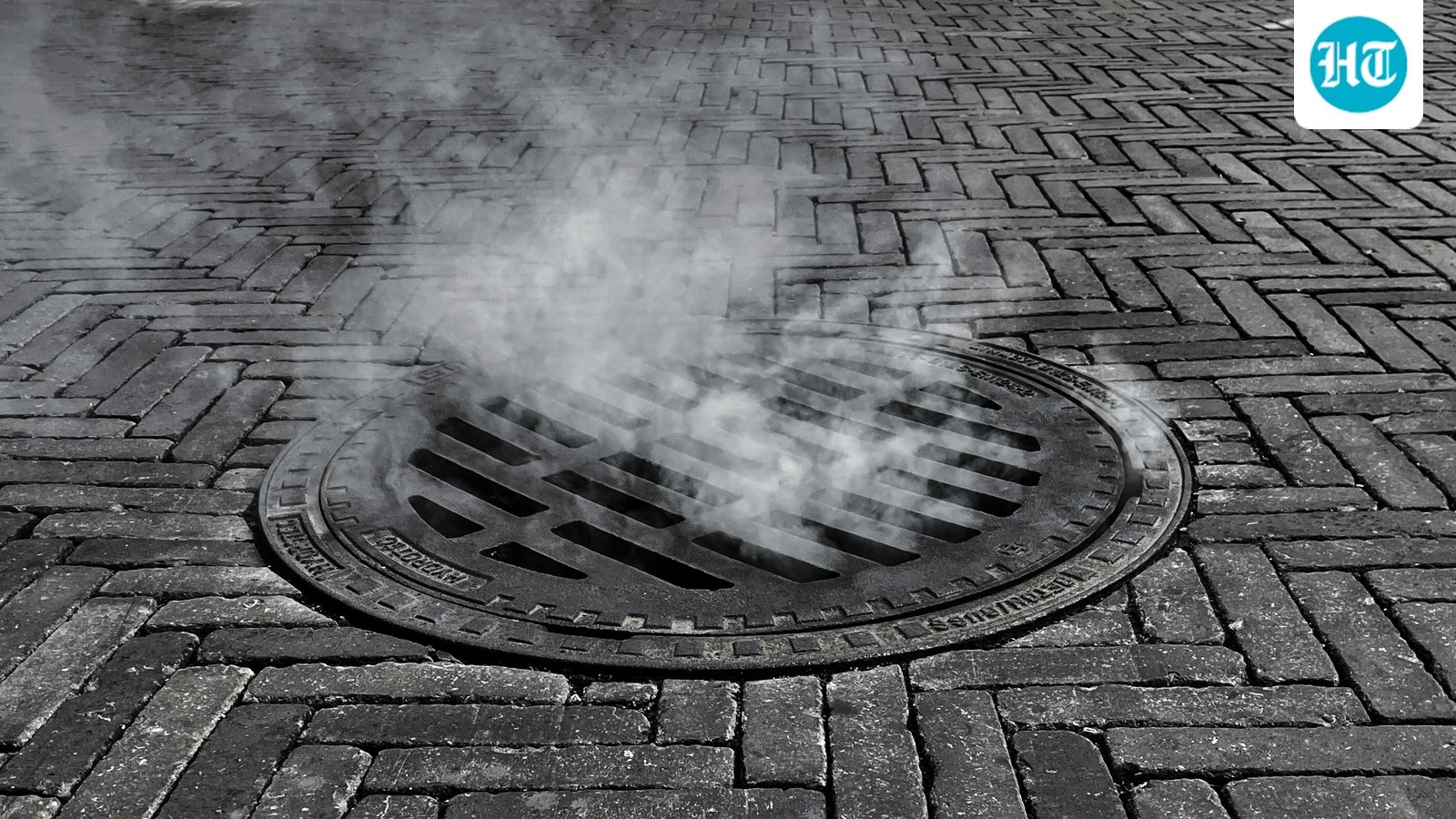
Have you ever walked past a manhole and wondered why its cover is almost always round? While there’s no universal rule that manhole covers must be circular, round covers are far more common than square, rectangular or triangular ones. Read on to find out why. (Also read: Why do Indian sweets have silver layer on top? )
Why round covers are safer and easier to handle
According to the American Water Works Association (AWWA), one of the biggest advantages of a circular manhole cover is that it cannot fall through its own opening. Unlike a square or rectangular cover, it has no corners that can be angled diagonally and slipped through the hole. This also makes installation easier. A round cover can be placed back over the opening without having to align specific corners or edges.
Manhole covers, particularly those made of cast iron, can be extremely heavy. Moving one by lifting it can be difficult and unsafe. A round cover, however, can simply be rolled from one location to another when maintenance or repair work is being carried out. This makes transportation easier and reduces the physical effort required to move it.
How circular covers offer strength and efficiency
The tools commonly used to create manhole openings typically produce circular holes. A circular cover therefore provides a natural fit for the opening while making installation and replacement relatively straightforward. Since there are no corners or edges to line up, workers can reposition a round cover from any angle.
Manhole covers need to withstand significant loads and pressure, including the weight of vehicles passing over them. A circular design distributes pressure more evenly across its surface and avoids the stress concentrations that can occur at the corners of square or rectangular covers.
For a cover of comparable dimensions and strength, a circular design can also be material-efficient. Its geometry allows manufacturers to create a strong cover without unnecessarily adding material around corners. This can make circular covers economical to manufacture while maintaining the required strength.
So, why not square?
Square and rectangular manhole covers do exist, but they come with some practical disadvantages. They need to be correctly aligned during installation, can have greater stress concentration at their corners and, depending on the dimensions, can potentially fall through the opening when turned diagonally.
Round covers avoid these issues while also being easier to roll, install and reposition. So, the next time you see a round manhole cover on the street, remember that its shape is not simply a design convention. It is an engineering choice that combines strength, safety, portability and ease of installation.
Source link