



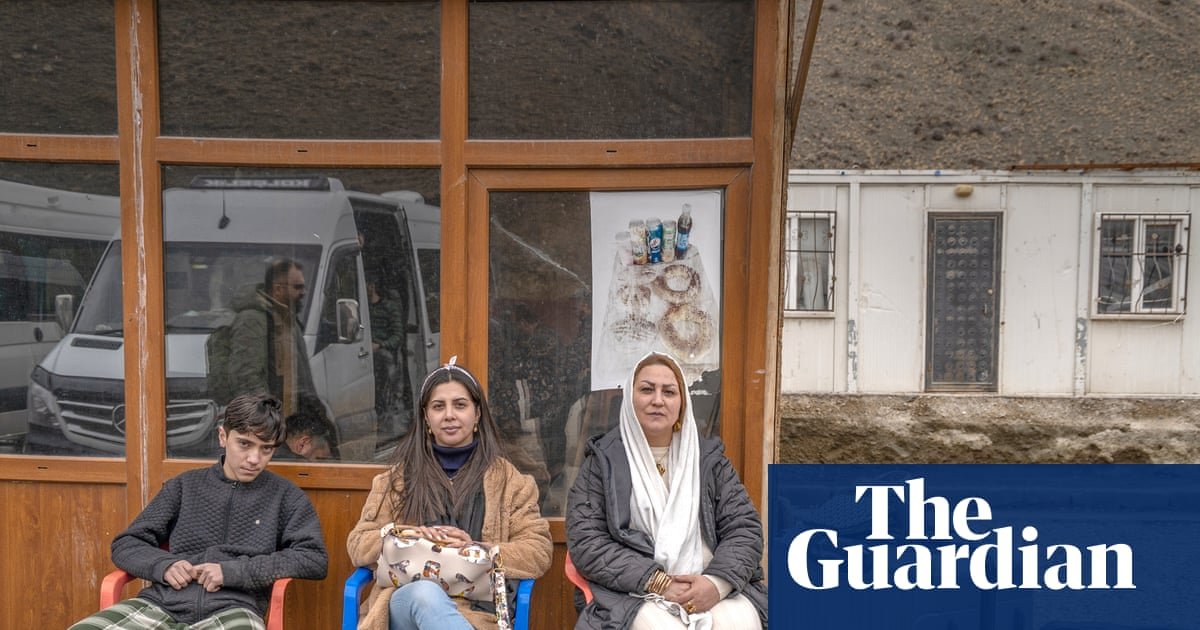
He could not help but splutter out a laugh at the question. Amir, whose name has been changed for his safety, had just crossed the Kapıköy border point in eastern Turkey, a mountain pass between snow-topped peaks that is one of the few gateways to the west from Iran.
Until a few weeks ago, this was a busy place, popular among Iranian daytrippers coming across to Turkey to do some shopping in the lively city of Van, a further two hours drive west, or to spend a couple of nights out in its discreet Iranian-only nightclubs and bars serving alcohol.
Back then, there had been plenty of reasons that an Iranian might give for making this trip. But today, just about visible behind Amir, was the lifeless black flag raised a month ago by the Iranian regime after the death under US and Israeli strikes of the supreme leader Ali Khamenei.
“Why? Amir asked back with a smile when questioned as to his motivation for leaving Iran. “Boom,” he responded. “Because of the war. Every night they are bombarding.”
Not that Amir, who had come from Tehran, was bitter about the American and Israeli campaign. “We must want to get rid of the regime,” he said. “Thank you to Trump,” he added with a weary nod of the head.
Amir, 33, a foreign exchange and crypto currency trader by profession, had no means to make a living in Tehran now. “No internet, no job,” Amir said of the internet blackout imposed by the Iranian regime over the last month. “I hope [the bombing] is working. Every night, bombs. Nearby cities, industrial areas and military bases, completely destroyed.”
A pharmacologist from Tehran was travelling to see her three adult daughters in Europe and intended to spend three months away. “All of the people live with anxiety,” she said. “I don’t like Trump but it is right this time for the Iranian people. We are very tired about the revolution of [the] Islamic republic of Iran. Most people like Trump because he might change the regime. We are very tired.”
Kapıköy, which translates as “village of the gate”, has not witnessed huge numbers of people fleeing Iran. According to the UN refugee agency (UNHCR), close to 64,000 Iranians arrived in Turkey between 3 and 30 March and more than 48,000 Iranian nationals went back into the Islamic Republic.
“The current volume of movement remains notably lower than pre-conflict levels, when crossings from both sides averaged approximately 5,000 individuals per day,” a UNHCR spokesperson said.
Turkey has plans to manage mobility from the border in case of an influx, creating a buffer zone and establishing tent cities for up to 90,000 people. It has not yet been necessary, although there are four army and security service checkpoints for those driving from the border to Van. Heavily armed soldiers in khaki could be seen on patrol by the roadside.
Salvador Gutiérrez, the chief of mission in Iran for the International Organization for Migration, speaking via a video call from Tehran, said people were moving internally within Iran, largely to the northern provinces close to the Caspian Sea.
People had been coming back to Tehran and the other cities in recent days, he said. It is understood that part-government-owned corporations that are central to the Iranian economy have started to order people back to work.
“Many people have savings or are receiving some support from their families, so I would say they are waiting to see what the outcome will be of this situation,” Gutiérrez said.
Trump has spoken of sending Iran “back to the stone age” and he vowed in an address on Wednesday night to hit Iran “extremely hard” over the next two to three weeks.
Gutiérrez said: “We have seen some interruptions to electricity, water and in some cases fuel supply. If people really begin to struggle having regular access to services, this may trigger onward movement.”
The International Organization for Migration estimates more than 82,000 residential units have been hit by the US and Israeli strikes, affecting 180,000 people, but for all the dangers of the war to civilians it is the further economic hit, on top of longstanding sanctions, that is being felt hardest, many at the Kapıköy border point said.
Muhammed, 42, who runs a travel business, was heading to Oman. “I have had to completely close the offices,” he said. “I have said to my staff to go and just rest for minimum two months and after that I don’t know what will happen. I am sure that for one year I cannot do anything.
“Our house is near to the airport. Each night you hear the big noises. More than a hundred times we have had the bombings. Each night I hear the big noises and then boom, boom. It was very hard for the first three days, but after four, five days it is normal to your mind … I am not sure about the future but I am sure about this point: the war is not good.”
A 39-year-old woman on her way to Istanbul from her home in east Tehran said she too quaked at the bombs as they fell at night, although it appeared only military targets were being struck near her. “The people live day by day, go shopping, but at night we are a little bit scared,” she said. “I hope for a change to [the] regime. For more than one month, no internet. It is 2026 – without internet!”
The sentiments of those passing through Kapıköy – largely western-facing, often well-educated and with money in their pockets – cannot be said to be a fair straw poll of sentiment in Iran.
Selma Ghaemzadeh, 24, said her city of Maragheh, in north-east Iran, had recently come under attack but that she was proud that she lived in a “strong not a weak country”. She was travelling to Van with her parents and 15-year-old brother to do some shopping for a few days but could not imagine a permanent move. “It is not safe, but Iran is my country and it is safe for me,” she said.
Many others were too scared to talk. High-profile dissidents hiding in Van have been snatched and returned to Tehran in the past. One woman in designer clothing who had started to talk abruptly stopped after being told by a man to keep quiet. “They are from Iran International,” he said, in reference to the Persian-language TV station based in the UK that has been described by the Iranian regime as a terrorist actor.
There was similar reticence as the Iranian Raja Rail Transportation Company’s 24-hour sleeper train from Tehran rolled in to Van train station mid-afternoon with a full load of passengers in its 12 carriages. “It isn’t safe to talk here,” one man said.
Others disembarking in the rain were less fearful. Soha, 29, a computer programmer, was on her way to Bangkok. She had no work due to the internet blackout, but it was the bombs landing a kilometre from where she lived that had driven her to get on the train out. “Safety was my biggest problem – a bomb hit next to my house,” she said.
Arash, 56, from Kiraj, said: “There are no sirens or shelters. People are getting hurt when they go to the windows to watch the bombs fall.”
Moji, 75, and his wife, Sholeh, 73, said the east and west of Tehran had been particularly badly hit. They were off to the US to stay with their sons for six months. Moji, a retired accountant, said he knew of a lot of people who had been injured in the attacks. “People hope it will lead to big changes,” he said. Did he have hope? “Not much.”
It is perhaps a strange truth that on some days there are more people returning to Iran via Turkey than leaving, often to be closer to relatives in peril. The Iranian men’s national football team passed through Kapıköy on Wednesday after their 5-0 victory in a friendly against Costa Rica played in Antalya, in southern Turkey.
Among others returning at the crossing were a couple who said they were doctors living in Canada. The husband, heaving bags out of a car on to the dusty road, did not want to talk. He vainly suggested that his wife keep her counsel too.
“I want to say something, I want to say something,” the woman insisted, balancing her handbag on top of a suitcase and stepping forward. She was in her 40s, smartly dressed, with a white scarf around her neck.
“This war is affecting everybody,” she said with intent. “My mum passed away from the stress, the heart attack she had. She was 65. She didn’t have anything wrong with her at all. This war is affecting everyone, either directly or like my mum.”
She said she would stay in Tehran for as long as her father needed her. “Thank you,” she added. “I just wanted to tell my story.”


