



When the former head of the late Alexei Navalny’s Anti-Corruption Foundation (FBK) was let go from his job last fall, he was light on details of the situation. But in a tell-all interview last week, he made some shocking claims.
Among them was an allegation of financial misconduct involving “fictitious employees.” While FBK has been no stranger to controversy since Navalny’s death, this was serious enough to elicit responses from its leadership and kick off the kind of ugly social media spat that many would have preferred to keep private.
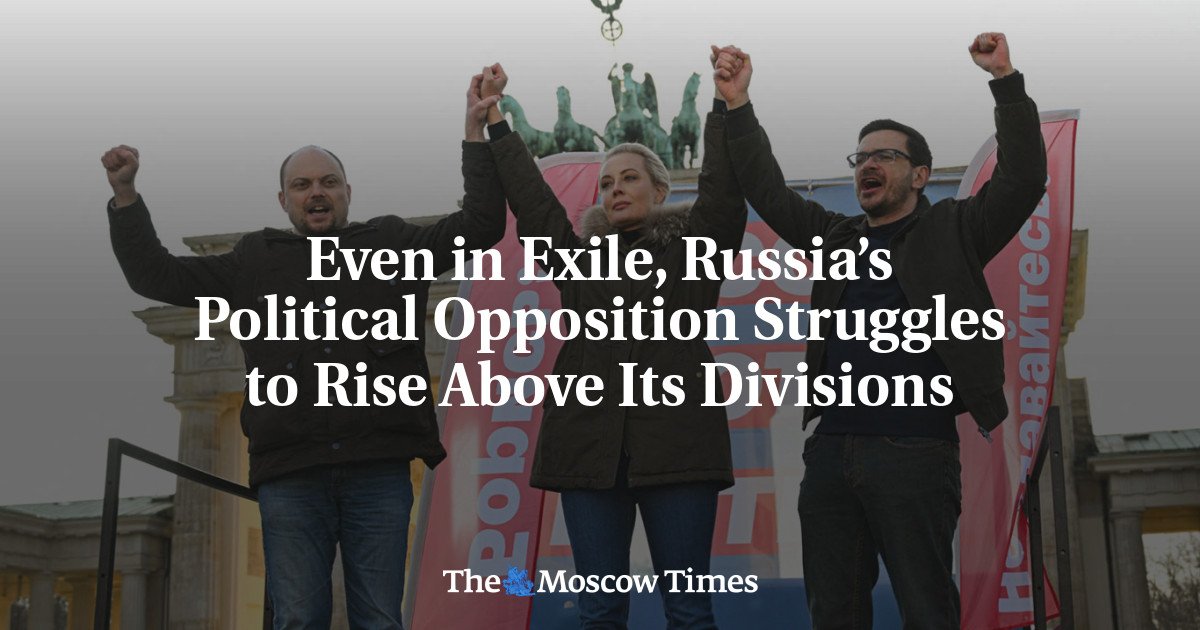
The public row has laid bare the deep divides and infighting that continue to dog Russia’s exiled anti-war political opposition.
More than four years since the invasion of Ukraine forced them to go abroad, these groups have struggled to articulate a cohesive vision and rise above the schisms that have led some to deem them “ineffective.” Critics argue they’re more focused on fighting each other than President Vladimir Putin.
At least, that’s the mainstream narrative.
Ask around political circles, and the story is far more nuanced. In interviews with The Moscow Times over the past few weeks, people involved in opposition politics in Russia and abroad gave diverging assessments of exiled opposition groups, with some agreeing that they are barely relevant and others saying they play an important role.
“We are constrained by repressive laws in what we can say or do, and they are constrained by not being physically present in Russia,” said one person affiliated with an opposition movement in Russia. “Where we have to use [coded speech], they can speak plainly and directly.”
“In that sense,” the source added, “they are a huge help, as they can fully flesh out the ideas we can only hint at.”
Like others interviewed for this story, the source requested anonymity to speak freely under Russia’s draconian wartime censorship laws.
Others were more critical in their assessments, describing opposition figures outside of Russia as unwilling to engage with those back home or modify harsh, polarizing positions.
“These groups spend too much time fighting amongst themselves,” said another source in Russia, an activist who has held political office. “At first, people in Russia watched it like a soap opera, but now everyone is tired of it.”
For many, last week’s FBK drama was the latest frustrating example of how these feuds can bog down organizations otherwise doing important work. An FBK spokesperson did not respond to a request for comment by the time of publication.
Opposition groups have long been caught between two fires. On one side they faced pressure from within their own ranks: petty public scuffles, wild accusations and fragmentation. On the other, security services engaged in harassment and intimidation, the state dialed up legal pressures and elections were marred by irregularities.
Upon the invasion of Ukraine, most anti-war political leaders who weren’t arrested for condemning the war were forced into exile or compelled into silence. And when Navalny died in prison in early 2024, the movement lost its most prominent figure.
Those who tried to continue with business as usual found that the system had become impossibly hardened.
One of them was Boris Nadezhdin. In 2024, the former State Duma lawmaker staged a remarkable anti-war presidential campaign, a largely symbolic move given Russia’s tight control of the electoral system. Despite drawing crowds of supporters across the country, Nadezhdin was disqualified a month before election day over supposed errors in his campaign’s list of signatures.
RFE/RL
Another anti-war candidate, Yekaterina Duntsova, had already been blocked from the ballot on similar grounds.
In reality, sources told The Moscow Times, the Kremlin had been shocked by Nadezhdin’s support and feared a public challenge to Putin could weaken the president’s image.
Nadezhdin’s failed campaign made it clear that there was no room for anti-war candidates.
It also highlighted a widening divide in the approaches of zealous overseas oppositionists and their more pragmatic counterparts at home. Nadezhdin even went as far as to criticize Navalny’s firebrand political style as harmful to his cause and to his followers.
“I learned from Navalny’s mistakes,” he told The Moscow Times after the Kremlin critic’s death.
Supporting Nadezhdin, whom some called a Kremlin spoiler candidate, effectively became one of the only legitimate ways for anti-war Russians to vocalize their discontent.
For some, his approach underscores the incompatibility of domestic and exiled voices. Sources told The Moscow Times that there is little cooperation between these groups and exiled opposition forces run the risk of losing touch with on-the-ground realities.
“These people used to be part of the same communities; in 2022, they stood for roughly the same things,” the activist in Russia said. “But over time, for those who stayed in Russia and those who left, their views, their daily experiences, and their assessments of reality began to diverge.”
As an example, the source said that many Russians bristle at the concept of society’s “collective guilt” for the war in Ukraine, an idea that has found some purchase among exiled opposition voices.
“Most who stay — though it’s hard to speak publicly — feel this is a dead end,” the source said. “They feel that while the trauma will need to be processed someday, right now, Russians are also victims of what is happening.”
Yana Fitskovskaya (CC BY-SA 4.0)
For their part, most of these figures face the daunting challenge of trying to remain relevant, with few promising options. Because the threat of imprisonment prevents them from returning to Russia right now, the solution of many is to prepare for a future — however implausible — in which they can.
Olga Galkina, an exiled former local politician now living in Berlin, told The Moscow Times that in her view, this should be the opposition in exile’s biggest priority, alongside freeing political prisoners.
“Sooner or later, these goals will definitely be achieved: the war will end, political prisoners will be released and it will be possible to return to Russia and continue our activities there,” she said.
The activities of exiled anti-war opposition groups run the gamut, from grassroots advocacy initiatives to political associations and alternative media projects. It’s a broad collective that analysts agree is largely unable to influence policy back home.
Many believe that a newly formed group of Russian representatives at the Parliamentary Assembly of the Council of Europe (PACE) provides the clearest avenue yet to raise their cause’s profile.
But even this group has already been riven by infighting. One member, Ruslan Kutayev, was suspended last month after making controversial comments about LGBTQ+ people and refusing to condemn the practice of so-called “honor killing” in his native republic of Chechnya, an ultra-conservative region in the North Caucasus.
Olga Galkina / Instagram
Svetlana Utkina is someone whose experience embodies the lofty idealism and seemingly unavoidable confrontations of Russian political life in exile. A former municipal deputy in St. Petersburg, she left the country in 2022 amid mounting legal pressure from authorities.
In her new home of Finland, Utkina couldn’t stay idle. She founded an NGO focused on political activism and joined an association of exiled local politicians called Deputies of Peaceful Russia.
Last summer, she had a falling out with the group over whether to allow members to join anonymously, becoming one of several people to resign in disagreement.
Now, she’s part of a new initiative that is generating some buzz, a political party founded by prominent opposition figure Ilya Yashin set to debut next month. Organizers hope that the party can unite disparate anti-war factions under one banner.
In a recent interview with The Moscow Times, Utkina disregarded criticism of exiled opposition figures as “nonsense” that serves the Kremlin’s aim of sowing divisions — while at the same time admitting that those divisions indeed exist.
“The Russian opposition in exile, or whatever you call it, cannot be united — because more than one party left [Russia],” Utkina said. “It’s not like [exiled activist Mikhail Khodorkovsky’s] followers got up and left. Or only Navalny’s followers left. The people who left are absolutely diverse.”
Svetlana Utkina / Facebook
Galkina has a similar attitude about the issue.
“Yes, such a problem exists. That’s life,” she said. “To say that it paralyzes work in exile — no, we wouldn’t say that. Does it cause damage? Well, in a sense, yes.”
Some critics have taken these incessant controversies as indicative of a unique deficiency of Russia’s political opposition.
But according to Margarita Zavadskaya, a senior research fellow at the Finnish Institute of International Affairs, that’s not true. Many political initiatives operating in exile of authoritarian countries are fragmented and “conflictual,” she said.
“These are actually very typical dynamics for these kinds of political groups,” Zavadskaya said. “So the bird’s eye view on Russian political exiles is that they’re not dramatically different — actually, they’re pretty typical in this kind of situation.”
Even in conditions of unprecedented repression, Russians have found ways to publicly disagree with the country’s leadership. Zavadskaya pointed to 2024’s “Noon Against Putin” protests — which took place in cities in Russia and around the world on the main day of the presidential election — as a sign that it’s still possible for opposition groups abroad and at home to operate in tandem.
But two years have passed since the demonstrations, and it’s unclear if the Kremlin would again tolerate such public dissent. State Duma elections this fall will test whether anti-war candidates will have any say in political affairs.
One person who has been involved in opposition politics in Russia noted that, ahead of the elections, political apathy and tightening of internet restrictions are now making it harder for everyone to reach audiences. For those outside the country, the effects are multiplied.
“In terms of information, one can remain. In terms of actual political participation in Russia, it’s unlikely,” the person said of people’s ability to actually stay engaged in politics outside the country. “However, Lenin was also abroad from 1907 to 1917 and didn’t have much influence.”
What they didn’t mention was that in the story’s next chapter, Lenin’s return home in the spring of that year set into motion events that would lead to the biggest political transformation in Russia’s history.
Mack Tubridy contributed reporting.
A Message from The Moscow Times:
Dear readers,
We are facing unprecedented challenges. Russia’s Prosecutor General’s Office has designated The Moscow Times as an “undesirable” organization, criminalizing our work and putting our staff at risk of prosecution. This follows our earlier unjust labeling as a “foreign agent.”
These actions are direct attempts to silence independent journalism in Russia. The authorities claim our work “discredits the decisions of the Russian leadership.” We see things differently: we strive to provide accurate, unbiased reporting on Russia.
We, the journalists of The Moscow Times, refuse to be silenced. But to continue our work, we need your help.
Your support, no matter how small, makes a world of difference. If you can, please support us monthly starting from just $2. It’s quick to set up, and every contribution makes a significant impact.
By supporting The Moscow Times, you’re defending open, independent journalism in the face of repression. Thank you for standing with us.
Continue
Not ready to support today?
Remind me later.
×
Remind me next month
Thank you! Your reminder is set.


