



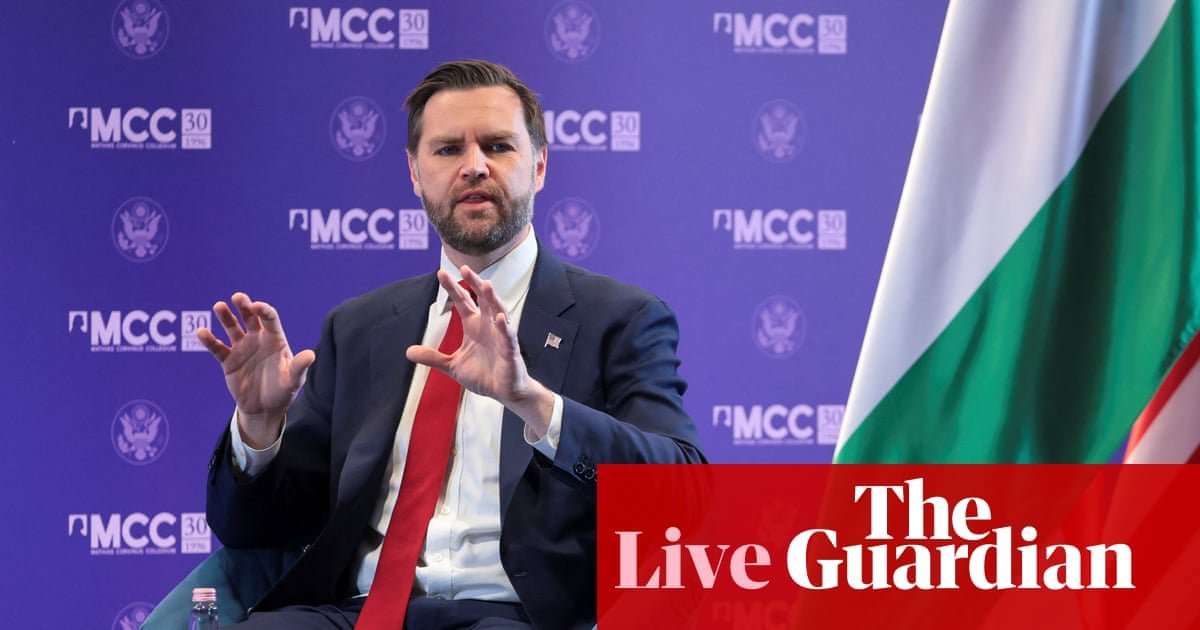
EU to ‘convey concerns’ to US about Vance’s Hungary intervention and accusations of interference
The European Commission’s spokespeople – three of them, no less – have reluctantly reacted to JD Vance’s comments alleging the EU’s unprecedented interference in the Hungarian elections.
At first they insisted they wouldn’t respond to his comments, even as they very pointedly noted the context of his visit – just days before the vote on Sunday.
The commission’s tech spokesperson Thomas Regnier somewhat mockingly said that “what the European bureaucrats have been doing is [moving] to set out a strong framework to make sure that the elections remain in the hands of our citizens.”
While his comments were seemingly about the regulation and use of social media platforms during election campaigns in Europe, it felt like there was a bit of an underlying message to the US VP, too.
But eventually, pushed a bit by several journalists, they went further, with the EU’s foreign spokesperson Anitta Hipper saying:
“We have also our diplomatic channels and we will be using these also to convey our concerns to our US counterparts.”
Pressed further on what the nature of the concerns was, however, she said the EU was “not in the business of disclosing what we talk about with our partners.”
The commission’s deputy chief spokesperson Arianna Podestà added:
“We have appropriate channels, appropriate frameworks, diplomatic contacts, [and] the joint statement. That is a framework in which we discuss matters of relevance with our partners. And that is where we will be bringing the discussions with the United States if they consider it something worthwhile pursuing with us.”
Key events
Russia backs Vance’s claims ‘many forces in Brussels’ work against Orbán, does not deny Putin phone call reports
Speaking of foreign interference, Russia has also chimed in, backing JD Vance’s suggestions that some in the European Union were opposed to the re-election of Viktor Orbán and actively trying to help his rivals.
“Many forces in Europe, many forces in Brussels, would not like Orbán to win the elections again,” Kremlin spokesperson Dmitry Peskov said.
“This is well known, it’s obvious to the naked eye, and, of course, they’re playing into the hands of those forces that politically oppose Orbán and believe that publishing such materials could harm him,” Peskov told reporters when asked about a leaked transcript of Orbán’s phone call with Russia’s Putin last year, reported by Bloomberg.
Reuters reported that Peskov, who did not deny the remarks were genuine, said they showed Orbán in a pragmatic light.
“He is indeed a very effective politician … one who is specifically defending the interests of his own country,” Peskov said.
JD Vance’s visit shows ‘who is interfering in what,’ Germany says as it rejects his criticism of EU
Germany also rejected JD Vance’s accusations that the European Union is interfering in the upcoming election in Hungary.
The fact that Vance is in Hungary “already shows, or speaks for itself, who is interfering in what,” a government spokesperson said.
EU to ‘convey concerns’ to US about Vance’s Hungary intervention and accusations of interference
The European Commission’s spokespeople – three of them, no less – have reluctantly reacted to JD Vance’s comments alleging the EU’s unprecedented interference in the Hungarian elections.
At first they insisted they wouldn’t respond to his comments, even as they very pointedly noted the context of his visit – just days before the vote on Sunday.
The commission’s tech spokesperson Thomas Regnier somewhat mockingly said that “what the European bureaucrats have been doing is [moving] to set out a strong framework to make sure that the elections remain in the hands of our citizens.”
While his comments were seemingly about the regulation and use of social media platforms during election campaigns in Europe, it felt like there was a bit of an underlying message to the US VP, too.
But eventually, pushed a bit by several journalists, they went further, with the EU’s foreign spokesperson Anitta Hipper saying:
“We have also our diplomatic channels and we will be using these also to convey our concerns to our US counterparts.”
Pressed further on what the nature of the concerns was, however, she said the EU was “not in the business of disclosing what we talk about with our partners.”
The commission’s deputy chief spokesperson Arianna Podestà added:
“We have appropriate channels, appropriate frameworks, diplomatic contacts, [and] the joint statement. That is a framework in which we discuss matters of relevance with our partners. And that is where we will be bringing the discussions with the United States if they consider it something worthwhile pursuing with us.”
New Median poll suggests Hungarian opposition could win big on Sunday
And just as JD Vance wraps up his speech, once again repeatedly endorsing Viktor Orbán to be re-elected this weekend, a new Median poll for hvg.hu appears to suggest that the opposition Tisza Party, led by Péter Magyar, could be on course to win big this Sunday.
Their latest analysis – looking at its five surveys – suggest the opposition could command as many as 138 to 143 seats in the next parliament, which would give it a two-thirds majority (there are 199 seats in total).
This is a critical point given how the Hungarian statutes, known as “cardinal laws”, require super majorities to reform laws in some critical areas, such as the judiciary.
A failure to get a supermajority would radically limit the new government’s ability to reform Orbán-era laws and resolve longstanding tensions with Brussels by making changes needed to unlock EU funds.
According to their calculations, Viktor Orbán’s Fidesz would get between 49 and 55 seats, with further 5-6 seats going to the far-right Mi Hazánk party.
Looking at vote share, Median’s poll implied 48% support for Tisza, with 30% for Fidesz, and 4% for Mi Hazánk. 15% of voters did not want to answer or were not planning to vote.
As always with all polls – published at any time, and even more so in the final week of the campaign – it’s best to be very, very careful with reading too much from them, but it’s still worth noting.
Vance urges to ‘stay involved, be patient’ and not ‘check out’ over political disagreements
Vance then goes into a longer discussion on the state of (primarily) higher education and his regular criticism of what he sees as a left-wing academia.
In a soft ball question to finish the panel on, he gets asked about his advice to younger people and to be fair to him makes a decent joke saying:
“I’d say enjoy your youth while it lasts, because one day you’ll wake up and you’ll be 41, and you’ll have a glass of wine at dinner and wake up with a headache the next morning and be talking to this fine gentleman.”
(That’s a resounding endorsement of Hungarian wine, which to be fair is indeed great.)
But then he issues a rallying cry to the conservative students in the audience, telling them to “resist the temptation to think that victory is immediate, or that we’re going to win back our civilisation through instant gratification.”
“But I think a lot of people this is particularly true in the United States of America. If they see something that the administration does, they don’t like, they say, oh, that’s not what we voted for. We’re going to check out a politics.
No, no, no, no. That’s the exact wrong response. If we do something you don’t like, the response should be to get more involved, to make your voice heard, and to try to push things in the direction that you want them to be pushed.
Our civilisation was not built overnight. It’s not going to be saved overnight. And so what I’d encourage you to do is stay involved, be patient, and don’t let disappointment turn to checking out of the system entirely.”
He then ends with a call to action:
“We need to take power back from those people and build the kind of institutions that can actually save our societies. It will not happen overnight. It will not happen in the term of one prime minister or one president. But it will happen so long as we keep our faith in God and we work hard to achieve it, that’s what we have to do.”
He gets a decent ovation and that wraps up the event.
Iran truce is ‘fragile,’ JD Vance says, as he hints at disagreements within Iranian regime and warns against attempts to sabotage deal
On Iran, JD Vance says this is why he was late to the meeting as he was “up very late last night” dealing with the Middle East.
He says the military aim in Iran – or “decimating the Iranian military” – has been “achieved,” and the focus shifted to re-opening the straits with Trump telling Iran to “stop trying to hold the world’s economy hostage.”
“And that’s exactly the agreement that we came to last night.”
He calls the truce “fragile,” but references Trump’s comments that “the Iranians are better negotiators than they are fighters.”
He says some people in Iran replied “very favourable” to the proposed truce, but others “are basically lying about what we have accomplished militarily” and “about the nature of the agreement.”
“This is why I say this is a fragile truce. You have people who clearly want to come to the negotiating table and work with us to find a good deal, and then you have people who are lying about even the fragile truce that we’ve already struck.”
He ends with a thinly veiled warning to the Iranian leadership:
“The president … has told me and he’s told the entire negotiating team, the secretary of state, the special envoy, Steve Witkoff, he said: go and work in good faith to come to an agreement. … If the Iranians are willing, in good faith, to work with us, I think we can make an agreement; if they’re going to lie, if they’re going to cheat, if they’re going to try to prevent even the fragile truce that we’ve set up from taking place, then they’re not going to be happy.”
He says:
“He’s told us to come to the negotiating table. But if the Iranians don’t do the exact same thing, they’re going to find out that the president, the United States, is not one to mess around.
He’s impatient. He’s impatient to make progress. He has told us to negotiate in good faith. And I think if they negotiate in good faith, we will be able to find a deal. That’s a big if. And ultimately it’s up to the Iranians how they negotiate. I hope they make the right decision.”
JD Vance criticises EU and UK energy policies
Repeating his lines from last night, Vance also talks about how much he and the US administration love Europe and want it to succeed and that this is where they harsh criticism come from.
He specifically criticises the energy policies of European partners, including specifically that of the UK (“which is way underinvested in their energy resources”).
He says:
“But is it a scandal that middle class Brits, that people who are working hard and playing by the rules, can’t afford to heat their home, can’t afford to transport themselves to work because their leadership has made energy so expensive? …
It is not magical that the United States has lower energy costs in the United Kingdom. It’s because we’ve made smart decisions and their leadership is not. They could change course, and we hope that they will.”
He then turns to criticise the EU’s scrutiny of US social media platforms, attacking the bloc’s “bureaucracy” in Brussels.
Vance repeatedly praises Orbán on Ukraine as he acknowledges his ‘unprecedented’ Budapest visit
Praising Orbán further, Vance says he “does a good job, because he does,” and is a “very, very important partner for peace.”
He says “most of the European political capitals have not been nearly as helpful to the cause of peace between Russia and Ukraine as Viktor Orbán has.”
He repeatedly rejects EU criticism of Orbán’s Hungary as a “scandal.”
He eventually acknowledges how unusual it is for him to be here, though:
“It’s the reason why I’m here. This is unprecedented. It’s unprecedented for an American vice-president to come the week before an election.
The reason why we’re doing it is because we thought there were so much garbage happening against Viktor in this election, that we had to show that there are actually a lot of people and a lot of friends across the world who recognise that Viktor and his government are doing a good job, and they’re important partners for peace.”
Circling back to the issue of Ukraine, Vance says the US has been “disappointed by a lot of the political leadership in Europe,” who he says “do not seem particularly interested in solving this particular conflict.”
He says only some leaders have been helpful – he namechecks Italy’s Giorgia Meloni and “some of the western European capitals, … at least behind the scenes” – but says Orbán “is the one who has encouraged us to truly understand this” conflict.
He says the work will go on, but Ukraine and Russia need to decide to move, too – seemingly implying that Kyiv should make territorial concessions to end the conflict.
“What I would say to both the Russians and the Ukrainians is, you know, we’re talking about haggling at this point over a few square kilometres of territory in one direction or another. Is that worth losing hundreds of thousands of additional Russian and Ukrainian young men? Is that worth an additional months or even years of higher energy prices and economic devastation?
We think the answer is clearly no. But it takes, you know, two to tango. So while Viktor and president Trump are going to continue to work towards a peaceful settlement, fundamentally we can only open the door. The Russians and the Ukrainians have to walk through it.”
In further comments, Vance says it’s “darkly ironic that people are accusing me of engaging in some kind of foreign influence.”
Erm.
Jakub Krupa
JD Vance literally says that the Hungarians should “reject these foreign influence operations” of foreign endorsements without even a hint of realising the irony of sitting and making that comment while actively campaigning for Orbán in Budapest four days before the election.
Amazing.


