



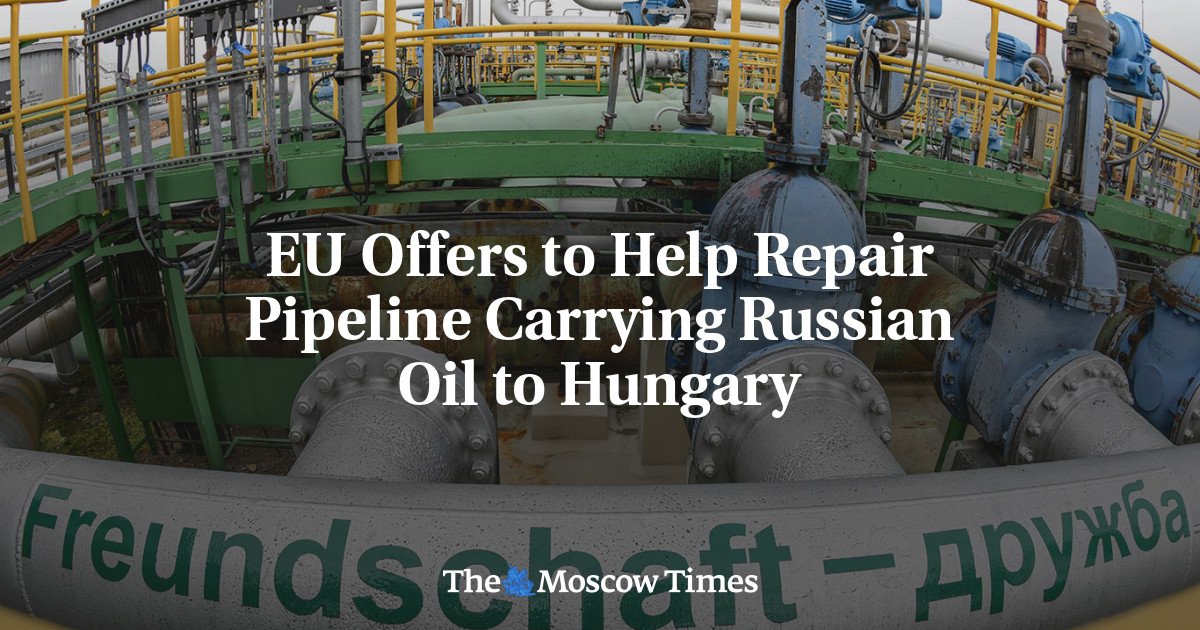
European Commission President Ursula von der Leyen said Tuesday that the bloc will help repair a damaged pipeline that pumps Russian oil through Ukraine to Hungary, coming after tensions between Hungary and Ukraine escalated over delays in restoring flows.
The dispute has intensified in recent days, with Hungarian Prime Minister Viktor Orbán using the issue to block an EU loan of 90 billion euros ($104 billion) to Ukraine and a new round of sanctions against Russia.
In a letter to Ukrainian President Volodymyr Zelensky, von der Leyen and European Council President Antonio Costa said they hoped a “rapid repair” of the pipeline would allow the bloc to move forward with both the loan and sanctions package.
“The EU has offered Ukraine technical support and funding. The Ukrainians have welcomed and accepted this offer,” von der Leyen said in a statement released alongside the correspondence.
“European experts are available immediately,” she said.
Hungary and Slovakia have accused Ukraine of deliberately delaying the reopening of the Druzhba pipeline, which officials in Kyiv claim was damaged by Russian strikes in January.
Ukraine had initially resisted EU involvement, with Zelensky calling attempts to link pipeline repairs to wartime support “blackmail.”
But the letters published Tuesday suggest Kyiv has softened its stance as pressure from Brussels mounted.
Zelensky said Ukraine would accept “necessary technical support and funding” to complete repairs and would task the head of state energy firm Naftogaz to coordinate with EU officials.
A European Commission spokesperson said Brussels is now “confident” that progress in issuing the loan to Ukraine could be made soon, “ideally” before a summit of EU leaders on Thursday.
The dispute between Hungary and Ukraine over the Druzhba pipeline came to a head as global energy markets tightened amid war in the Middle East. Governments are scrambling to boost energy supplies and ease soaring prices.
Orbán, who maintains an amicable relationship with Russian President Vladimir Putin, has called on the EU to suspend sanctions on Russian oil and gas.
A Message from The Moscow Times:
Dear readers,
We are facing unprecedented challenges. Russia’s Prosecutor General’s Office has designated The Moscow Times as an “undesirable” organization, criminalizing our work and putting our staff at risk of prosecution. This follows our earlier unjust labeling as a “foreign agent.”
These actions are direct attempts to silence independent journalism in Russia. The authorities claim our work “discredits the decisions of the Russian leadership.” We see things differently: we strive to provide accurate, unbiased reporting on Russia.
We, the journalists of The Moscow Times, refuse to be silenced. But to continue our work, we need your help.
Your support, no matter how small, makes a world of difference. If you can, please support us monthly starting from just $2. It’s quick to set up, and every contribution makes a significant impact.
By supporting The Moscow Times, you’re defending open, independent journalism in the face of repression. Thank you for standing with us.
Continue
Not ready to support today?
Remind me later.
×
Remind me next month
Thank you! Your reminder is set.


