



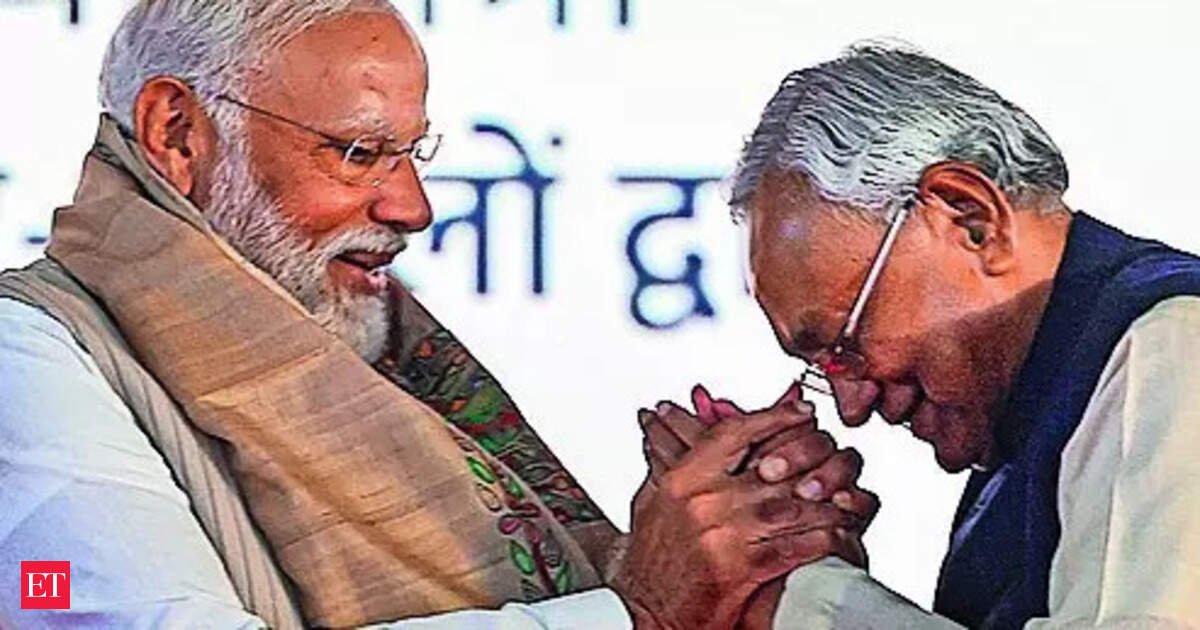
Together, they ensured the dominance of regional parties in Bihar even as neighbouring states in the Hindi heartland experimented with BJP- and Congress-led governments. Nitish’s departure heralds a new political phase in Bihar that both the BJP and JDU are largely unaccustomed to. When a chief minister who has ruled for two decades steps aside, it becomes difficult for the successor to match public expectations as well as manage alliance dynamics. In this scenario, Nitish’s exit poses several challenges and opportunities for the new government, the BJP and the JDU.
Challenge for the BJP
In 2005, Nitish Kumar reshaped the social equations in Bihar by countering the backward-Dalit coalition crafted by Lalu Prasad Yadav and building a new social combination that has remained politically formidable since then. With around seven per cent Kurmi-Kushwaha population, Nitish emerged as the leader of the Lav-Kush caste grouping.
The next chief minister will be from the BJP, and the party’s challenge will be to identify a face capable of holding together this caste combination or creating a new social coalition that can sustain – if not strengthen – Nitish Kumar’s social base. Caste continues to play a decisive role in heartland politics, and the BJP is likely to weigh caste equations carefully before selecting the new leader.
Challenge for the new bihar government
Nitish Kumar’s legacy remains firmly embedded in public memory. His image as ‘Sushasan Babu’ sets a benchmark that the new government will be expected to match. His social engineering experiments – bringing groups such as the Extremely Backward Classes (EBCs) and Mahadalits into the political mainstream through targeted welfare schemes and reservations in local bodies – reshaped Bihar’s social landscape.
Most importantly, Nitish enjoys strong support among women voters through empowerment initiatives such as the Jeevika self-help group programme and reservation for women in government jobs. The transfer of ?10,000 to women’s SHG accounts ahead of the assembly polls was also widely credited to him. The prohibition policy further consolidated goodwill among what he often referred to as ‘Aadhi Aabadi’.For the new government, the challenge will be to address the aspirations of these social groups and women voters in a way that prevents constant comparisons with Nitish Kumar’s tenure. Earlier, governments were largely compared with the 15-year rule of Lalu Prasad Yadav and Rabri Devi. Now, every policy decision will also be weighed against Nitish Kumar’s long tenure. Filling the shoes of a chief minister who led the state for two decades will require careful and mature governance.
Challenge for the JDU
The biggest challenge, however, lies with the JDU, whose political identity has long been intertwined with Nitish Kumar. In many ways, Nitish Kumar is the JDU, and the JDU is Nitish Kumar. His recent health concerns have compelled the party to look for an alternative leadership structure. The party is considering the political entry of his son Nishant Kumar, but Nitish carries a unique political aura.
If Nishant eventually steps into politics, the party will have to ensure he can build political credibility and influence over time. Otherwise, the JDU will need to identify a leader capable of holding the party together. The key question is whether the JDU can convince its core voters that the party remains equally relevant even with Nitish taking a back seat.
For the first time, the JDU will also be playing second fiddle in Bihar. Historically, when a regional party becomes the junior partner in an alliance, its influence tends to shrink while the national party expands at its expense. The JDU’s challenge will therefore be to preserve its identity and vote base while partnering with a dominant ally like the BJP.


