






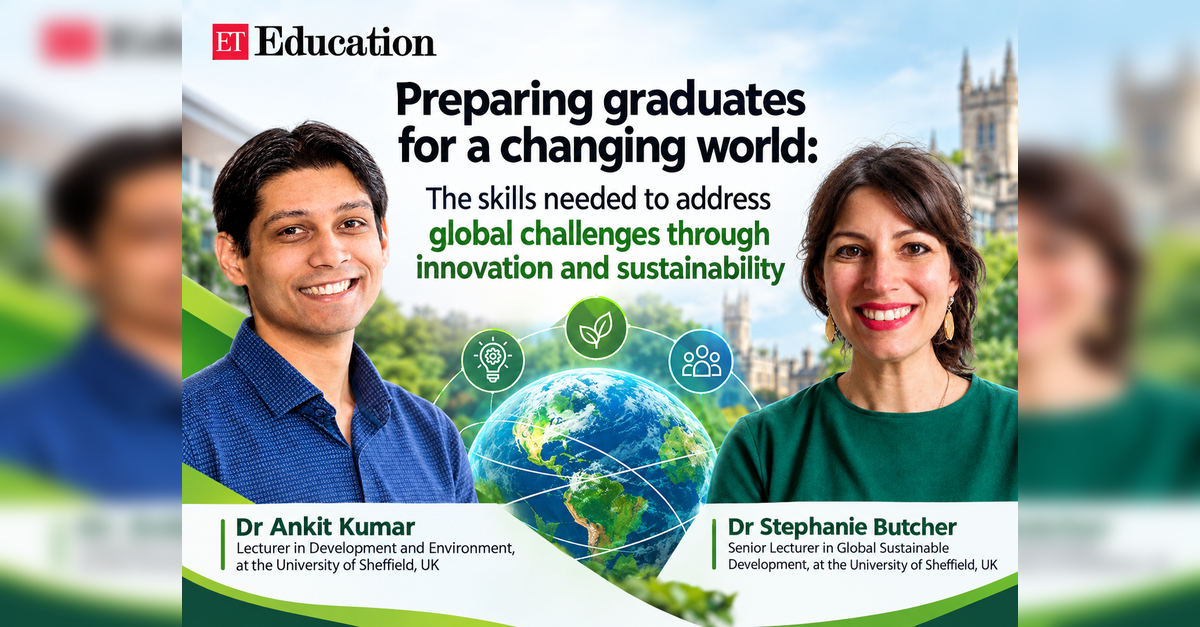
By Dr Stephanie Butcher and Dr Ankit Kumar.
Identifying how we collectively work towards a planet that supports prosperous, dignified, and sustainable human and non-human flourishing across diverse geographies and social groups is one of our most pressing global challenges. Addressing these challenges requires us to understand the connections between society, the economy, the environment, and the systems that shape them. It also requires new forms of thinking, collaboration, and action.
As sustainability challenges become increasingly interconnected, there is growing demand for professionals who can work across disciplines, think critically and ethically, collaborate across diverse stakeholders, and understand the politics and histories of development as a way of building strategies for a sustainable future. Degrees focussed on Global Sustainable Development equip students with the knowledge and skills necessary to meet this demand, make a positive impact, and work towards a more just, equitable, and environmentally sustainable world.
Understanding the multidimensionality of global sustainable development challenges
A primary benefit of studying global sustainable development is gaining a deep understanding of the complexity of sustainability issues. Degree programmes in this area engage with a wide range of topics, potentially including environmental crises and sustainability, urban informality, social equity, labour conditions, disaster risk and resilience, and resource management.
The emphasis on ‘global’ recognises that development concerns are playing out
across the global North and the global South, and that a sustainable future relies upon
solidarities and collaborative action across the globe. Crucially, as we start to think about the complexities of global sustainable development, we also start to understand the vital importance of seeing sustainable development as an interdisciplinary concept: not something be solved either by science or social sciences alone – but rather requiring partnerships across sectors, disciplines, and communities. Exploring such interdisciplinary degree programmes can support graduates with the skills to diagnose, understand, and address the complex challenges that come with creating sustainable solutions.
Developing critical thinking and practical problem-solving skills
Beyond understanding complex issues, students develop the analytical and practical capabilities needed to respond to them. They learn how to examine problems, gather and interpret evidence, and develop innovative solutions using a range of methodologies and perspectives.
Through critical thinking, problem-based learning, and engagement with emerging innovations, students encounter diverse forms of knowledge from scientists and researchers to policymakers, community organisers, activists, and grassroots groups. Many programmes also emphasise learning through practice, including policy analysis, fieldwork, and research with partner organisations.
These experiences help students build transferable capabilities: understanding concepts, theories, and histories; conducting critical and impact-oriented research; communicating complex ideas; and developing professional competencies to address some of the most pressing questions facing societies today.
Reflecting on Ethics and Practices
One of the most significant benefits of this field is the opportunity to explore different perspectives and cultures, learning to work collaboratively with people from
different backgrounds. Students typically learn about histories and legacies of colonialism, capitalism, and extractivism, and how this shapes modern day inequalities. They also learn how to think ethically and reflexively about their own contributions to make a difference in the world. This includes a deeper understanding of the rationalities, tensions and trade-offs that exist within global development challenges, and how to partner with different kinds of organisations and groups to address these issues at different scales.
This encourages students to critically interrogate the world and understand power dynamics, and get immersed in the solutions that policy makers, researchers and scientists, civil society organisations, and grassroots activists are already engaging to build a more equitable and sustainable world.
Building an Impactful Career
The capabilities developed through these programmes are increasingly valuable in a world where organisations across sectors are responding to environmental and social change. Graduates bring interdisciplinary perspectives, research skills, communication abilities, and the capacity to analyse complex information and communicate evidence-based arguments to different audiences.
As sustainability challenges become increasingly complex, employers are looking for graduates who can think critically, collaborate across disciplines, analyse competing perspectives, and translate knowledge into practical solutions that balance environmental, economic and social considerations.
The ability to understand how different stakeholders approach sustainability challenges and develop evidence-based strategies for addressing them is becoming relevant across an expanding range of careers. Sustainability is reshaping the future of work by influencing roles across finance, business, consulting, technology, engineering, manufacturing, supply chains, healthcare, property, marketing, and data.
Professionals are increasingly expected to engage with areas such as ESG (Environmental, Social and Governance), climate risk, sustainable business models, responsible innovation, and resource efficiency as organisations rethink their strategies and operations in response to global pressures. These skills are valuable across careers including civil service and government, sustainability consulting, environmental policymaking, activism, research institutions, think tanks, NGOs, and international organisations such as the World Bank and the UN, alongside emerging sustainability-focused roles across the private sector.
Graduates are therefore well placed to flourish and productively contribute to an uncertain and changing world. For those who are passionate about working collaboratively to create a more equitable and sustainable future, global sustainable development offers an opportunity to develop the perspectives and capabilities needed to make a valuable contribution.
Tha author Dr Stephanie Butcher is the Senior Lecturer in Global Sustainable Development, and Dr Ankit Kumar, is the Lecturer in Development and Environment at the University of Sheffield, UK.
DISCLAIMER: The views expressed are solely of the author, and ETEDUCATION does not necessarily subscribe to it. ETEDUCATION will not be responsible for any damage caused to any person or organisation directly or indirectly.


