


IT IS A launch of a more bureaucratic sort than normal for SpaceX, but still characteristically spectacular. On May 20th, after America’s financial markets had closed, Elon Musk, the rocketry firm’s founder and the world’s richest man, lit the blue touch paper on the biggest initial public offering ever. Documents filed with American regulators pave the way for SpaceX, which has conquered space but is spending a fortune on artificial intelligence (ai), to make its debut on the NASDAQ exchange in June.
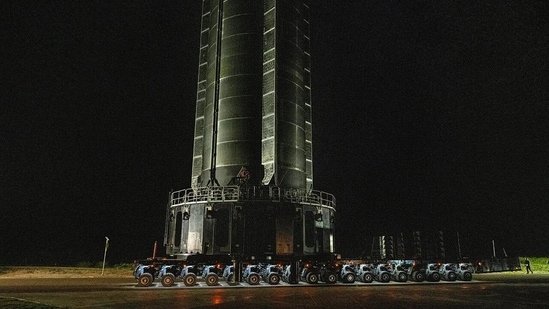
Mr Musk had hoped to mark the occasion with a test flight of the latest version of the firm’s gigantic, troublesome Starship rocket, upon whose stainless-steel frame the company’s astronomical ambitions rest. But the test, originally scheduled for May 19th, has slipped repeatedly. As The Economist went to press, Starship was due to fly on May 21st. Its success or failure could have a big impact on the IPO.
For many years SpaceX had dismissed the idea of an IPO. “We can’t go public until we’re flying regularly to Mars,” said Gwynne Shotwell, the firm’s chief operating officer, in 2018. Mr Musk has long argued that public markets are too short-termist and unimaginative for a firm whose goal is eventually to build a city on Mars.
But getting to Mars is expensive. The $75bn or so SpaceX hopes to raise from investors would far exceed the record sum raised by Saudi Aramco, an oil giant, when it went public in 2019 (see chart 1 ). SpaceX’s target valuation of around $1.75trn is more than 90 times the $18.7bn in revenue the firm brought in last year. (Tesla, Mr Musk’s electric-vehicle company, trades at a mere 16 times revenue.)
Business, but not as we know it
Since its founding in 2002—with little more than “carpet and a Mariachi band”, as Mr Musk once joked—SpaceX has elbowed aside incumbents such as Boeing and Lockheed Martin and left government space agencies in the dust. These days it runs the world’s biggest space programme. Its pioneering re-usable rockets carry almost 90% of everything that goes into space (see chart 2). Starlink, its satellite-broadband service, boasts nearly 10,000 satellites, over two-thirds of the total in orbit, and more than 10m customers. As Mike Grace, the boss of Longshot, a space startup, puts it, SpaceX “owns the solar system right now, and the rest of us just rent it”.
Mr Musk thinks he has found an even bigger market for SpaceX to dominate: ai. He believes that AI’s appetite for computing power cannot be satisfied by earthly data centres, which are often impeded by power shortages, red tape and opposition from a distrustful public. Along with several other AI bigwigs, he reckons those problems can be solved by putting data centres in space. He argues that SpaceX, with its unmatched ability to carry things off the planet, is the firm to make it happen.
The scale of his ambition is outlined in the firm’s regulatory filings. Mr Musk’s pay depends on SpaceX’s valuation rising even further (to as much as $7.5trn); on the firm putting 100 terawatts of computing power into orbit (about 1,000 times the total of every data centre on Earth today); and on building a Martian city with at least a million inhabitants.
Could anything remotely like that come to pass? The paperwork reveals a firm with a fast-growing money-spinner in the form of Starlink, which brought in $4.4bn in operating profit in 2025—but also a money pit that is growing even faster. In January SpaceX merged with xAI, Mr Musk’s AI firm, which lost $6.4bn in 2025 as it raced to build computing infrastructure. Partly as a result, SpaceX’s capital spending almost quintupled last year compared with 2023, to more than $20bn. Mr Musk seems to have calculated that, even with Starlink, this bill could not be met with private money alone. But some investors may hesitate to pour cash into an AI lab that is a pipsqueak compared with such rivals as Anthropic and OpenAI. SpaceX’s filings say AI makes up 93% of its claimed “total addressable market” of $28.5trn.
If this gigantic bet on AI-from-space is to pay off, at least three things must happen. Starship, which is already behind schedule, must be made to work. Starlink must generate more cash. And orbital data centres must offer big advantages to an industry that is already investing astronomical sums in Earth-bound computers.
Start with Starship. The gargantuan rocket, the heaviest flying object ever built, is “vital to SpaceX’s future”, says Caleb Henry of Quilty Space, a firm of analysts. It is supposed to finish the revolution that the Falcon 9, SpaceX’s current launch vehicle, began: transforming space flight from something that is rare, bespoke and expensive into something cheap, mass-produced and routine. Before SpaceX, most rockets were disposable, flown once and then dumped into the ocean or abandoned in space. Mr Musk likens that to building a plane, flying it once and then scrapping it.
Half of every Falcon 9, by contrast, is designed to be re-used. After separating from the upper stage the rocket’s lower portion can fly back to its launch site or a waiting ship and land on its own tail. It took SpaceX five years, and plenty of crashes, to pull off its first successful landing in 2015. But these days, it is routine. SpaceX conducted 165 Falcon 9 launches in 2025, a number that would have seemed impossible even five years ago. Some boosters have flown more than 20 times.
That has helped SpaceX slash the cost of going to space. It charges $74m for a Falcon 9 flight, which can take 17.5 tonnes into orbit. That works out to about $4,200 per kg—about 85% less than what incumbents such as United Launch Alliance, a joint venture between Boeing and Lockheed Martin, used to charge. (The actual cost to SpaceX is thought to be much lower, perhaps around $1,000 a kilo.)
Starship aims to drive that down even further, partly by making the rocket’s payload as big as 200 tonnes, but mostly by making the second stage re-usable as well. The filing documents suggest a goal of $185 a kilo. But making it work has not been easy. “Starship was supposed to take over from Falcon 9 in 2023 or 2024,” says Tim Farrar, who runs TMF Associates, a satellite-industry analysis firm. It is not just SpaceX that is frustrated by the delays. NASA is waiting for a modified Starship to ferry humans to the moon as part of its Artemis programme.
SpaceX has on several occasions flown Starship’s booster stage back to its launch site and caught it with robotic “chopstick” arms mounted on the launch tower. Re-using the second stage, though, is far harder. It travels much farther and faster, and must survive temperatures above 1,000°C as it re-enters the atmosphere at speeds of 8km a second or more. Speaking recently on a podcast, Mr Musk noted that several second stages have managed controlled splashdowns at sea, but their heat shields were damaged, he said, and so “not re-usable without a lot of work”.
The Space Shuttle—the industry’s previous big attempt at re-use—suffered from similar problems. Fixing the damaged heat-shield took weeks or months. Mr Musk, in contrast, hopes the same Starship might eventually fly several times a day.
Boldly going forward
Starship’s main job will be to bolster Starlink, the fastest-growing and only profitable part of SpaceX’s business. Since its debut in 2021 the service has signed up airlines, shipping firms and more than 10m individual customers, revolutionised warfare in Ukraine and spawned a secretive offshoot called Starshield for government customers. The firm’s newest “direct-to-cell” (D2C) satellites can communicate directly with smartphones and other devices on the ground, with no need for the special pizza-box-sized antennas that its residential plans require. Starlink’s revenue grew by 50% between 2024 and 2025, from $7.6bn to $11.4bn.
There is clearly more room for growth, says Mr Farrar. He notes that in one 80-day period in 2025 the firm added 1m new customers. He thinks Starlink may eventually sign up anywhere between 20m and 50m residential subscribers, although average revenues per customer are likely to decline as it adds users outside the rich world. At the moment, though, Starlink’s growth is held back by the size of the satellites that SpaceX can fit onto a Falcon 9. It plans “version 3” satellites that will each add 20 times more capacity than the “v2 Minis” it currently uses. But they are so big they can be launched only with Starship.
SpaceX is investing heavily to keep Starlink growing. Last year it spent $19.6bn to acquire spectrum from EchoStar, an American telecoms firm, to bolster the nascent D2C business, and has sought authorisation to launch 15,000 specialised satellites. PitchBook, which gathers data on venture-capital-backed firms, notes that these are expensive wagers. The EchoStar deal represents more than a year of SpaceX’s revenues. But it expects Starlink to top 1bn subscribers over the next 15 years.
Analysts are divided over Starlink’s potential. “I think D2C is just not going to live up to the hype,” says Mr Farrar, arguing that it will be used mostly in places where there are no terrestrial phone masts and therefore few people. Simon Potter of BryceTech is more optimistic: “It could enable ubiquitous connectivity between devices using standard smartphone kit. That could be transformational in applications such as cars, agriculture, logistics—and maybe in military ones, too.” Franco Granda, at PitchBook, thinks that Starlink and SpaceX’s launch business could justify a $1.75trn valuation by themselves.
Launching lots of satellites, however, will not use up all Starship’s capacity. SpaceX is planning fleets of them. It is building a pair of huge factories, dubbed “Gigabays”, which Mr Musk hopes will eventually produce hundreds of Starships a year. Even with the Falcon 9, points out Mr Henry of Quilty Space, there was not a “clear commercial case for a high-cadence launcher”. In the end, SpaceX had to develop Starlink to give its rockets enough work to keep them busy. Its plans for data centres in space, he says, are an attempt to repeat the trick.
Tom Mueller, SpaceX’s first-ever employee, the designer of its rocket engines and now the founder of Impulse, another space firm, summarised his old employer’s plans last year. Building a settlement on Mars requires hundreds of Starships, he noted. But the movements of the planets mean they can travel to Mars only roughly every two years. “What do you do with the hundreds of Starships the other 25 months of the Mars cycle?” he wrote. “Fly data centres to space, paid for by investors.”
SpaceX did not come up with the idea of putting AI in orbit. Last year Starcloud, a startup, flew a prototype (aboard a Falcon 9) to prove the idea could work. Google, a tech firm, hopes to test satellites of its own in 2027. (It is reportedly in discussions with SpaceX to launch them.)
Proponents of orbital data centres (ODCs) cite several advantages. One is an abundance of power. With no atmosphere to get in the way, sunlight in orbit is about 30% more intense than on even the sunniest day on the ground. Putting solar-powered ODCs in certain “sun-synchronous” orbits could provide almost permanent sunlight. Efficiency is another plus. A terrestrial data centre might use a quarter of the electricity it consumes to cool its servers. ODCs could instead rely on the freezing vacuum of space.
The final advantage is remoteness. The AI industry stirs fears of job losses and even human extinction. Many people take a dim view of the technology. Dozens of American state and local governments have banned new data centres or are considering it. Putting them in space might keep them out of mind as well as sight.
We can’t find reverse
With typical bravado, Mr Musk has said that within two to three years, ODCs will be the cheapest way to provide computing for AI. (Sam Altman, the boss of OpenAI, thinks that timeline is “ridiculous”.) The economics depend on how low launch costs go, how efficient satellites are at turning sunlight into data-crunching, and how much those satellites cost. SpaceX hopes to make use of its experience mass-producing Starlink’s satellites by building ODCs, at least at first, on the same chassis. In January the firm applied for regulatory approval to launch up to a million of them.
If they can be made to work, the market could be absurdly lucrative. Capital spending on data centres is forecast to exceed $800bn this year. The revenues of the top AI labs are growing fast, from about $17bn in 2025 to an anticipated $90bn-100bn this year. Both Anthropic and OpenAI are planning IPOs at valuations of about $1trn.
SpaceX could profit in two ways. The first is by boosting xAI, which has struggled to compete with its longer-established rivals. If being part of SpaceX gives xAI access to cheap, quickly deployable computing power, that could provide the boost it needs to overtake its competitors.
If that does not work, an industry-wide switch to space-based infrastructure could leave SpaceX occupying a similar position to Nvidia, which designs AI chips, or TSMC, which manufactures them—an indispensable provider of infrastructure. There have been hints of this latter approach already. On May 6th Anthropic signed a deal to pay as much as $1.25bn a month for the next three years to use some of the computing capacity at xAI’s existing, land-based Colossus data centre.
Giant rockets, AI in space—science fiction made real: will investors buy it?There is likely to be appetite, especially given what Gil Luria of D.A. Davidson, an investment firm, calls the “hopes and dreams” premium that Musk’s futuristic endeavours tend to command. The IPO includes a five-to-one stock split, which reduces the cost per share, a boon for Mr Musk’s legions of fans among retail investors.
But investors should brace for volatility. Many of the venture capitalists who made early bets on SpaceX will be keen to cash out as soon as possible. That could hit the stock price. The firm’s two-tier share structure makes Mr Musk in effect unremovable, no matter how his plans go. Although some of his big bets have paid off—re-usable rockets, electric cars, Starlink—others have not, or at least not on schedule. Tesla’s fleet of robotaxis has been just over the horizon for years. Its humanoid robots are also late for work.
xAI, meanwhile, is losing billions. If progress on Starship slows, Starlink’s growth will be hobbled, bringing in less cash to cover those losses. SpaceX’s dominance in launch could be eroded by competitors such as Blue Origin, which is owned by Jeff Bezos, the founder of Amazon. Markets are high and nervy; even if AI proves as useful as its pioneers hope, many see current levels of investment as unsustainable. Where would SpaceX’s plans stand if they slowed?
Mr Musk’s lofty aspirations for SpaceX can be made to hang together, at least conceptually. As he is fond of saying when assessing a grand idea, nothing about them breaks the laws of physics. That means making it all happen is “merely” a question of engineering, both industrial and financial. But as Mr Musk knows, engineering is an unforgiving discipline.
