






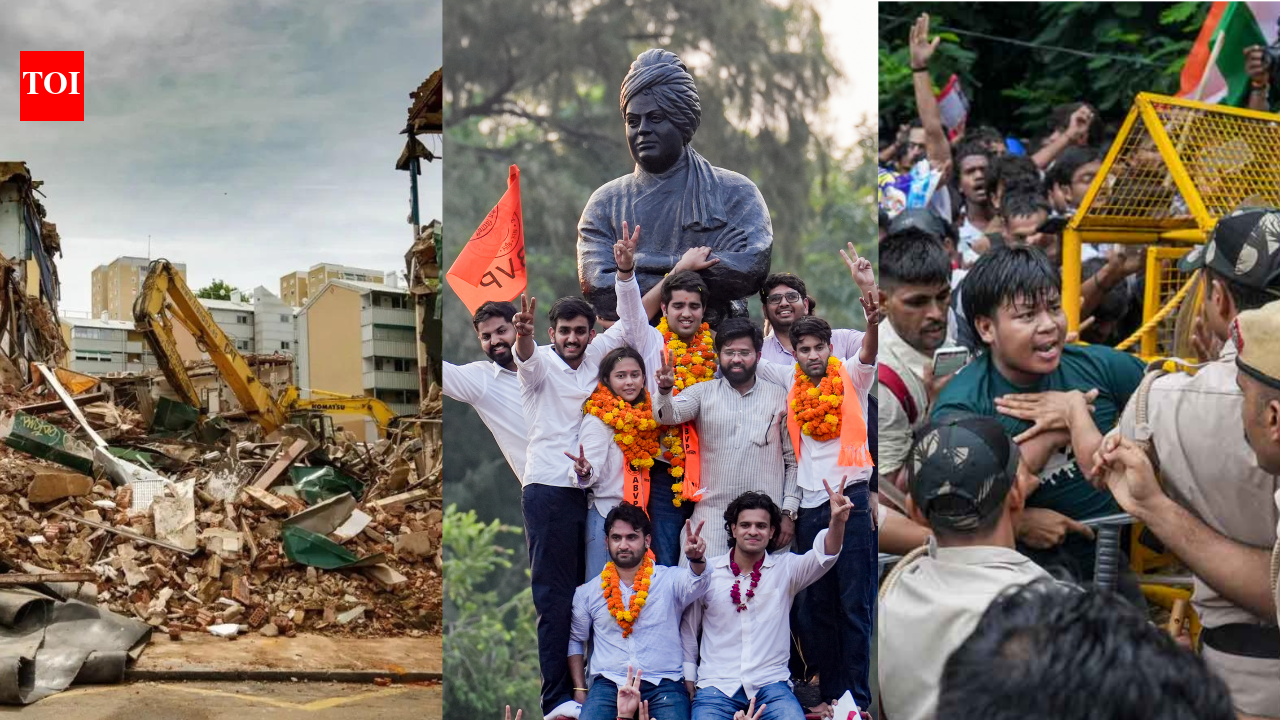
NEW DELHI: The ABVP rode out the headwinds of the Gen Z protest at Jantar Mantar and the recent Satya Niketan tragedy to retain its dominance in Delhi University student politics, sweeping three of the four DUSU posts on Saturday.The result came after a campaign in which students openly discussed issues affecting them, from the NEET paper leak to the collapse of a paying guest building that claimed the lives of five DU students.The Congress’s National Students’ Union of India (NSUI), which had sought to tap into the sentiment around these issues, lost all four central posts.An NSUI rebel-turned-Independent, Deepanshu, however, won the vice-president’s post, defeating ABVP’s Ishu Maurya, his closest rival.The ABVP’s Yash Dabas won the president’s post, defeating NSUI’s Vijay Shankar Meena by 2,053 votes. Riya Chhawdi and Lakshya Raj Singh won the secretary and joint secretary posts respectively.The outcome came three months after the Gen Z protest at Jantar Mantar, where the Cockroach Janta Party (CJP) had led an agitation seeking redressal of the NEET paper leak issue.
Jantar Mantar protest shapes student discourse
Ratna Singh, a CJP leader, said the protest movement had since expanded its focus to other issues concerning students and youth.“Since the Jantar Mantar protest, we have been actively addressing other issues related to students and youth, like the condition of schools in the states. The DUSU elections were a different space that we did not directly engage with,” she told PTI.BJP leader Vijay Goel, who served as DUSU president during 1977-78, said the Jantar Mantar protest should not be viewed as an expression of opposition to the BJP or the Centre.“The Jantar Mantar protest was basically against the NEET paper leak issue, which the government finally addressed and resolved. You cannot say that the youth were against the BJP or the government,” he said.
Satya Niketan tragedy becomes DUSU campaign issue
The Satya Niketan tragedy emerged as another major issue during the DUSU campaign. A paying guest building in the locality abutting DU’s South Campus collapsed on September 6, killing seven people, five of them college students.The incident became a major rallying point during the campaign, with students expressing their political awareness of incidents that directly affected them.Deepanshu, who won the vice-president’s post, gained popularity after he gave up wearing footwear in protest over the tragedy.Students said the impact of the Jantar Mantar protest was less about directly supporting or opposing any organisation and more about reassessing what different student outfits represented and the issues they advocated.“Students have been increasingly antagonised over the last few years. It made many of us question the positions taken by different student organisations and whether they actually represented the issues that students were raising or toed their party line,” said a Hindu College student.The DUSU contest has traditionally been a direct battle between the ABVP, which is covertly supported by the BJP, and the NSUI, the Congress’s student wing.While the ABVP retained three of the four posts this time, the NSUI failed to secure a place on the central panel.Congress national secretary and Karnataka co-in-charge Ajay Dutt alleged that the BJP had “influenced” the DUSU elections, as he alleged it had done in state and national polls.“Our candidate was leading for the post of president in the last rounds by around 500 votes and ultimately was declared defeated. The BJP misused the administration to influence the results,” he charged.BJP leaders said the ABVP victory carried a “big message”, despite Rahul Gandhi “doing his best” to “mislead and misguide” the youth.The ABVP’s victory thus came despite a campaign in which recent student protests and the Satya Niketan tragedy had brought questions about student issues and representation to the forefront.The NSUI, which had dominated DUSU for a long time in its earlier years, was left without any of the four central posts.(With PTI inputs)


