






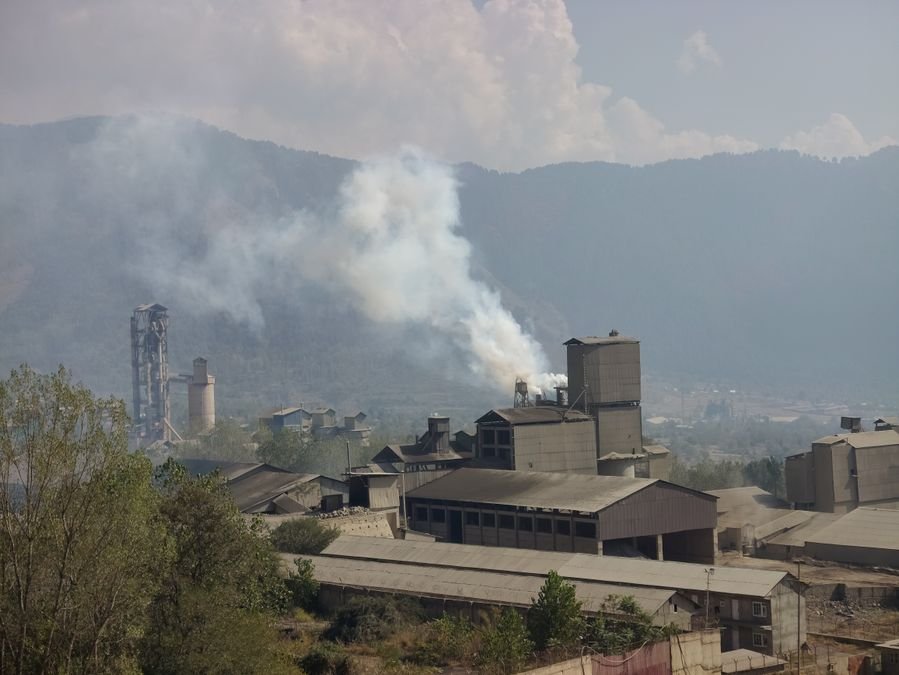
Khrew (Pampore), Oct 18: For residents of Khrew in Pampore area of south Kashmir’s Pulwama district, the growing pollution is no longer just an environmental concern but a daily struggle to breathe, as locals allege that industrial emissions are affecting their health, damaging vegetation and turning hundreds of kanals of land barren.
Residents allege that dust from cement manufacturing, limestone mining and associated industrial activities settles over homes, roads, trees and fields, affecting their quality of life and threatening livelihoods dependent on agriculture and horticulture.
Rising Kashmir visited the area and talked to cross sections of the society to get actual feedback from ground zero. “We are not against factories, but human beings must be saved,” said Muhammad Maqbool, a local. “Industries are important for employment and the economy, and we understand their role. But development cannot come at the cost of people’s health. We breathe the same air every day, our children grow up in this environment, and our elderly people are particularly vulnerable. There must be a balance between industrial growth and the right of people to live in a clean and healthy environment.”
Another resident, Rayees Ahmad, called for the installation and regular maintenance of modern pollution-control equipment at industrial units operating in the area.
“Modern technology is available to control dust and emissions. The factories must install the most effective equipment and ensure that it functions properly. Pollution cannot be controlled through assurances alone. There should be regular monitoring, transparent reports and strict action wherever violations are found,” Ahmad said.
The concerns raised by residents also figured in the recent autumn session of the J&K Legislative Assembly, where the government has acknowledged the public-health challenges associated with dust pollution in Khrew.
In a written reply reported on February 18, 2026, the government disclosed 80 reported cases of Chronic Obstructive Pulmonary Disease (COPD), 72 cases of bronchitis, 40 cases of asthma and two cases of lung cancer from the area. The government has acknowledged that fine particulate matter can increase the risk of respiratory, allergic, skin and cardiovascular conditions. Children, elderly residents and people with pre-existing illnesses are particularly vulnerable to the effects of air pollution.
The government has also indicated that health surveillance, respiratory screening, public-awareness campaigns and stronger enforcement of dust-control measures are among the interventions being considered. For elderly residents, the issue is particularly distressing. An elderly resident, Ghulam Mohiudin, suffering from a chest infection, said persistent dust in the surroundings had added to his worries about breathing and recovering from illness.
“I am already suffering from a chest infection, and breathing in a dusty environment makes life difficult,” the elderly resident said. “At this age, we need clean air and a healthy atmosphere. We cannot keep our doors and windows closed all the time, and we cannot avoid going outside for our daily needs. The authorities must understand what people here are going through.”
The issue has been raised repeatedly over the years. In a response to a Lok Sabha question in December 2023, the government acknowledged that an assessment of the carrying capacity of the Khrew industrial area had identified critical pollution concerns associated with dust and fugitive emissions. The assessment’s Comprehensive Environmental Pollution Index findings indicated that the area was critically polluted in relation to dust pollution and fugitive emissions.
What experts say
Dr Tanveer Khan, senior environmentalist and researcher, who was part of the visit to the Khrew area, said that the cement factories of Khrew raise serious environmental and public-health concerns that Jammu and Kashmir can no longer afford to ignore.
“Communities living in and around this industrial belt deserve clean air, safe water and protection from prolonged exposure to industrial dust and emissions. Cardiovascular, respiratory and ophthalmological illnesses, along with other potential health impacts, must be investigated through independent, long-term medical and environmental studies—not dismissed with official assurances and statements,” he said. “Equally alarming is the potential threat to the fragile ecosystem surrounding Dachigam National Park, an internationally recognised conservation landscape and home to the endangered Hangul, Kashmir’s iconic stag. The precise impact of industrial emissions on the park and its wildlife requires rigorous scientific assessment.”
He said that Khrew is paying a devastating price for cement factories—its people suffer, its landscape chokes, and its environment bleeds. “We must not forget that behind every affected field stands a farmer, a livelihood and a cultural legacy that no compensation can fully restore. Development must not come at the cost of people’s health, livelihoods and environmental heritage.”
Dr Khan added: “Environmental laws must not become ceremonial documents, nor should industrial interests outweigh people’s fundamental right to a healthy environment. There is an urgent need for an independent Environmental Impact Assessment (EIA) and Environmental Audit, conducted by a reputed, internationally experienced environmental consultancy, with transparent findings and meaningful public participation. Equally urgent is the need to immediately suspend or shut down, in accordance with due process and applicable law, all factories found to be operating in violation of environmental legislation or without mandatory statutory consents and to impose strict penalties for proven violations.”
The investigation, Dr Khan said, must examine compliance with the Environment (Protection) Act, 1986; the Water (Prevention and Control of Pollution) Act, 1974; the Air (Prevention and Control of Pollution) Act, 1981; the Wildlife (Protection) Act, 1972; applicable forest-conservation legislation, including the Van (Sanrakshan Evam Samvardhan) Adhiniyam, 1980, as amended; the Indian Forest Act, 1927, wherever applicable; the Biological Diversity Act, 2002; and the National Green Tribunal Act, 2010, along with all applicable environmental clearances, pollution-control consents and other statutory requirements.
“Kashmir needs industry, but not at the cost of its people, its saffron and its Hangul. Enough speeches—let there be action before irreversible damage becomes our legacy,” the expert said.


