



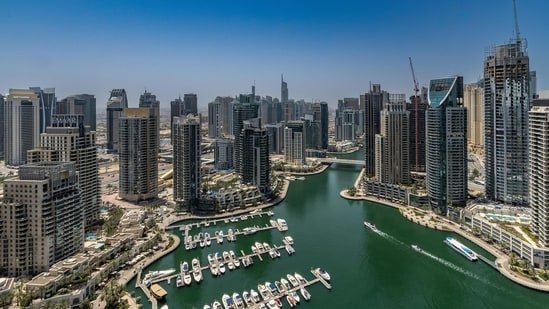
Heightened geopolitical tensions stemming from the Iran–US–Israel ‘war’ have put Dubai’s property market in the spotlight, reviving comparisons with New York City after the September 11 attacks and Mumbai following the 26/11 terror attacks, as investors assess the potential impact on real estate demand. Reddit users noted that although property transactions slowed and sentiment weakened in the immediate aftermath of those events, markets in globally integrated urban centres ultimately stabilised and recalibrated rather than collapsing.


A Reddit post titled ‘Are we going to see Indian real estate investments shift from Dubai back to India?’ sparked a debate among users, with some arguing that isolated geopolitical events rarely alter long-term property trends. One user wrote that Dubai’s market was unlikely to change because of a single incident. ‘Dubai will not change due to one incident ..,” the Redditor wrote.
Another pointed to New York City after 9/11 and Mumbai after the 26/11 attacks as examples of real estate markets that eventually recovered and strengthened.
’If that was the case, New York real estate wouldn’t have existed post 9 11. Or Mumbai post 26 11. Dubai attacks were not even 1% of what New York or Mumbai experienced. See where these cities’ real estate stands now.”
Another Reddit user echoed the sentiment, saying the situation was likely to result only in “temporary jolts,” with at most a short-term price correction rather than a lasting shift in investment patterns.
“Nope. These are just some temporary jolts. The most we can expect is a correction in the price,” the user wrote.
Also Read: Dubai real estate: Will housing sales moderate if buyers adopt a wait-and-watch approach?
Will Dubai’s uncertainty divert NRI interest back to India?
“I invest in both Dubai and India, so I’m watching this pretty closely,” one of the Redditors wrote.
He pointed out that the first impact of uncertainty is rarely a fire sale. Instead, “it shows up in hesitation.” “You’ll see a pause in new Dubai buying way before you see a dramatic ‘Dubai to India’ rotation.”
He argues that prices are set at the margin. Even if most existing owners hold steady, a slowdown in fresh capital can affect volumes and transaction benchmarks. “Fewer fresh cheques, more ‘let’s wait 2–4 weeks,’ and more requests for price or terms to reflect the new risk premium,” he wrote.
If tensions remain contained, he believes demand could return quickly. But if uncertainty drags on for weeks or months, “some of the ‘new allocation’ that was headed to Dubai will redirect,” often toward India’s top metros.
Short-term caution likely as foreign capital drives Dubai property cycle
Another Reddit post pointed out that “Real estate doesn’t pause because the world gets loud. It just adjusts,” acknowledging that rising uncertainty naturally affects confidence but “capital does not disappear; it reallocates.”
Neelu Jain, Director at SNN Raj Corp, said Dubai’s real estate market could see short-term disruption if geopolitical tensions persist, given the city’s heavy reliance on foreign capital.
“Foreign nationals account for roughly 54% of investments in Dubai’s real estate sector, with a significant share coming from India, the UK, China, Saudi Arabia and Russia. In periods of uncertainty, this can translate into stalled projects, delays in funding and homebuyers postponing purchase decisions,” she said.
Jain said that developers may also face cost pressures. “If supply chains tighten and raw materials become scarce, construction costs could rise, prompting developers to phase execution until conditions stabilise. Historically, while rentals tend to remain relatively stable during war-like situations, capital values can witness temporary downgrades.”
Also Read: Trump properties in Dubai attacked? Claim viral amid Palm Jumeirah fire as Iran strikes back
Dubai may witness a temporary dip in real estate transactions, say experts
Real estate experts, however, noted that Dubai has historically demonstrated paradoxical resilience during regional crises. In the past, when regional tensions arose, transaction volumes would temporarily dip. However, price corrections in stable markets remained in the single digits, and activity would return to normal—one to two quarters later—once the market cleared the uncertainty, they said.
“While global wars typically create broad market corrections, regional instability often results in capital moving into Dubai rather than out of it. High-net-worth investors from West Asia, Europe and South Asia, including a significant Indian investor base, view Dubai as a politically stable, tax-efficient and currency-secured jurisdiction,” Sahil Verma, COO, Shray Projects said.
However, experts also pointed out that for Indian investors in particular, who form one of the largest foreign buyer groups in Dubai, the behaviour is not about exit but about calibration.
“Existing investments are typically held, given real estate’s long-term nature. However, fresh allocations may be staggered, and some investors may choose to diversify by allocating part of their capital to Indian premium residential markets, especially in NCR, Mumbai and Bengaluru, which are currently witnessing strong domestic demand and infrastructure-led growth,” Verma said.


