


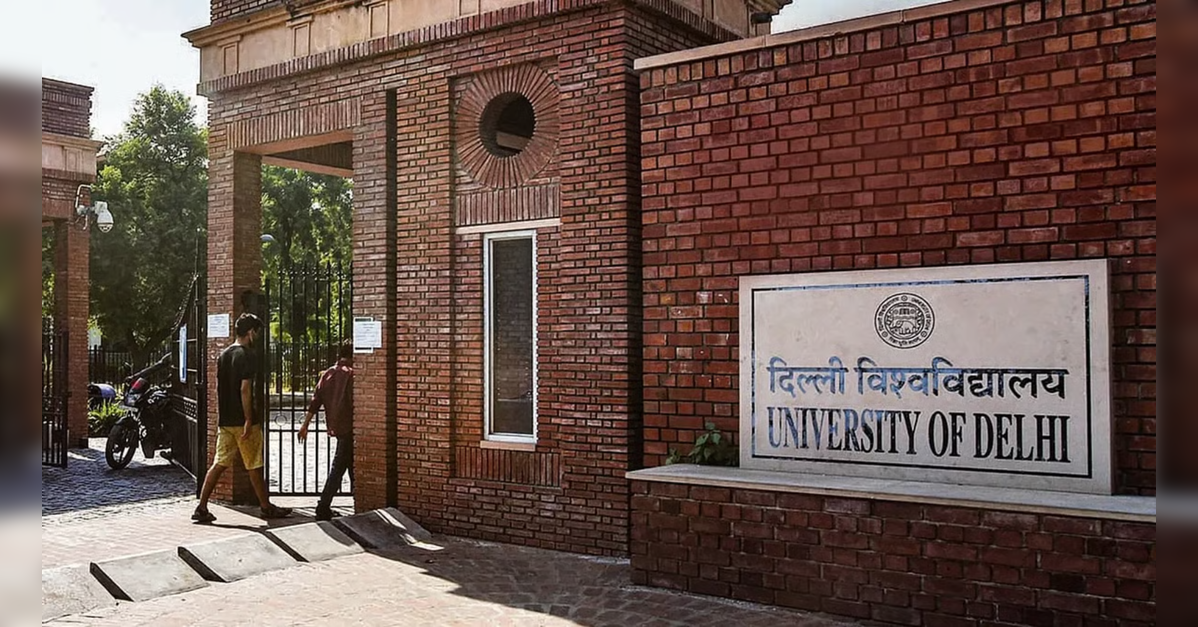
Students hoping for an early start to Delhi University’s undergraduate admission process may have to wait a little longer. University officials have indicated that registrations are expected to begin only after the Common University Entrance Test (CUET-UG) results are announced, raising the possibility of another delayed admission cycle, a PTI report stated.
The update comes months after university authorities had suggested that the admission registration process could begin by the third week of May. However, fresh disruptions linked to CUET-UG have pushed the timeline further.
Dean of Admissions Haneet Gandhi said the university is planning the admission schedule around the entrance examination results.
“The UG admission process will tentatively start after the CUET-UG results are declared. While we will be taking precautions to avoid any unnecessary delay in the start of the academic session, at least four lists are expected to be released leading up to the admission.”
Technical Glitch in CUET Adds to Uncertainty
The latest delay follows problems during this year’s CUET-UG examination. On May 30, a technical issue disrupted the test, prompting the National Testing Agency (NTA) to revise the examination schedule.More than 3,700 students who left their examination centres before the test resumed were offered a one-time re-examination opportunity. According to the NTA, the revised examination dates have been scheduled for June 6 and 7.
CUET-UG remains the primary gateway for undergraduate admissions to most central universities, including Delhi University.
Teachers Say Delays Are Becoming a Pattern
For many faculty members, the current situation is not an isolated incident but part of a recurring trend that has affected academic schedules since CUET was introduced in 2022.
Although Delhi University began classes on August 1 in 2025, admission rounds and mop-up lists continued until late September, meaning some students entered classrooms weeks after teaching had already started.
A similar situation unfolded in 2024 when CUET result delays pushed the beginning of the academic session to August 29. Admission-related rounds continued into October.
Teachers argue that such prolonged processes create challenges for both students and faculty while disrupting regular classroom learning.
Calls Grow for Rethinking the Admission Model
Abha Dev Habib, Associate Professor of Physics at Miranda House, questioned whether the current system is achieving its intended goals.
“Students have lost faith in the NTA at this point. But a bigger issue remains the delay in admissions and the impact it has on the academic calendar.”
She suggested that Delhi University should examine the possibility of returning to admissions based on Class 12 performance.
“We should seriously consider reverting to the earlier system of admissions based on Class 12 results. One of the main arguments for CUET was that it would provide a level playing field for students from different boards.”
Habib added that the same objective could be achieved through a percentile-based model that treats top-performing students from different boards equally while allowing admissions to conclude on time.
Coaching Culture Under Spotlight
Habib also expressed concern about the growing dependence on coaching institutions linked to entrance examinations.
“Exams like CUET shift the focus towards multiple-choice preparation and have led to a mushrooming coaching industry. The emphasis moves away from actual academic learning.”
She further noted that prolonged mop-up rounds mean some students enter courses much later than others, creating academic difficulties for both learners and teachers.
Faculty Says DU Has Lost Control of Its Calendar
Similar concerns were raised by Rudrashish Chakraborty, Associate Professor of English at Kirori Mal College, who believes the university’s traditional academic rhythm has been disrupted.
“CUET has taken away the autonomy of the university. Earlier, we had a fixed academic calendar, admissions were completed on time and examinations followed a predictable schedule and DU was considered a model university in that regard.”
According to Chakraborty, uncertainty has now become an annual feature.
“Now every year begins with uncertainty. The entire calendar depends on when the CUET process concludes, and that process has witnessed disruptions almost every year.”
He also pointed to what he described as an unintended shift in student behaviour.
“An increasing number of students are enrolling in dummy schools for Classes 11 and 12 so that they can focus exclusively on coaching and preparing for the MCQ-based CUET pattern. This has adversely affected broader academic engagement and student aptitude.”
Bigger Questions Around Entrance Exam Management
The discussion around CUET delays comes at a time when several national examinations and recruitment tests have come under public scrutiny. Controversies surrounding NEET-UG, delays in competitive examinations and complaints related to examination management have kept the NTA in the spotlight.
While Delhi University officials say efforts are being made to minimise disruption to the upcoming academic session, many teachers believe the repeated delays reveal deeper structural issues. They argue that a system introduced to simplify admissions has instead made the university’s academic calendar heavily dependent on the functioning of a centralised entrance examination process.
