



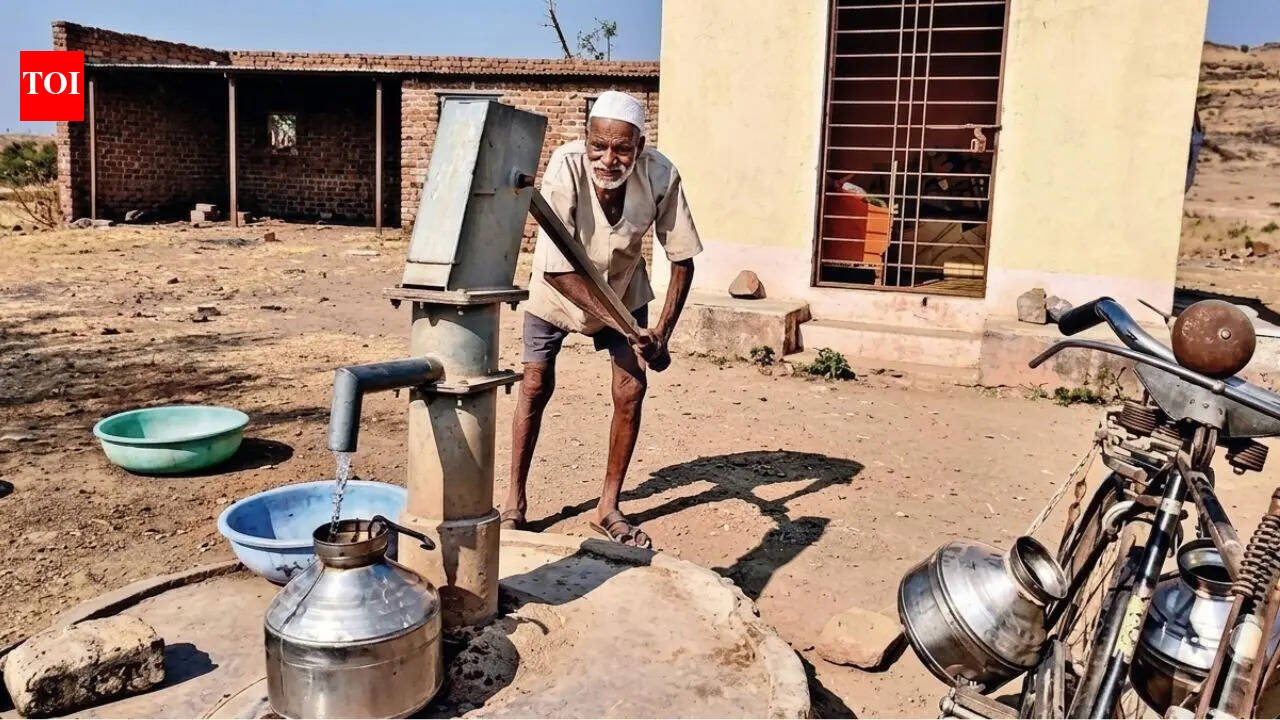
KOLHAPUR: At 80, Bhiku Jadhav should not have to walk miles in punishing heat for water. But in Pangri village of Man tehsil, he drags his bicycle, no longer able to ride it, laden with containers for a daily trek to a distant handpumpoperated borewell.“Even the borewell is dry,” said Jadhav, one among many elderly residents now shouldering the burden as the younger family members migrate in search of livelihoods.In Vadgaon of the same tehsil, farmer Satyawan Ombase watches his sugar cane crop wither. With no water left for irrigation, his concerns point to an agrarian distress alongside the drinking water crisis.
This parched region of Satara, along with parts of Sangli and Solapur, makes up Man Desh, a rain-shadow zone, receiving rain mainly during the retreating monsoon months of Sept and Oct, making it chronically drought-prone.This year, the strain is sharper and more visible.Across Man Desh, the crisis is no longer just about scarcity, but about who is left behind to endure it. With fields drying up and incomes shrinking, the young leave.The elderly stay back, walking longer distances each day for dwindling water.
NCP functionary Anil Desai, who is a Satara zilla parishad member, alleged the gravity of the situation is being underplayed. “The actual number of villages, hamlets currently facing drinking water shortage is high, so is the number of water tankers. However, the officially declared numbers are fewer. This is to avoid bringing disrepute to rural development minister Jaykumar Gore, who represents Man-Khatav in the assembly,” he said.TOI tried to reach Gore for the comment, but his phone remained switched off or engaged. District collector Santosh Patil said he has directed the irrigation department to map water sources and ensure adequate drinking water supply for residents and cattle. State data highlighted the fast-deteriorating situation.In May alone, an average of 116 villages and 485 hamlets are being added every week to the list of those facing drinking water scarcity.On average, 128 water tankers have been deployed in each of the three weeks so far in the month.At present, the Chhatrapati Sambhajinagar division leads in the number of water tankers with 244 deployed to meet the requirements of residents in 138 villages and 64 hamlets, followed by Nashik with 159 tankers for 156 villages and 444 hamlets.
Across Maharashtra, 633 villages and 1,652 hamlets currently face water shortages, with 706 tankers in operation. Though less severe than last year, when 1,196 villages and 3,484 hamlets were affected with 1,459 tankers deployed, the crisis remains acute on the ground. Authorities have turned to acquiring wells and borewells, but reservoir levels are steadily falling. Nine large dams each in Sambhajinagar and Pune divisions have less live storage than they did at this time last year.With forecasts warning of alikely El Niño impact reducing rainfall, chief minister has directed dam authorities to stretch limited water resources till the end of Aug, prioritising drinking needs. But for many like Jadhav, the crisis is not measured only in data, but also in every exhausting step taken under the sun for a pot of water.
Around 127 villages and hamlets across Chhatrapati Sambhajinagar and other parts of the Marathwada region are reeling under severe water scarcity this summer. To mitigate the crisis, authorities have pressed 156 tankers into service to ensure a steady supply for affected residents.According to official data, Chhatrapati Sambhajinagar is the worst-hit district, with 85 villages and hamlets reporting shortages. As per official data, Chhatrapati Sambhajinagar has a maximum 85 villages and hamlets affected due to the water scarcity, followed by Jalna (39), Latur (2) and Hingoli (1). Out of 156 water tankers deployed in the affected areas, Chhatrapati Sambhajinagar has a maximum 115 tankers, 38 in Jalna, two in Latur and one in Hingoli.
“As the summer progresses, drinking water sources are depleting, leading to scarcity in several pockets. Local authorities have standing instructions to arrange water tankers immediately upon receiving complaints from residents,” said a senior official from the Chhatrapati Sambhajinagar Divisional Commissioner’s office.To sustain the tanker supply, authorities have acquired several private and public wells in scarcity-hit areas to serve as refilling points.Data from the India Meteorological Department (IMD) shows that live storage across major, medium, and minor irrigation projects in Marathwada had dropped to nearly 41% on May 9. While the cumulative stock is roughly 10% higher than at this time last year, many reservoirs have reached “worrisome” levels, triggering local shortages.The crisis has been exacerbated by the extreme weather in late April, where temperatures in Marathwada hovered around 43°C. These heatwave conditions led to significant evaporation losses from regional water resources. On May 9, Chhatrapati Sambhajinagar recorded a maximum temperature of 39.2°C, which is 0.5 units above the seasonal normal.


